The tell is the rebuttal
When an industry commissions a study to prove it is not doing the thing everyone accuses it of, the study is rarely the news. The fact that it was commissioned is. In May 2026 the Data Center Coalition, a trade group whose members include the largest hyperscalers, released a literature review from the energy consultancy E3 with a tidy headline finding: there is "no quantitative evidence to date that data centers have historically been subsidized by other customers."[1] The coalition said it would carry the result to Capitol Hill and to regulators at the national, state, and local levels.
You do not build a lobbying distribution plan around an academic literature review unless the politics have already turned against you. They have. The same quarter that produced the rebuttal also produced the thing it was written to answer: the fastest collapse in data center siting the buildout has yet seen.
None of this reverses a case we have made before. The question that dominated three years of earnings calls, whether AI infrastructure spending actually converts into revenue, was answered in the affirmative this spring, and we said so: the first-quarter cloud results vindicated the demand side of the buildout.[2] This is the other side of the same ledger. Grant that the revenue is real and the capital is rational; the constraint does not disappear, it relocates. It moves from "will the spending pay off" to "will the thing be permitted at all." That is not a reversal of the bullish case. It is the bullish case meeting its next obstacle.
The number the industry is responding to
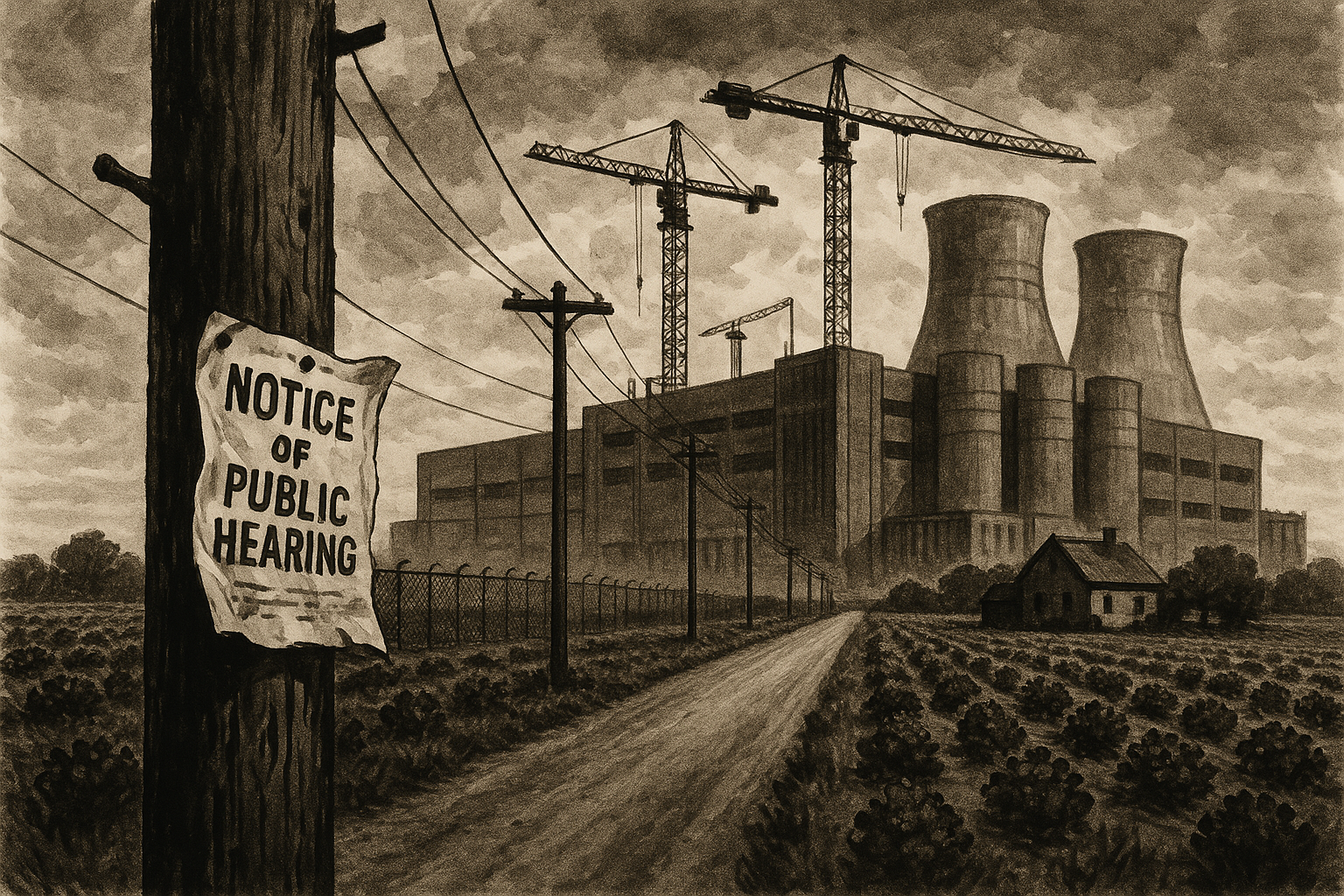
In the first three months of 2026, local opposition killed at least 20 proposed data center projects in the United States, representing more than $41.7 billion in planned investment and at least 3.5 gigawatts of electricity demand, according to a national survey by Heatmap Pro.[3] The methodology is worth stating plainly because it is unusually direct: researchers regularly call every U.S. county to tally cancellations and new rules limiting construction. This is not a model. It is a census of defeats.
The flow number is more telling than the stock. Roughly 100 new data center fights were added to the database in the quarter, described as a new record, on top of at least $85 billion in projects canceled over the past three years.[3] A backlash that produces a record quarter of new fights is not maturing toward equilibrium. By Heatmap''s own read, it "has not yet peaked."[3]
Project Jarvis is the emblematic case. The proposed Sentinel Grove Technology Park in St. Lucie County, Florida, a one-gigawatt facility carrying a $13.5 billion price tag, lost a planning board vote in October and was withdrawn on February 26, 2026 as state legislation moved toward passage - Governor DeSantis had been actively promoting an AI Bill of Rights for data centers since December 2025, and the Florida Senate passed SB 484 the following day.[3] Note what killed it: not interest rates, not a chip shortage, not a hyperscaler capital review. A county board and a state-level political signal. The capital was willing. The site was not.
Why the no-subsidy study does not settle anything
Take the E3 finding at its strongest. It is plausible that, in aggregate and historically, there is no clean econometric link between data center load growth and the retail rates a residential customer pays. Bills rise for many reasons at once: plant retirements, inflation, market design, wildfire hardening, grid modernization. E3 says as much, and also concedes the obvious limitation, that the research base specific to data centers is thin.[1] A literature review of a question no one studied closely until recently cannot exonerate the subject; it can only report that the file is empty.
And the file is not entirely empty. In the same reporting, Monitoring Analytics, the independent market monitor for the PJM interconnection - the largest grid in the country - attributed a 76% surge in first-quarter 2026 wholesale power prices in large part to data center demand.[1] Whether or not that flows cleanly to a household''s monthly bill in a way an economist would certify, it is exactly the kind of figure that lands on the desk of a county commissioner the night before a zoning vote. Local siting decisions do not run on peer-reviewed causal inference. They run on a neighbor''s utility bill, a contested water table, and a commissioner who would rather not be the one who said yes. The E3 study is aimed at a courtroom standard of proof in a venue that has never used one.
The squeeze nobody is pricing
Set the political picture against the physical one. Morgan Stanley''s utilities team, led by Stephen Byrd, projects a U.S. power shortfall of roughly 44 gigawatts through 2028 before any unconventional time-to-power solutions, the gap between what AI-driven demand wants and what the grid can deliver on schedule.[4] Their proposed relief, on the order of 15 to 20 gigawatts from gas turbines, 5 to 8 from fuel cells, 5 to 15 from new nuclear, is precisely the category of generation that itself has to clear local permitting.[4]
That is the squeeze. Demand-side capital is committing to gigawatts faster than the grid can supply them, and every marginal gigawatt of both compute and the generation meant to feed it now has to survive a local political process that is breaking records for hostility. The two constraints are not independent. The same county that rejects the data center is the county that rejects the gas peaker built to power it.
What this means for the people writing the checks
The dominant story about AI capital is a story about chips and money: who has the GPUs, who has the balance sheet, who signed the multi-year compute commitment. That story is mostly settled, and it has trained the market to treat siting as a formality that follows funding. The first quarter of 2026 is the evidence that the formality has become the constraint. A $13.5 billion project does not die at a planning board in a world where land use is a rounding error.
The honest way to price an AI infrastructure commitment now is to discount it by the probability that the dirt under it is contested, and to recognize that probability is rising, not falling. The industry understands this; the E3 commission is what understanding it looks like from the inside. The buildout''s next bottleneck is not silicon, and it is not the cost of capital. It is whether a room of local officials, looking at their constituents'' power bills and water tables, decides to let the thing get built at all. Models that still assume frictionless siting are not conservative. They are mispriced.
Sources