AI Research
GLM-5.1 and the Benchmark That Got Complicated
Tips, corrections, or questions? support@omniscient.media
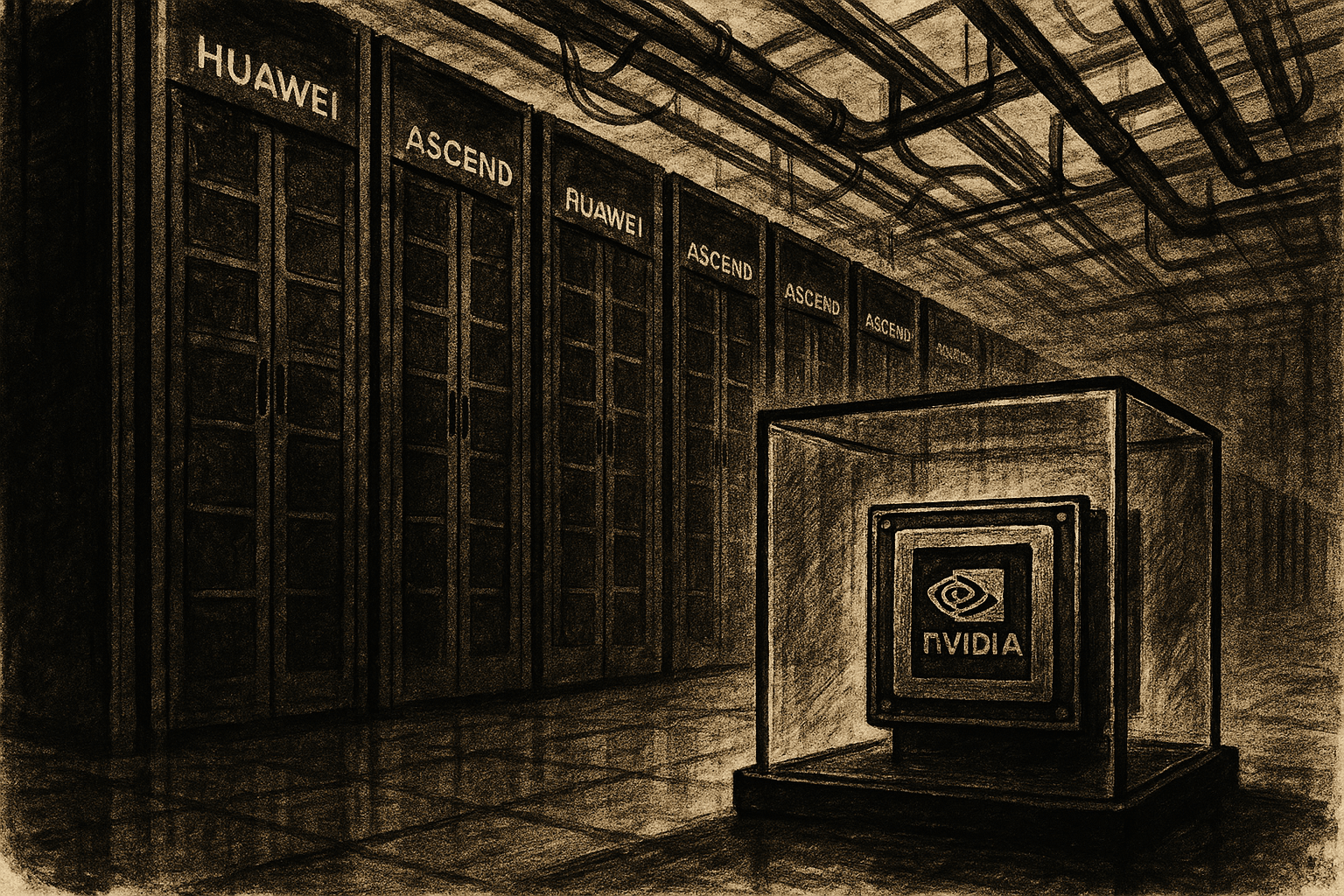
On April 7, Z.ai - the Beijing-based lab formerly known as Zhipu AI - released the weights of GLM-5.1 under an MIT license and published a benchmark table that generated genuine attention in engineering circles.[1] The headline claim: a 754-billion-parameter open-weight model had scored 58.4% on SWE-Bench Pro, placing it - at the time - ahead of every publicly available proprietary model.[2] The detail buried below the headline is just as interesting: the entire model was trained on approximately 100,000 Huawei Ascend 910B chips, with no NVIDIA silicon anywhere in the stack.[3]
Both facts deserve scrutiny. The benchmark story has already moved on - Anthropic released Claude Opus 4.7 on April 16, posting a self-reported 64.3% on SWE-Bench Pro and pushing GLM-5.1 out of first place within nine days of its release.[4] The geopolitical story is more significant, and more durable, than any single benchmark number.
The Geopolitical Fact That Survives the Benchmark Debate
Z.ai was placed on the U.S. Commerce Department's Entity List in January 2025, cutting off legal access to NVIDIA's H100, H200, and B200 GPUs.[9] The GLM-5.1 training run used approximately 100,000 Huawei Ascend 910B chips running Huawei's MindSpore framework - hardware and software that exist entirely outside the American technology supply chain. Three months after completing its Hong Kong IPO in January 2026 - the first major Chinese LLM developer to go public, raising roughly $558 million - Z.ai has delivered a model that sits in the competitive frontier tier on coding tasks, regardless of where exactly it lands within that tier on any given week.
This is the fact that American export control policy needs to grapple with. The argument for restricting Chinese labs' access to advanced chips rested partly on the assumption that hardware constraints would translate into persistent capability gaps. GLM-5.1 does not prove that assumption entirely wrong - Huawei's Ascend 910B is slower and less memory-efficient than NVIDIA Blackwell at equivalent tasks, and the gap in training cost efficiency likely remains substantial. But it does demonstrate that the capability gap on the specific task category enterprises most want to automate - software engineering - has closed to a range where the difference is measured in scaffolding choices and release timing, not in qualitative capability tiers.
Pricing reinforces the strategic picture. The API runs at $0.95 per million input tokens and $3.15 per million output tokens - meaningfully below what Anthropic and OpenAI charge for comparable-tier models. Anthropic's Claude Opus 4.7 is priced at $5 per million input tokens; OpenAI's GPT-5.4 runs at $2.50 per million input tokens but $15 per million output tokens, making the output cost comparison the more meaningful one for code-generation workloads. The MIT license permits unrestricted commercial use and self-hosting with no royalties or vendor agreements required. For enterprises evaluating agentic coding infrastructure, the combination of frontier-tier performance, open weights, and sub-dollar input pricing is a materially different value proposition than anything the American supply chain currently offers at this capability level.
What GLM-5.1 Actually Is
Strip away the leaderboard debate and the architecture is worth understanding on its own terms. GLM-5.1 uses a Mixture-of-Experts design Z.ai calls GLM_MOE_DSA (Dynamic Sparse Attention), with 754 billion total parameters across 256 routed experts, of which 8 are active per token at inference - a configuration confirmed by both Z.ai's Hugging Face model card and NVIDIA's NeMo AutoModel documentation.[3][10] The context window is 200,000 tokens with a 128,000-token maximum output - generous for an open-weight model, though Anthropic's Claude Opus 4.7 now ships with a 1 million token input context.[4] GLM-5.1 is text-only; no image, audio, or video input.
The capability Z.ai emphasizes most is sustained autonomous execution. The official documentation positions GLM-5.1 as capable of running a full plan-execute-test-optimize loop for up to eight hours without human checkpoints - what the company calls "long-horizon task capability."[1] In company-produced demonstrations, the model completed 655 autonomous iterations to build a Linux desktop environment from scratch, and improved a vector database's query throughput to 6.9 times its baseline across 178 iterative rounds. On KernelBench Level 3, a GPU kernel optimization benchmark, it achieved a 3.6x geometric mean speedup versus torch.compile's 1.49x in max-autotune mode.
These are self-reported results from controlled demos, not independent reproductions. But the underlying technical problem they address is real: current agentic systems typically degrade after a few dozen steps, losing goal alignment or beginning to optimize for the wrong objective. Maintaining coherent strategy across hundreds of tool calls is a genuine open problem in the field, and GLM-5.1's architecture choices - large output window, Dynamic Sparse Attention, MCP integration - are engineered specifically for this use case.
"The way we evaluate model capability is shifting from 'how smart it is in a single turn' to 'how long it can work reliably on a long-horizon task, and what it can actually deliver.'" - Z.ai official documentation[1]
What the Benchmark Numbers Actually Say
SWE-Bench Pro has emerged as the most credible measure of real-world software engineering capability precisely because it resists the contamination that undermined its predecessor. SWE-Bench Verified - long the default leaderboard citation - fell out of use after OpenAI confirmed that every frontier model it tested could reproduce gold patches or problem-statement specifics verbatim, a finding that exposed deep contamination across the field. OpenAI has stopped reporting Verified scores; other labs continue to self-report on it, but the consensus has moved on.[5] SWE-Bench Pro, maintained by Scale AI's SEAL lab, uses 1,865 tasks drawn from 41 repositories across Python, Go, TypeScript, and JavaScript, with average fixes spanning 107 lines across 4.1 files. It is meaningfully harder, more multilingual, and more contamination-resistant than anything that came before it.
The catch is that SWE-Bench Pro distinguishes carefully between two types of results: standardized scores, where Scale AI runs every model through identical scaffolding with a 250-turn limit, and agent system scores, where teams bring their own context management, tool access, and retrieval infrastructure. The two are not directly comparable. On the Scale SEAL standardized leaderboard, GPT-5.4 currently leads at 59.1% - though that result carries an asterisk, having been run with the mini-swe-agent harness rather than the standard scaffold used by every other entry on the board.[6] Under the standard harness, Claude Opus 4.6 (thinking) sits at 51.9% and Gemini 3.1 Pro (thinking) at 46.1%.[6] Agent system scores from the same models run 10 to 15 percentage points higher - Anthropic's Claude Code scaffold pushed Opus 4.6 to 53.4% before Opus 4.7 eclipsed it entirely at 64.3%.[4]
Z.ai's 58.4% is an agent system result, self-reported, using Z.ai's own scaffolding. It has not been submitted to Scale AI's standardized evaluation, which means it sits in a different column from the SEAL figures above.[6] Artificial Analysis' independent agentic leaderboard placed GLM-5.1 as the leading open-weight model, behind GPT-5.4 and both recent Claude flagship releases - partial external corroboration, but partial is the operative word.[7]
None of this means the result is fraudulent. The same scaffolding dependency applies to every agent system score on every leaderboard, including OpenAI's. The margin between top agent system scores is narrow enough that GLM-5.1's 58.4% was a plausible first-place result the week it was published. What changed is that Anthropic shipped a direct upgrade nine days later, and the decimal-point lead evaporated. The right takeaway is not that Z.ai's benchmark claim was wrong; it is that the field moves fast enough that "first place" has a very short shelf life.
Where the Numbers Fall Short
The benchmark profile has real gaps beyond the coding category. On AIME 2026, the advanced mathematics competition benchmark, GLM-5.1 scores 95.3% - creditable, though trailing models like GPT-5.4 on pure mathematical reasoning.[8] GPQA-Diamond, which tests graduate-level scientific reasoning, shows a more significant gap: GLM-5.1 at 86.2% against Claude Opus 4.7's 94.2% and Gemini 3.1 Pro's 94.3%.[4] The model is also text-only at a moment when every major Western frontier model handles images, audio, and video as standard inputs - a practical limitation for any multimodal deployment.
These gaps matter for understanding what GLM-5.1 is: a model engineered specifically for long-horizon software engineering tasks, not a general-purpose frontier replacement. That specificity is, arguably, a strategic choice as much as a technical one. The use cases where it is most competitive - agentic coding, kernel optimization, autonomous software development - are precisely the use cases with the highest near-term enterprise value.
Claude Opus 4.7 may lead SWE-Bench Pro today. The more important observation is that it leads by less than seven percentage points over an open-weight model built entirely on Chinese hardware, running under a fully open license, at roughly one-fifth the input token price of Anthropic's flagship. The debate over whether GLM-5.1 is definitively first or third on a given leaderboard is the wrong argument. The right argument is about what it means that the argument is possible at all.
Sources
GLM-5.1: Towards Long-Horizon Tasks - Z.ai official blog Inline ↗
GLM-5.1: 754B MoE model, AIME 95.3%, SWE-Bench Pro 58.4%, MIT licensed - Reeboot (April 8, 2026) Inline ↗
Claude Opus 4.7: Benchmarks, Pricing, Context & What's New - LLM Stats (April 16, 2026) Inline ↗
SWE-Bench Pro Leaderboard (2026): Why 46% Beats 81% - Morph Inline ↗
GLM-5.1 takes the open weights lead on the Artificial Analysis leaderboard - Artificial Analysis (April 2026) Inline ↗
GLM-5.1 benchmark table: AIME 2026 95.3%, GPQA-Diamond 86.2% - Reeboot (April 8, 2026) Inline ↗
The first of China's 'AI tigers' goes public as Zhipu climbs in Hong Kong debut - CNBC (January 8, 2026) Inline ↗
GLM-5 / GLM-5.1 (MoE + DSA) - NVIDIA NeMo AutoModel Documentation (April 17, 2026) Inline ↗
Get this every weekday.
The Omniscient Bulletin: consequential AI, explained and evaluated. 5 to 7 items a day with the take, not the recap.