Industry
GPT-5.6 Sol or Claude Fable 5: Which One Should You Actually Build On?
GPT-5.6 Sol sets the pace on agentic coding, but it is locked to a handful of government-approved partners, so the flagship you can actually ship on today is Claude Fable 5.
Tips, corrections, or questions? support@omniscient.media
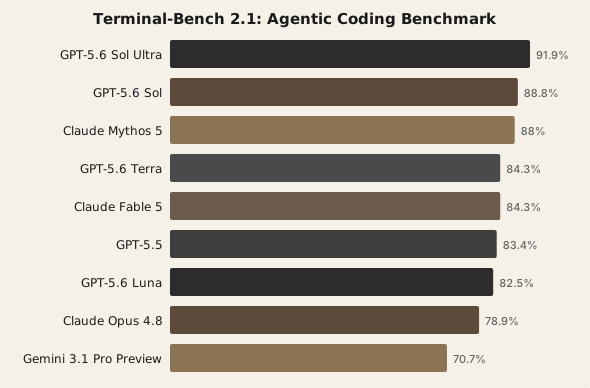
OpenAI's newest model tops the hardest agentic coding benchmark in the industry, and almost no one can use it. GPT-5.6 Sol posts a state-of-the-art 88.8 percent on Terminal-Bench 2.1, the test of real command-line engineering work that requires planning and coordinating tools across a multi-step task, and climbs to 91.9 percent in its compute-heavy Ultra mode.[1] Anthropic's generally available flagship, Claude Fable 5, sits four and a half points back on that same benchmark, behind even Anthropic's own gated twin, Mythos 5. Yet Fable 5 is the model a team can actually deploy this quarter, and Sol is not. For anyone deciding which model to build on, that inversion, the two strongest scores locked away and the more modest one shippable today, is the entire decision.
What did each company actually ship?
Anthropic went first. Claude Fable 5 launched June 9 as the company's most capable generally available model, paired with a restricted sibling, Claude Mythos 5, the same underlying weights with safeguards lifted for a small set of vetted partners under a program called Project Glasswing.[2] Fable 5's guardrails work by routing certain cyber, biology, chemistry, and distillation queries to Anthropic's prior flagship, Claude Opus 4.8, instead of answering with Fable 5 directly. Anthropic says that fallback triggers in under 5 percent of sessions, so more than 95 percent of users see Fable 5's full capability with no substitution at all.[2]
OpenAI's GPT-5.6 arrived seventeen days later, on June 26, as a three-tier family: Sol, the flagship; Terra, a balanced tier OpenAI says is competitive with GPT-5.5 at half the price; and Luna, the cheapest and fastest of the three.[3] All three ship only through the API and Codex, to a pre-approved partner list of around twenty organizations, with no consumer ChatGPT access and no general-availability date beyond "the coming weeks." OpenAI's system card classifies Sol, Terra, and Luna as "High" capability under its Preparedness Framework for both cybersecurity and biological and chemical risk, though none reach "High" for AI self-improvement.[4]
Who actually leads on the benchmarks?
On Terminal-Bench 2.1, the real split is not between the two companies. It is between the models each company has gated and the ones it has shipped. OpenAI calls Sol a new state of the art on the benchmark, and the published numbers back it: 88.8 percent for Sol, 91.9 percent in Ultra mode.[1] The nearest score, 88.0 percent, belongs to Claude Mythos 5, Anthropic's own restricted twin, not to any generally available model. Sol edges Mythos 5 by well under a point, close enough to sit inside normal benchmark noise. The real gap opens beneath both of them: the generally available Fable 5 scores 84.3 percent, tied with OpenAI's own mid-tier Terra, and just ahead of GPT-5.5 at 83.4 percent, GPT-5.6 Luna at 82.5 percent, Claude Opus 4.8 at 78.9 percent, and Gemini 3.1 Pro Preview at 70.7 percent. Put plainly: the two best scores on the hardest coding benchmark in the industry both belong to models a typical developer cannot get.
Then the picture flips. On the Vals AI SWE-bench Verified leaderboard, the benchmark most engineering teams actually cite for everyday bug-fixing, Fable 5 posts the highest independently verified score of any model, 95.00 percent under a Mini-SWE-agent harness.[6] OpenAI has published no directly comparable Sol figure. That is an odd omission. The system card runs to more than 75 pages of capability testing alone, yet it leaves out the one number that would let this exact comparison be made directly.[4] So the two headline coding benchmarks disagree about who is ahead: on agentic, multi-step terminal work the gated models own the top two spots, and on the single-issue software-repair test, the model anyone can actually buy owns the best independently verified number in the field.
How close are the flagships on cybersecurity risk?
On cybersecurity the two draw close again. OpenAI reports Sol is "competitive with Mythos Preview" on exploit-finding tasks while using roughly a third of the output tokens, and that in testing against Chromium and Firefox it found real bugs and exploitation primitives without assembling them into a working end-to-end exploit.[3] Anthropic's own system card draws a nearly identical line for Mythos 5: it scores far ahead of Opus 4.8 on exploit development but only modestly above the earlier Mythos Preview, and Anthropic's threat modeling classifies the model as chemical-and-biological "CB-1," capable of helping with non-novel weapons, while judging, with less confidence than for prior models, that it stays under the "CB-2" line for novel weapon design.[5] For teams whose work touches offensive security research, the two flagships read as roughly matched, and that convergence cuts against the buyer, not for them: both come wrapped in the heaviest restrictions either company applies, so the tier of model most likely to be needed for serious security work is exactly the tier neither company will hand over freely.
What does each cost, and who can actually get it?
Pricing is where the gated tiers turn out to be the aggressive ones. GPT-5.6 Sol is priced at $5 per million input tokens and $30 per million output, and Terra is listed at $2.50 input and $15 output, half of Sol and a fraction of Fable 5's rate, at performance OpenAI pegs to GPT-5.5.[7] Fable 5 costs $10 and $50, itself already less than half of what the restricted Mythos Preview charged.[2] On price alone the OpenAI tiers win comfortably. On access they lose completely.
Model | Terminal-Bench 2.1 | SWE-bench Verified | Price (input / output, per 1M) | Access today |
|---|---|---|---|---|
GPT-5.6 Sol | 88.8% (91.9% Ultra) | Not published | $5 / $30 | API/Codex, ~20 partners, no GA date |
Claude Mythos 5 | 88.0% | Not published | Not published | Project Glasswing partners only |
GPT-5.6 Terra | 84.3% | Not published | $2.50 / $15 | API only, pre-approved partners |
Claude Fable 5 | 84.3% | 95.0% | $10 / $50 | Broadly available since July 1 |
Read plainly, the table has one practical conclusion in it: for a team that needs a flagship-class coding model in production this quarter, not next, Fable 5 is the only row that says "available." Sol and Mythos 5 are the stronger models on agentic work, and Terra is the better deal on paper, but a model nobody outside a partner list can run is not really an option, at any price.
Why isn't the leader available?
Both gating decisions trace back to the same government, though for different reasons. Anthropic's flagship pair was suspended worldwide by a US directive on June 12, three days after launch, over a disputed jailbreak claim; Anthropic complied and restored access on July 1 while publicly disputing the directive's grounds.[8] OpenAI, by contrast, gated GPT-5.6 from day one at the government's own request, ahead of any incident, choosing the narrower rollout rather than having one imposed after the fact.[9] Neither company disputes that some government role in reviewing frontier releases is now normal; both are lobbying, in similar language, for a written process to replace the current ad hoc one. That fight is real, but it is separate from the one facing a team choosing a model today: whichever way the policy settles, Fable 5 is the flagship a developer can use right now, and Sol is not.
So which one should you actually build on?
Strip away the marketing and the decision is unusually clean. If you could run anything today, Sol or Mythos 5 would be the defensible pick for agentic, multi-step engineering, and Terra would be the value play the moment it opens up. You cannot run any of the three. Fable 5 trails Sol on Terminal-Bench by four and a half points and trails Mythos 5 by nearly as much, but it leads every published model on SWE-bench Verified and is the only flagship-class model without a partner-list gate to clear, which for most teams settles it. A shop already invested in Codex and comfortable waiting has a real reason to hold for Terra's price. Anyone whose actual workload is offensive security research should plan around neither flagship being reachable without a Project Glasswing or equivalent arrangement, whichever company's name is on the model card.
The number to watch next is not a benchmark score. It is the first general-availability date, Sol's or Terra's, because the day one of them opens to everyone is the day the best model on the benchmark and the one you can actually deploy finally become the same model.
Sources
OpenAI, "Previewing GPT-5.6 Sol: a next-generation model" (Terminal-Bench 2.1 results), June 26, 2026 Inline ↗
Anthropic, "Claude Fable 5 and Claude Mythos 5," June 9, 2026 Inline ↗
OpenAI, "Previewing GPT-5.6 Sol: a next-generation model" (tiers, availability, cyber evaluations), June 26, 2026 Inline ↗
OpenAI, "GPT-5.6 Preview System Card," June 25, 2026 Inline ↗
Anthropic, "System Card: Claude Fable 5 and Claude Mythos 5," June 9, 2026 Inline ↗
OpenAI Help Center, "A preview of GPT-5.6 Sol, Terra, and Luna": pricing table Inline ↗
Anthropic, "Statement on the US government directive to suspend access to Fable 5 and Mythos 5," June 12, 2026 Inline ↗
Axios, "Trump administration asks OpenAI to limit release of GPT-5.6," June 25, 2026 Inline ↗
Get this every weekday.
The Omniscient Bulletin: consequential AI, explained and evaluated. 5 to 7 items a day with the take, not the recap.
Discussion
Commenting is open to existing reader accounts. Sign in if you have one.