Industry
The $700 Million Bet That Nobody Has Built the Right AI Yet
Tips, corrections, or questions? support@omniscient.media
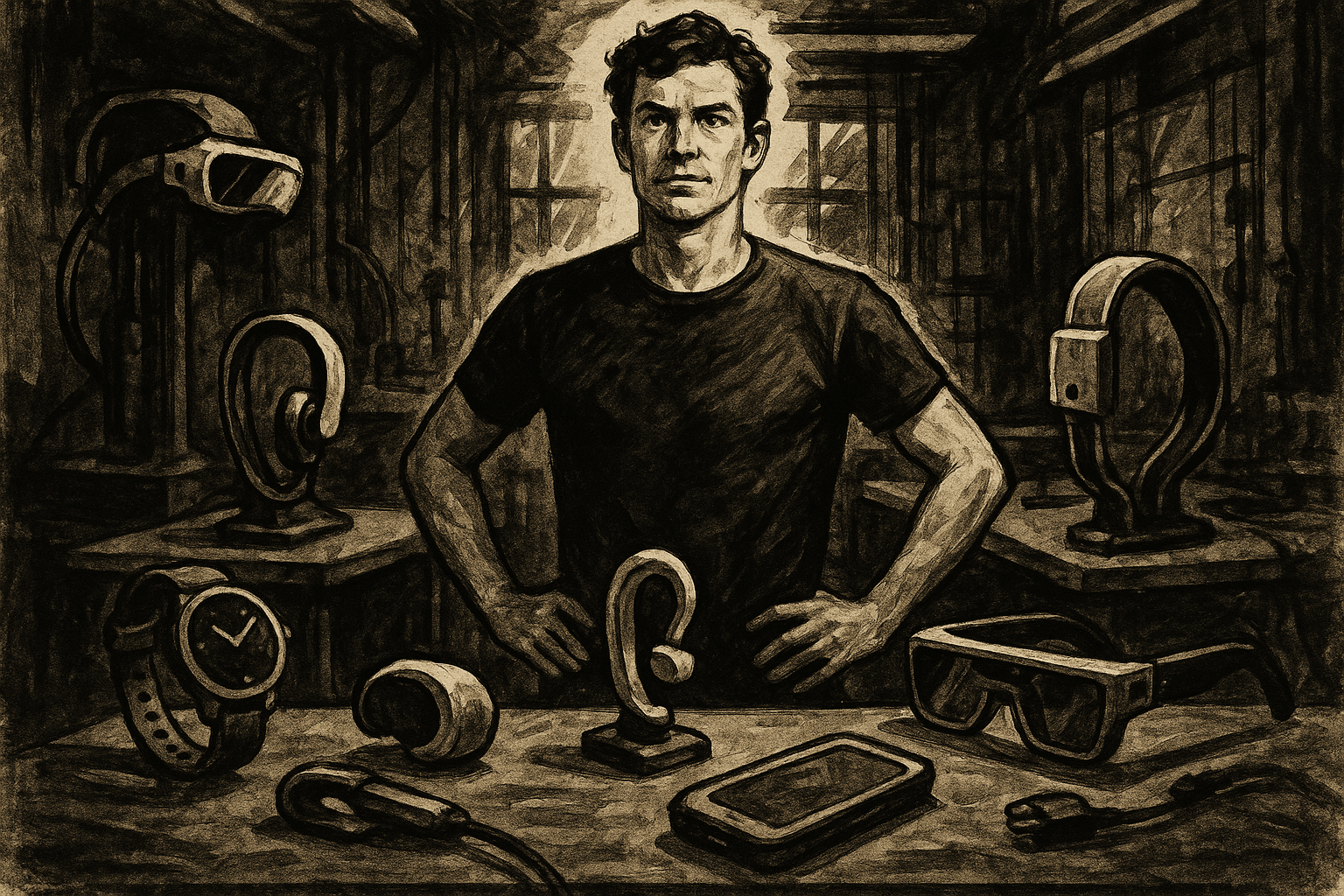
What does it mean when the chip industry writes a $700M blank check to a company with no public product?
On Thursday, Hark - a San Jose AI lab that has shown the world almost nothing - announced it had raised $700 million in a Series A round at a $6 billion post-money valuation.[1] The round was led by Parkway Venture Capital, with participation from Nvidia, Align Ventures, AMD Ventures, ARK Invest, Brookfield, Greycroft, Intel Capital, Prime Movers Lab, Qualcomm Ventures, Salesforce Ventures, and Tamarack Global.[1] The company has 70 employees, a data center running Nvidia B200 GPUs, and plans to ship AI models this summer followed by hardware at an unspecified date.[2]
The product? That remains largely a secret. What Hark will say is this: it is building "advanced personalized intelligence" - multimodal, agentic, vertically integrated across models, software, and native hardware - to serve as a "universal interface between humans and machines."[1] The company's design director, Abidur Chowdhury, a former Apple industrial designer who led the design of the iPhone Air, told TechCrunch this week that he hasn't "seen anything that feels like something that will really help the normal person."[2] When pressed on how Hark would solve the obvious privacy problems posed by an always-on personal AI, he smiled. "Sounds like that would make a great product."[2]
That mixture of conviction, secrecy, and deflection would normally raise eyebrows. In this particular moment, it raised $700 million instead.
Why is every chip company in this round?
The most revealing detail about Hark's funding is not its size - it is its composition. When Nvidia, AMD, Intel Capital, and Qualcomm all back the same early-stage company simultaneously, they are not making a conventional venture bet. They are buying a seat at the table for whatever hardware platform emerges from the consumer AI race. Each of those companies has a direct commercial stake in which chips power the next generation of personal AI devices. A Hark win is a chip-ecosystem win; a Hark loss costs them a relatively small line item on a balance sheet.
This logic mirrors how the semiconductor industry backed Figure AI - Adcock's humanoid robotics company - when physical AI was the defining category. Nvidia, Microsoft, OpenAI, and Jeff Bezos all backed Figure at a $2.6 billion valuation in February 2024.[3] The chip-industry coalition investing in Hark suggests the market believes consumer AI hardware could be an analogous inflection point: a platform transition where getting the chip architecture right from day one matters enormously.
Adcock seeded Hark with $100 million of his own capital in late 2025.[2] He has an estimated net worth of nearly $20 billion, accrued through exits at Vettery (acquired by Adecco for $110 million in 2018) and a stake estimated at roughly half of Figure AI, which was valued at $39 billion last year.[4] This is not a first-time founder hoping that momentum will paper over a thin product thesis. Adcock has, by any reasonable measure, already won. Hark is a deliberate second act from someone who has repeatedly executed a vertical integration playbook - he describes building five generations of aircraft at Archer Aviation, integrating flight software, electric motors, and battery systems himself.[3]
The graveyard this round has to reckon with
Consumer AI hardware has a recent and highly visible failure record. The Humane AI Pin raised $230 million, launched to devastating reviews in 2024, and was acquired by HP for $116 million within a year - a deal that transferred the company's IP, software platform, and employees but excluded the AI Pin device itself, which was discontinued. The Rabbit R1 generated enormous pre-order hype before shipping a device that delivered little its users couldn't do more easily on a smartphone. Both products tried to retrofit AI capability onto form factors that didn't justify new hardware at all.
OpenAI is attempting to learn from those failures. The company announced its acquisition of Jony Ive's io Products team in May 2025, with an initial target of debuting its first hardware device in 2026 - reportedly a screenless, pocket-sized, contextually aware device. Wired subsequently reported that the hardware has slipped to 2027 amid a trademark dispute over the 'io' branding.[5] Meta's Ray-Ban smart glasses have had genuine commercial traction but remain a content-consumption accessory rather than a true AI interface. Google's Android XR glasses are coming. Apple's Vision Pro stalled at $3,499.
The graveyard is real, but the Chowdhury thesis deserves a fair hearing: every product that has failed so far was either a software product wearing hardware clothing, or a hardware product that demanded too much behavioral change for too little utility. What hasn't been attempted at serious scale is a fully vertically integrated system - models, software, and hardware designed together from the ground up - by a team with the engineering depth to pull it off. Hark is betting it can be that company.
What Hark is actually building
The company's own press release is unusually candid about the problem it is diagnosing, even if it is guarded about the solution. "Today's AI largely operates through chat interfaces and decades-old consumer devices, with no persistent memory of who you are, and no interface hardware designed for intelligent interaction," the release states.[1] The framing is explicitly a systems critique: current AI is powerful but trapped inside form factors (the smartphone, the laptop, the chat box) that weren't designed for it.
What Hark is building in response is described as "proactive, personalized AI that interacts with the world through speech, vision, and memory" - an agentic system with persistent context, multimodal perception, and native hardware to match.[1] The company is deliberate about the sequence: models ship this summer to establish the software foundation, hardware follows. This order is strategically significant. Releasing models first builds a user base, establishes the AI's memory and personalization layer, and - critically - de-risks the hardware launch. Users who have already integrated Hark's AI into their routines have a reason to buy purpose-built hardware for it. It is a playbook closer to how Apple built iOS before committing to the Apple Watch than how Humane approached the AI Pin.
Chowdhury's point about the current AI industry's developer bias is pointed: "People are really building things to help people make software, and it's working, and it's really impactful, but we haven't really seen that for the normal person yet."[2] This is not a novel observation - it has been the critique of the AI industry from outside for two years - but it carries different weight when it comes from someone who spent years at Apple designing hardware for billions of non-technical users. The $700 million round suggests that a significant portion of Silicon Valley's investor and infrastructure establishment agrees.
The question the smile didn't answer
The privacy problem is, in fact, the hardest problem in consumer AI hardware, and Chowdhury's smile acknowledged as much. Any device that provides genuinely personalized, contextually aware AI must, by definition, observe a great deal about its user - and often about the people around that user. The Humane Pin's always-on camera unnerved people in public. Meta's glasses have faced repeated scrutiny over passive recording. An AI that "actually knows you" requires a data collection and retention regime that will need to be both technically sound and publicly defensible.
No company in this space has solved the consent and privacy architecture for ambient AI in a way that has earned broad public trust. That includes OpenAI, Meta, and Google, all of which have vastly more users, regulatory experience, and institutional credibility than a 70-person startup in San Jose. Hark's model-first, hardware-second roadmap delays this confrontation but does not eliminate it. When the hardware ships, the privacy conversation will arrive with it.
What Thursday's round confirms is that the consumer AI interface race is now fully open and well-funded from multiple directions. OpenAI has Jony Ive and significant manufacturing ambitions. Meta has distribution through Ray-Ban's existing retail channels. Google has Android's installed base. Apple has the iPhone ecosystem and a decade of wearables data. Hark has $700 million, a vertically integrated thesis, a founder who has built hardware companies before, and - for now - the competitive advantage of not having already shipped something the market has judged.
That last advantage has a short shelf life. Models drop this summer. The test begins then.
Sources
Hark Raises $700M Series A at a $6B Valuation - Intel Capital / BusinessWire (primary press release) Inline ↗
Hark raises $700M Series A for its secretive 'universal' AI interface - TechCrunch, Tim Fernholz, May 21, 2026 Inline ↗
Brett Adcock - Official Bio (Vettery, Archer, Figure AI founding history) Inline ↗
Figure AI's CEO just raised $700 million for his next big bet - Business Insider, May 21, 2026 Inline ↗
Exclusive: OpenAI aims to debut first device in 2026 - Axios, January 19, 2026 Inline ↗
Get this every weekday.
The Omniscient Bulletin: consequential AI, explained and evaluated. 5 to 7 items a day with the take, not the recap.
Discussion
Commenting is open to existing reader accounts. Sign in if you have one.