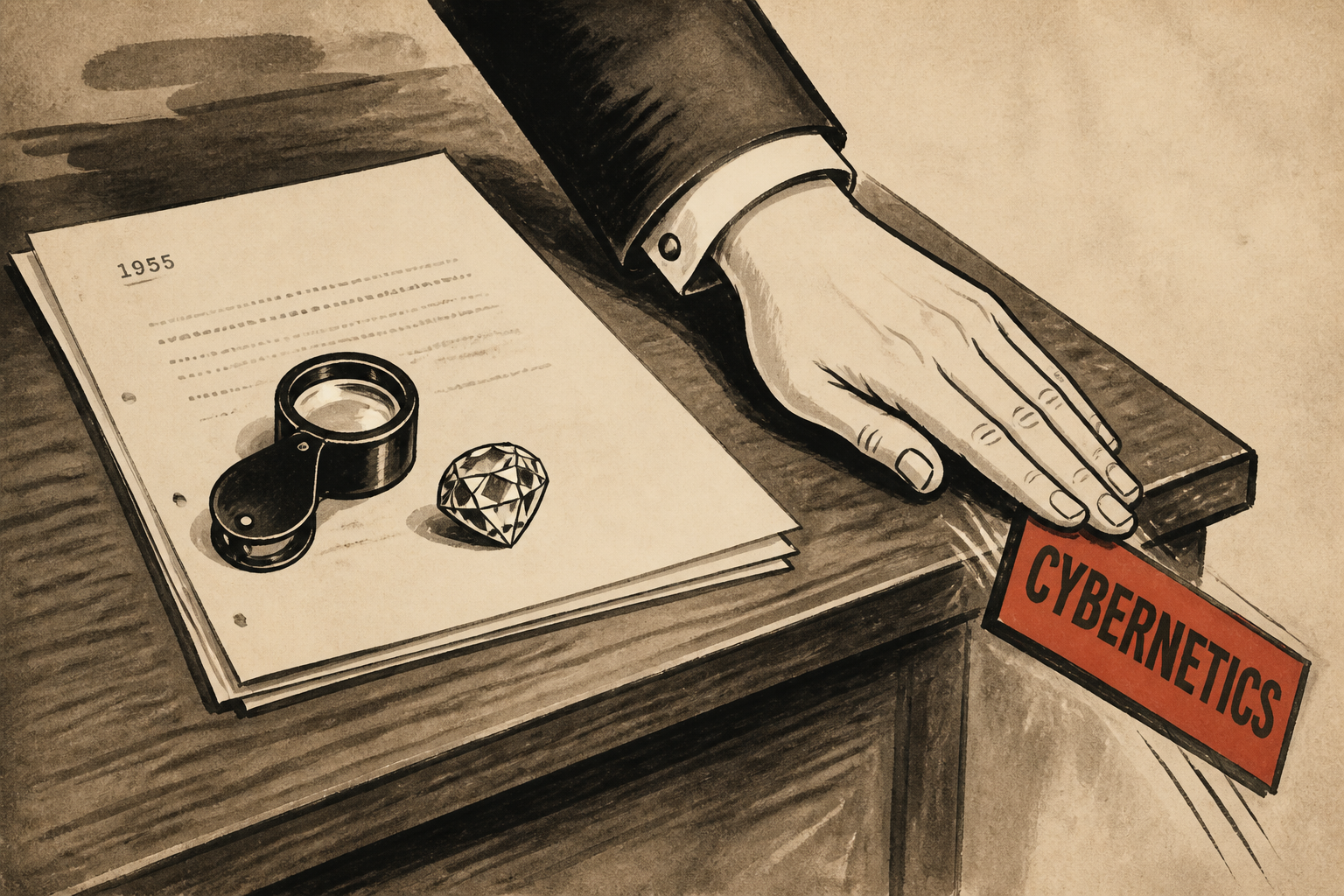
John McCarthy coined "artificial intelligence" in a proposal dated August 31, 1955, for the following summer's workshop at Dartmouth College, co-signed by Marvin Minsky, Nathaniel Rochester, and Claude Shannon. It wasn't a philosophical choice. The field already had names on offer: cybernetics, automata studies, machine intelligence, complex information processing. McCarthy invented a new one to get away from cybernetics, and from the man who owned it. In a 1988 interview he admitted the term was meant partly to dodge having "either to accept... Wiener as a guru or having to argue with him." Norbert Wiener was famous, territorial, and had already clashed with Shannon, one of McCarthy's own co-organizers.
So the founding document of AI is, in part, a piece of office politics. That's the detail I keep coming back to: the word we've spent seventy years defending or attacking wasn't built to describe the technology. It was built to get one difficult man out of the room.
What's actually on the record:
Source | What's on record |
|---|
Dartmouth proposal, August 31, 1955 | First written use of the phrase "artificial intelligence." |
Claude Shannon, proposal co-author | Preferred "automata studies." Allen Newell and Herbert Simon kept using "complex information processing" for years afterward. |
Herbert Simon, via biographer Pamela McCorduck | Said he and Newell had already been doing this work before Dartmouth; they'd just called it operations research. |
John Haugeland, Artificial Intelligence: The Very Idea (1985) | Proposed an alternative: "synthetic intelligence." |
Daniel Dennett, Brainstorms (1978) | Made the counter-argument: some categories are about structure, others about who made the thing and how. |
McCarthy needed a word that wasn't Norbert Wiener's
The petty version of this story is the one that matters most, and it's usually left out. McCarthy wasn't running a naming contest for accuracy. He was trying to build a field that wasn't a subsidiary of Wiener's cybernetics, and "artificial intelligence" did that job precisely because it was new enough to owe nobody anything. Nobody at Dartmouth was thrilled with it, including two of his own co-signers. There’s something ironic about a term becoming load-bearing for a $2 trillion industry: not chosen because it was right, but because it was unclaimed.
The jewelry argument nobody remembers
Thirty years on, Haugeland tried to fix it, tucking his objection into a footnote: AI, he argued, is not aiming at a fake imitation of intelligence, it's aiming at the real thing. His fix was a word swap, "synthetic" for "artificial," and the argument underneath it is basically about jewelry. Cubic zirconia is a simulant. It looks like a diamond and isn't one. A lab-grown diamond has the identical carbon lattice, the same hardness, and it cuts glass exactly the way a mined one does. Nobody calls that an imitation diamond. It's a diamond that happens to have been manufactured rather than dug up. "Artificial" points at the zirconia. "Synthetic" points at the lab-grown stone. And the word did real work on us: artificial started out neutral in English, meaning simply made by skill, then picked up its counterfeit smell from things like artificial silk and artificial flavoring. By 1955 it was already pre-loaded with the "fake" reading, and every skeptical argument about machine intelligence since has been quietly built on that foundation.
Why "synthetic" isn't as clean as it looks
I'd love to end there and declare the whole field mislabeled, but there are two main reasons that stop me. First, in 1955 "synthetic" carried no prestige at all: synthetic rubber and synthetic fabrics were wartime substitutes, the cheaper stand-in for the real material. Our current instinct that synthetic means authentic is borrowed from a lab-grown diamond market that's maybe a decade old. Haugeland's fix would have sounded like a downgrade to his own contemporaries.
Second, Dennett pointed out that any vodka is real vodka no matter who distilled it, but a molecule-perfect copy of a Chateau Latour is still a fake. Some categories are defined by structure. Others are defined by provenance, and no amount of chemistry fixes that. Whether intelligence is the vodka kind or the wine kind is the actual question, and it's one neither "artificial" nor "synthetic" answers, they just each smuggle in a different guess. Pick "synthetic" and you've assumed intelligence is a structure, like carbon lattices, that can be reproduced anywhere and still count. Pick "artificial" and you've assumed it's something more like the Latour, tied to where and how it came from, so nothing manufactured can ever be the real thing.
Nobody at Dartmouth was trying to answer that question in August 1955. They were trying to get through a summer without Norbert Wiener in the room. We've been arguing downstream of that dodge for seventy years, and the label we're still fighting over was never built to hold the weight we've put on it.