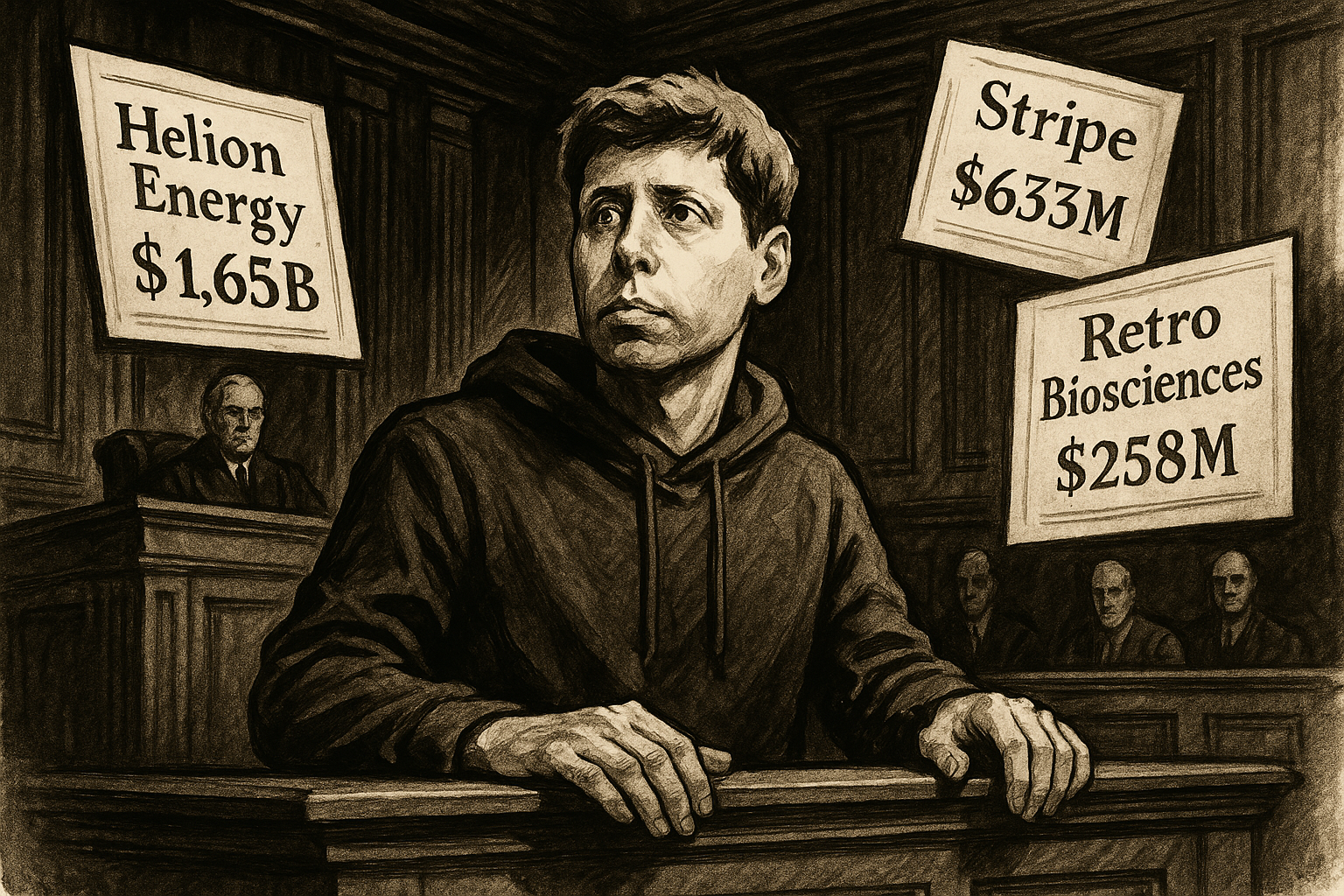
The Oakland courtroom was supposed to be a venue for Elon Musk's argument that Sam Altman betrayed OpenAI's nonprofit charter. By Tuesday afternoon it had become something else: the most candid public disclosure of where the CEO of the world's most valuable AI company has personally bet his money. Court filings entered into evidence put Altman's stakes in companies that do business with OpenAI at more than $2 billion[1]. Musk's lead counsel Steven Molo walked Altman through each position in cross-examination, framing them as conflicts. He is not wrong. He may also have inadvertently surfaced the cleanest read available on what Altman believes are the binding constraints on the next decade of frontier AI.
What the filings actually list
The court document, reported in detail through the Reuters wire on Wednesday, names four positions of consequence[2]:
A roughly one-third stake in Helion Energy, the Everett, Washington fusion startup, valued at approximately $1.65 billion as of late 2025.
A $633 million position in Stripe.
A $258 million stake in Retro Biosciences, the longevity research company.
A position in Reddit that Altman has since disposed of, but which he held while personally spearheading OpenAI's May 2024 content licensing partnership with the platform.
Altman, who left Helion's board in March, told the court he has consistently recused himself from OpenAI's dealings with the fusion company. His counsel explained that recusal covered "the decision to proceed and the final approval of terms"[1]. Altman also said something else in cross-examination, and it is the more useful sentence: that "a huge percentage" of his time as CEO of OpenAI is spent securing energy and compute[1].
Take that admission at face value, and the portfolio stops looking random.
The energy layer
Helion is the easiest position to read, and the largest. Compute is power. The binding constraint on frontier-model training over the next decade is not chip count but the gigawatts to run the chips. Altman has been explicit about this. In public remarks made at the time of Helion's 2023 Microsoft power purchase agreement, he framed the bet directly: "if we can drive the cost of intelligence and the cost of energy way, way down, the quality of life for all of us will increase incredibly"[3].
The technical case for Helion is not vapor. In February, the company's Polaris prototype reached 150 million degrees Celsius and demonstrated measurable deuterium-tritium fusion, the first privately developed machine to do so[3]. The commercial case is more advanced still. Helion's Orion plant broke ground in Washington state last summer, anchored by a Microsoft power purchase agreement, the first commercial fusion PPA in history, targeting 50 megawatts or greater after a one-year ramp from a 2028 in-service date[4]. Constellation Energy will market the power and manage transmission.
The OpenAI side of the Helion relationship is materially different from Microsoft's, and that difference matters. There is no binding offtake. Altman testified that OpenAI has never bought or received any power from Helion, and that the 2024 agreement was "a way for us to have the opportunity to do that in the future"[1]. Read generously, that is an option contract that preserves OpenAI's claim on capacity Helion is already building for Microsoft. Read less generously, it is the precise legal structure you would write if you wanted to keep a personal investment's commercial trajectory intact without committing your employer's balance sheet to it.
The state attorneys general and the House Oversight Committee have not been generous. Oversight sent Altman a letter on May 8 citing the Helion relationship specifically, asking for assurance that "funds donated for charitable purposes are not diverted for unintended uses, such as artificially increasing the market value of other companies in which an executive or board member may hold an interest"[2].
The infrastructure read does not need to absolve Altman of those concerns. It only needs to observe that, conflict or no conflict, the largest personal bet the CEO of OpenAI has made is on the company building the solution to the binding constraint on his own roadmap.
The commerce layer
Stripe is the next position, and the framing rhymes. Agentic commerce is moving from theory to product across the major platforms, with AWS AgentCore Payments and Coinbase's x402 protocol opening preview within the last two weeks. Stripe is the dominant payment rail AI agents acting on a user's behalf will plausibly transact through. Altman's $633 million Stripe position is, on its face, a personal bet on the same infrastructure his product strategy will lean on. Molo's cross-examination did not dwell on Stripe to the degree it dwelled on Helion, in part because the OpenAI-Stripe commercial relationship has been less visibly a discretionary CEO decision. But the shape of the bet is the same: long the rails the product needs.
The data layer, resolved by exit
Reddit is the layer where the conflict has been adjudicated, by sale rather than by ruling. Altman led OpenAI's negotiation of the May 2024 content licensing partnership with Reddit while holding a personal Reddit position. He disposed of that position by the end of 2025. Molo called the original arrangement an "obvious conflict"; Altman testified to having recused himself from final approval[1].
The technological backdrop is the more durable point. Reddit's IPO was priced in part on its AI data licensing potential; Google signed a parallel deal; the New York Times sued. The shift from scraped to licensed training corpora has decisively happened. Altman's now-exited Reddit position made him long that shift before it was visibly priced into the market. Whether or not the conflict was properly handled, the bet was directionally correct in a way the bet on Helion may not yet be.
The demand side
Retro Biosciences looks like an outlier in the infrastructure-stack reading, until you trace the actual technical relationship. In January 2025, OpenAI and Retro jointly announced GPT-4b micro, a protein-engineering model derived from GPT-4o and retrained for biology, and used it to engineer new variants of the Yamanaka reprogramming factors[5]. The RetroSOX and RetroKLF variants the collaboration produced delivered a roughly 50-fold increase in pluripotency marker expression in lab testing, and cut induced-pluripotent-stem-cell generation from roughly three weeks to seven days[5]. GPT-4b micro is not generally available; Retro is its canonical customer.
That changes the read on the $258 million stake. The infrastructure thesis is that Altman is personally long the supply side of OpenAI's roadmap: energy to run the models, payment rails to transact through them, licensed data to train them. Retro is the demand side. It is the company most visibly proving that the most differentiated, highest-margin application of OpenAI's frontier work is not chatbots but scientific discovery. The Retro position is a bet that the per-experiment value of a specialty OpenAI biology model, in a regulated and capital-rich market, will compound faster than the per-token value of a general OpenAI chat model in a commoditizing one.
That is the cleanest possible defense of why an OpenAI CEO would hold $258 million in this specific biotech: he is staking his own balance sheet on the application of AI he believes will matter most. It is also the most damning version of the conflict, because the customer Altman is long is the customer OpenAI's product strategy directed engineering effort to serve. Both readings are simultaneously true.
What the disclosure actually reveals
The governance question is real. The House Oversight letter, the state AG inquiries, and Molo's cross-examination are not vexatious. A 501(c)(3) parent overseeing a CEO whose personal portfolio mirrors that subsidiary's procurement and partnership decisions is a structure that ought to be examined.
But the disclosure has produced something the governance frame undersells. Read as a single thesis, the four positions are an unusually candid statement of what the CEO of the most operationally consequential AI company believes is true about the next decade: that compute is gated on energy, agents are gated on payment rails, models are gated on licensed data, and the highest-margin output of the entire stack is AI-accelerated science. A financial analyst trying to construct that thesis from the outside would have struggled to do so with this precision.
Closing arguments in Musk v. Altman are expected this week. What the advisory jury weighs is governance - with Judge Yvonne Gonzalez Rogers holding the final ruling. What the filings have already settled, regardless of that outcome, is which constraints Altman is willing to spend his own money to remove.
The character-defense quotes Altman gave Molo on Tuesday will travel. The more useful sentence in his testimony was the one about how much of his time as CEO goes to energy and compute. That is the disclosure. The dollar figures are just its receipts.
Sources