Industry
Vol. 1·Wednesday, May 6, 2026
Anthropic's Wall Street Play Is Not a Software Deal
Noah Ogbi11 min read
Tips, corrections, or questions? support@omniscient.media
TopicsIndustry Strategy
CompaniesAnthropic
Tips, corrections, or questions? support@omniscient.media
Get this every weekday.
The Omniscient Bulletin: consequential AI, explained and evaluated. 5 to 7 items a day with the take, not the recap.
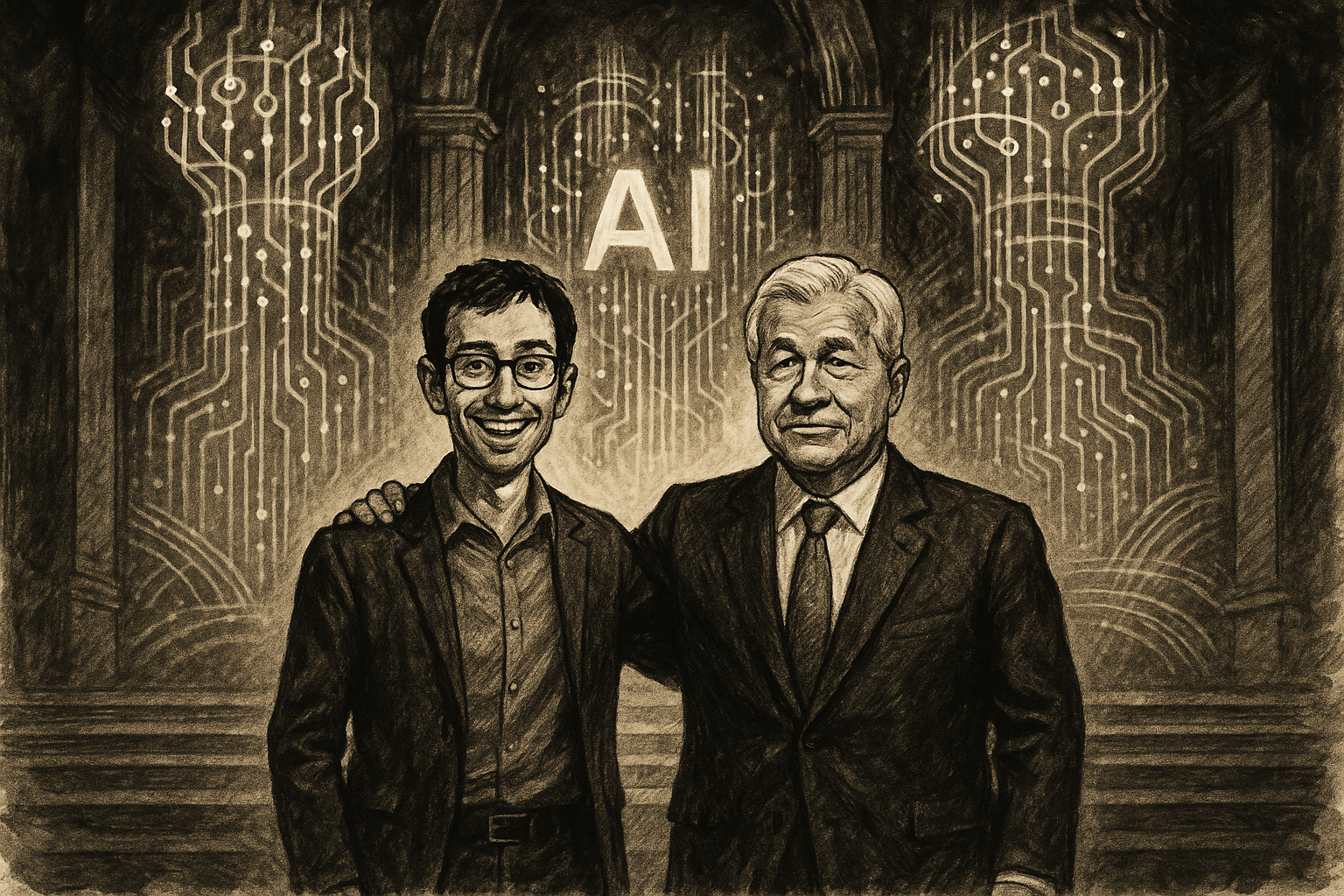
In the early months of 2026, Anthropic has had two modes: research lab and enterprise blitz. The 48-hour sequence that concluded with a New York financial services briefing on May 5 was the purest expression of the second mode. By the time Dario Amodei and Jamie Dimon left the stage together, Anthropic had quietly assembled something none of its frontier AI peers have managed: a distribution channel that runs straight through the operational hearts of companies it will never have to sell to directly.
Anthropic's new enterprise services firm is a standalone, AI-native company formed in partnership with Blackstone, Hellman & Friedman, and Goldman Sachs, backed by approximately $1.5 billion in committed capital.[1] According to Wall Street Journal reporting that Anthropic has not officially confirmed, Blackstone, H&F, and Anthropic each contributed roughly $300 million, with Goldman Sachs at $150 million.[2] A wider consortium - Apollo Global Management, General Atlantic, Leonard Green, Singapore's GIC, and Sequoia Capital - rounds out the backing.[1]
The structural point is what separates this from an ordinary partnership. The new firm is not a channel partner or a reseller. It is a forward-deployment operation, modeled loosely on Palantir's engineer-in-residence approach, with Anthropic engineering and partnership resources embedded directly within its team.[1] Its initial proving ground is the hundreds of portfolio companies held by its PE backers. Its longer-term target is the broader mid-market - every PE-owned business in healthcare, manufacturing, financial services, retail, and real estate that currently cannot afford the consulting fees or the talent required to run frontier AI systems at scale.
"There's a big shortage of people who know how to apply these tools into businesses and then transform them," Goldman's Marc Nachmann, Global Head of Asset and Wealth Management, told CNBC. "Having the model alone doesn't change your workflows or how you operate."[3]
The arithmetic behind the bet is straightforward. The services market that Anthropic is targeting dwarfs the software market it already competes in. Industry estimates have put the software-to-services spending ratio at roughly 1:6 - meaning the total addressable market for AI-native implementation is many times larger than the model licensing revenue any frontier lab currently captures.[4] Anthropic CFO Krishna Rao put it plainly: "Enterprise demand for Claude is significantly outpacing any single delivery model."[1]
The joint venture represents a structurally novel answer to the central distribution problem every frontier lab faces. Selling software to enterprises is one thing. Becoming entrenched in their operations - owning the implementation layer, not just the model layer - creates switching costs that API pricing alone cannot generate. Palantir spent more than a decade building this into a moat. Anthropic is attempting to buy its way into a comparable position in a single transaction.
The PE channel is especially significant because private equity firms exercise a unique kind of leverage over their portfolio companies' technology choices. As Fortune reported in November 2025, 85% of buyers already factor AI-enabled finance capabilities into company valuations at exit, meaning sponsors have every incentive to push Claude adoption through their holdings quickly. Anthropic now has a built-in constituency - and a ready-made sales force in the form of PE deal teams - that no other AI lab currently possesses at this scale.
OpenAI finalized its own version of this bet on the same day, confirming the model is now consensus rather than differentiated. OpenAI's vehicle - formally called The Deployment Company - is anchored by TPG and backed by 19 investors including Brookfield Asset Management, Advent International, and Bain Capital, with $4 billion in PE capital at a total valuation of $10 billion.[5] Its structure differs from Anthropic's in one significant way: OpenAI has committed to a 17.5% guaranteed annual return for its PE backers, a quasi-debt arrangement with no precedent in enterprise AI. The two deals landing simultaneously makes the Palantir-style forward-deployment model the industry standard - and shifts the competitive question from whether to use PE distribution to how it is financed. On that count, Blackstone alone manages more than $1.3 trillion in assets, and the consortium's collective reach into portfolio companies gives Anthropic a client base that a later mover will find difficult to replicate.[1]
Claude Opus 4.7, the model underlying the financial services launch, now leads Vals AI's Finance Agent benchmark with a score of 64.4% and tops the GDPval-AA evaluation for economically valuable knowledge work.[6] Built on top of it is a library of roughly ten pre-built agents targeting the most labor-intensive back-office workflows in finance: pitchbooks and earnings analysis, credit memos, underwriting, KYC, month-end close, statement audits, and insurance claims.
Each agent ships as a reference architecture - with the connectors, subagents, and workflow logic already assembled - that firms can then adapt to their own risk policies and internal approval chains. Once configured, agents can run inside Claude's Cowork and Claude Code environments alongside human analysts, or as Claude Managed Agents where Anthropic handles the production infrastructure.[6]
AIG CEO Peter Zaffino disclosed at the briefing that Claude scored 88% as accurate as a human claims expert out of the box - a number that works in two directions simultaneously. It is impressive enough to justify deployment; it is also insufficient enough to preserve the role of the human expert as a validator and continuous trainer.[6] Paul Smith, Anthropic's chief commercial officer, described a "staircase of autonomy" tracing finance AI's path from research assistance toward fully autonomous senior-analyst-level work. Lisa Crofoot, a research product management leader at Anthropic, put a timeline on it: finance AI is currently six to twelve months behind where software engineering AI had reached at a comparable stage - a lag she said is closing.[6]
Alongside the agents, Anthropic announced a significant expansion of the data connectors available within Claude. Verisk, Third Bridge, Dun & Bradstreet, Experian, GLG, Guidepoint, IBISWorld, Fiscal AI, and others join an existing roster that includes S&P Capital IQ, LSEG, Morningstar, and PitchBook.[6]
The marquee addition is Moody's. The full Moody's platform - covering credit ratings, risk data, and financial profiles for more than 600 million companies - is now embedded directly inside Claude as a native app, accessible without leaving the interface.[6] For a credit analyst running counterparty due diligence, or an underwriter assessing a portfolio company, this collapses a workflow that previously required toggling between at least three separate tools.
The Microsoft 365 integration completes the picture on the productivity side. Claude add-ins for Excel, PowerPoint, and Word are generally available; the Outlook integration is in beta. Claude now carries context across all four applications simultaneously - meaning a financial model, a client presentation, and an email thread can be handled by a single agent that remembers what happened in each.[6]
The Dimon-Amodei pairing was not purely symbolic. Dimon opened with an anecdote that landed with the room: he had spent 20 minutes over the weekend using Claude Code himself to build a fixed-income dashboard tracking asset swaps, Treasury bid-ask spreads, and investment-grade markets. "It was very accurate about what I wanted," he said - no small endorsement from a CEO whose firm runs one of the world's most sophisticated proprietary trading operations.[6]
Amodei offered an unusually candid data point on Anthropic's own trajectory. The company had projected 10x annualized revenue growth over a recent period. Instead, it recorded approximately 80x annualized revenue growth in a single quarter. "The cone is even wider than I thought," he said, characterizing Anthropic's position as one of "absolute radical uncertainty" in which upside scenarios continue to outrun internal models.[6] This disclosure followed our prior coverage noting Anthropic's annualized revenue had reached $30 billion in early April, surpassing OpenAI's $24 billion run rate.[7]
Anthropic's chief economist, Peter McCrory, added context drawn from the company's proprietary Economic Index: AI is now being used for at least a quarter of tasks in roughly half of all U.S. jobs, up from one-third of jobs just a year ago. McCrory projected that AI could add 1.8 percentage points annually to U.S. labor productivity over the next decade - a figure that, if realized, would roughly double recent run rates and return the economy to the productivity growth of the late 1990s.[6]
The question worth sitting with is not whether Anthropic's financial services strategy is impressive - it clearly is - but whether any of it constitutes a durable moat. Model capability is compressible. The 64.4% Finance Agent benchmark score will be exceeded by a competitor within months. The Microsoft 365 integration is a channel, not a lock-in. Even the Moody's partnership is, in principle, replicable.
What is harder to replicate is the joint venture structure itself. The PE channel is not just a distribution mechanism; it is an alignment of incentives. Blackstone, Goldman, and H&F now have a direct financial interest in making Claude the default infrastructure for hundreds of their portfolio companies. That creates a pulling force toward adoption that no sales team can substitute for. The real bet Anthropic is making is that enterprise AI transformation is primarily a services problem, and that whoever owns the services layer will own the recurring revenue - regardless of which underlying model is running beneath it.
Goldman's Marco Argenti put the investment thesis succinctly: "This is the first time that instead of buying infrastructure, you can actually buy intelligence."
That framing is either a genuine inflection point or a very expensive piece of marketing. Given the numbers Amodei disclosed on stage, the market is currently betting it is the former.
Blackstone - Official press release: Anthropic Partners with Blackstone, Hellman & Friedman, and Goldman Sachs to Launch Enterprise AI Services Firm (May 4, 2026) Inline ↗
The Wall Street Journal - Anthropic, Blackstone, Goldman Sachs, Hellman & Friedman Form AI Venture (May 4, 2026) Inline ↗
CNBC - Anthropic teams with Goldman, Blackstone and others on $1.5 billion AI venture targeting PE-owned firms (May 4, 2026) Inline ↗
Fortune - Anthropic takes shot at consulting industry in joint venture with Wall Street giants (May 4, 2026) Inline ↗
Fortune - OpenAI's Deployment Company closes $4B from PE giants at $10B valuation (May 4, 2026) Inline ↗
Fortune - Anthropic deepens Wall Street push with new AI agents, Microsoft and Moody's partnerships (May 5, 2026) Inline ↗
Omniscient Media - Anthropic Passes OpenAI on Revenue: A Lead Built on Code, Not Consumers (May 2, 2026) Inline ↗