Industry
Vol. 1·Thursday, April 30, 2026
Cloud Revenue Vindicates Big Tech AI Spending, but Meta's Runaway Capex Unnerves Investors
Noah Ogbi9 min read
Tips, corrections, or questions? support@omniscient.media
Tips, corrections, or questions? support@omniscient.media
Amazon Web Services reported $37.6 billion in revenue for Q1, up 28% year over year - its fastest growth rate in fifteen quarters - as enterprise demand for AI compute capacity continued to accelerate.[5] Amazon's total revenue of $181.5 billion beat the $177.2 billion analyst consensus, and earnings per share of $2.78 was nearly double the $1.65 estimate - a margin expansion story as much as a growth one.
CEO Andy Jassy highlighted that Amazon's custom silicon business has crossed a $20 billion annual revenue run rate, growing triple digits year over year.[5] That figure - covering Amazon's Trainium and Inferentia chips - matters because it signals that hyperscalers are not simply buying from Nvidia; they are building proprietary compute stacks that could alter the semiconductor supply chain over time. Advertising services added $17.2 billion, up 24%, demonstrating that AWS's cloud growth is not cannibalizing Amazon's other high-margin businesses.
"AWS is growing 28% - our fastest growth in 15 quarters - on a very large base." - Andy Jassy, Amazon CEO[5]
Meta's first-quarter results were, by conventional measures, strong: revenue of $56.3 billion grew 33% year over year, and net income of $26.8 billion rose 61%. Adjusted earnings per share of $7.31 comfortably beat the $6.79 analyst consensus tracked by LSEG - though GAAP EPS reached $10.44 due to an $8.03 billion tax benefit tied to the Trump administration's tax legislation, which Meta said partially offset a prior tax charge.[6] The stock fell roughly 6% after hours anyway, and the reason is straightforward: the company raised its full-year capex guidance to $125-$145 billion, up from a prior range of $115-$135 billion - itself already a revision from earlier in the year.[6]
CFO Susan Li attributed the increase to "higher component pricing" and "additional data center costs to support future year capacity." The explanation is plausible, but it arrives in the same week that Meta told employees it would cut 8,000 staff - about 10% of its workforce - in May and close 6,000 open roles to "offset" AI investment costs.[5] The optics of simultaneous mass layoffs and a raised spending ceiling are difficult to reconcile, particularly when the company has not specified what products or revenue streams the incremental billions are expected to produce.
Unlike Alphabet, whose $460 billion Cloud backlog provides contracted justification for its own elevated capex, or Microsoft, whose AI run rate gives investors a denominator to measure spending against, Meta's infrastructure bet is essentially a bet on future advertising efficiency and consumer AI adoption. CEO Mark Zuckerberg's statement - "we're on track to deliver personal superintelligence to billions of people" - is a strategic vision, not a financial return. Investors have been willing to follow that vision before, but the ceiling keeps moving.
Get this every weekday.
The Omniscient Bulletin: consequential AI, explained and evaluated. 5 to 7 items a day with the take, not the recap.
For three consecutive years, Wall Street asked the same question of every big-tech earnings call: when does the AI infrastructure spending translate into revenue? On April 29, 2026, Alphabet, Microsoft, Amazon, and Meta reported first-quarter results that collectively amounted to the most definitive answer yet - and the market liked most of what it heard.
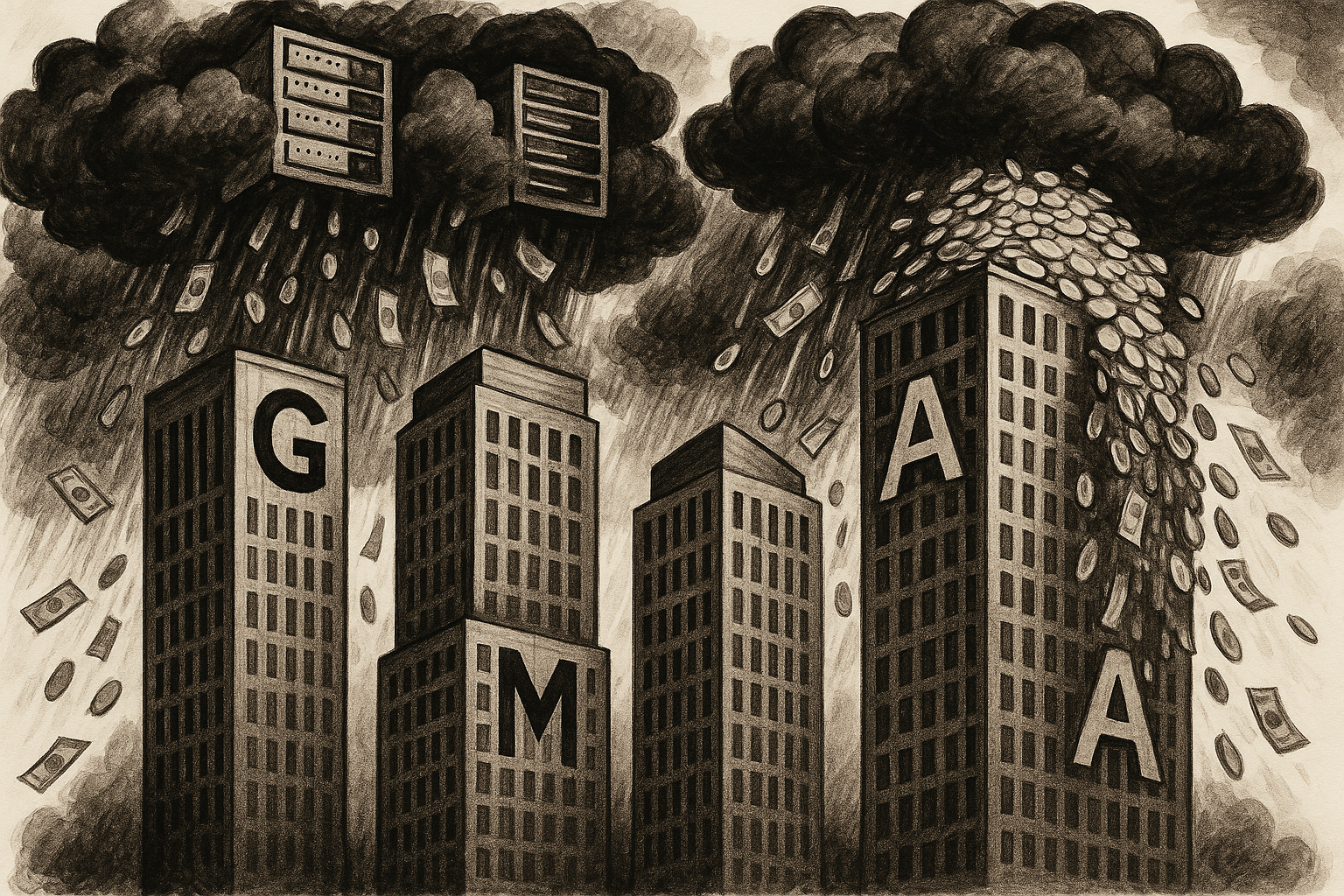
Two of the four companies saw their stocks rise in after-hours trading on the strength of cloud growth that surpassed even optimistic forecasts. The outlier was Meta, whose revenue and earnings beats were overshadowed by a capital expenditure guidance range that has been revised upward repeatedly in the past year, with no concrete product milestone attached to the ceiling.
Big Tech Q1 2026 Earnings at a Glance | |||||
Company | Revenue | YoY Growth | Key Cloud/AI Metric | 2026 Capex Guidance | After-Hours Move |
|---|---|---|---|---|---|
Alphabet (GOOGL) | $109.9B | +22% | Google Cloud +63% to $20B | $180B-$190B | +5% |
Microsoft (MSFT) | $82.9B | +18% | Azure +40%; AI run rate $37B/yr | ~$31.9B (Q1 spend) | -2% |
Amazon (AMZN) | $181.5B | +17% | AWS +28% to $37.6B | $200B (full year) | +3% |
Meta (META) | $56.3B | +33% | 3.56B daily active users | $125B-$145B | -6% |
Google Cloud's 63% year-over-year revenue growth to $20.03 billion in a single quarter is not just a headline number - it is the fastest growth rate among the three major hyperscalers and reflects a fundamental shift in enterprise AI procurement.[1] The growth reflects a structural change in how large enterprises procure AI capacity: instead of incremental cloud trials, they are signing long-term infrastructure commitments, locking in access to Google's custom TPU silicon and Gemini model APIs. Cloud backlog nearly doubled quarter over quarter to over $460 billion - contracted future revenue, not a forecast.[1] CEO Sundar Pichai noted that Gemini is now processing more than 16 billion tokens per minute through the direct API alone.
Alphabet's overall revenue of $109.9 billion - its 11th consecutive quarter of double-digit growth - beat analyst consensus of $106.79 billion by roughly 3%.[1] Net income surged 81% year over year to $62.58 billion, with earnings per share of $5.11 on a GAAP basis - though that figure included a $37 billion non-cash gain on equity securities that analysts had excluded from forecasts; on an adjusted basis, EPS of approximately $2.62 came in roughly in line with the $2.63 consensus.[1] Search revenue growth has in fact accelerated as AI features have driven query volumes to all-time highs - a direct refutation of the thesis, popular since ChatGPT's launch, that generative AI would cannibalize Google's advertising base. Search and Other revenue grew 19% to $60.4 billion.[1] YouTube contributed $9.9 billion in advertising revenue, up 11%.
The one note of investor caution: Alphabet raised its full-year 2026 capex guidance to $180-$190 billion (up from a prior range of $175-$185 billion), and CFO Anat Ashkenazi signaled that 2027 capex would increase further.[2] Shares climbed roughly 5% in after-hours trading, a sign that markets are increasingly willing to reward the combination of contracted cloud demand and strong earnings momentum - while still watching the open-ended spending commitment with cautious eyes.
Microsoft's quarter is best understood as a rebuttal. Three months ago, its stock fell 10% despite beating earnings because investors were fixated on record capital spending, tepid Copilot adoption, and a revenue backlog heavily concentrated in OpenAI.[3] This time, Azure's 40% growth - beating the company's own forecast - provided the vindication the market needed. Total revenue of $82.9 billion exceeded the $81.4 billion consensus, and earnings per share of $4.27 topped the $4.06 estimate.[4]
The more consequential disclosure was Microsoft's AI business run rate: $37 billion annually, up 123% from the $13 billion it last reported in January 2025.[4] That figure covers Azure AI services, Copilot subscriptions, and related products - and it answers, with hard numbers, whether enterprise customers are actually paying for AI. Microsoft 365 Copilot now has 20 million paid seats, up from 15 million in January, representing roughly 4.4% of the commercial base.[3] Adoption remains narrow, but the trajectory is no longer speculative.
Quarterly capex actually fell to $31.9 billion from $37.5 billion the prior quarter - Microsoft had flagged this would happen due to data center construction timing, not demand weakness.[3] The Intelligent Cloud segment grew 30% to $34.7 billion, now nearly equal in size to the company's productivity business for the first time, a structural milestone that underscores how completely Microsoft's center of gravity has shifted toward infrastructure.[4]
Taken together, the four companies are committing somewhere north of $550 billion in capital expenditure in 2026 alone - a figure that excludes Apple and includes Amazon's $200 billion commitment announced separately in February.[5] This is not a coordinated bet; each company has distinct strategic rationale. But the collective scale has implications that extend well beyond these quarterly scorecards.
For Nvidia and the broader semiconductor supply chain, sustained hyperscaler demand at this level provides a floor. For enterprise buyers, the aggressive expansion of cloud AI capacity - with Google's backlog nearly doubling and Azure exceeding its own projections - should translate into greater availability and, eventually, competitive pricing pressure on AI compute. For workers in the technology industry, the picture is more ambiguous: each of these companies is simultaneously expanding infrastructure headcount and trimming operational staff, reflecting a bet that AI can absorb the productivity gap.
The Q1 results settle one question: AI infrastructure investment is generating real cloud revenue, at scale, ahead of schedule. The question now is whether the next wave of spending - already committed and climbing - can continue to outrun the expectations it creates.
Alphabet Inc. - Q1 2026 Earnings Release (Official) Inline ↗
Microsoft tops Wall Street expectations, reports accelerating Azure growth and $37B AI run rate - GeekWire (Alphabet capex guidance and CFO comments) Inline ↗
Microsoft tops Wall Street expectations, reports accelerating Azure growth and $37B AI run rate - GeekWire Inline ↗
Microsoft Corp. - FY2026 Q3 Earnings Press Release (Official) Inline ↗
Amazon Posts $181.5 Billion in Revenue and Smashes Wall Street's Q1 Earnings Expectations - Variety (AWS figures, Jassy quotes, Meta layoffs) Inline ↗
Meta Platforms, Inc. - Q1 2026 Earnings Press Release (Official) Inline ↗