Industry
Build More, Hire Less: Big Tech's Defining Contradiction of 2026
Tips, corrections, or questions? support@omniscient.media
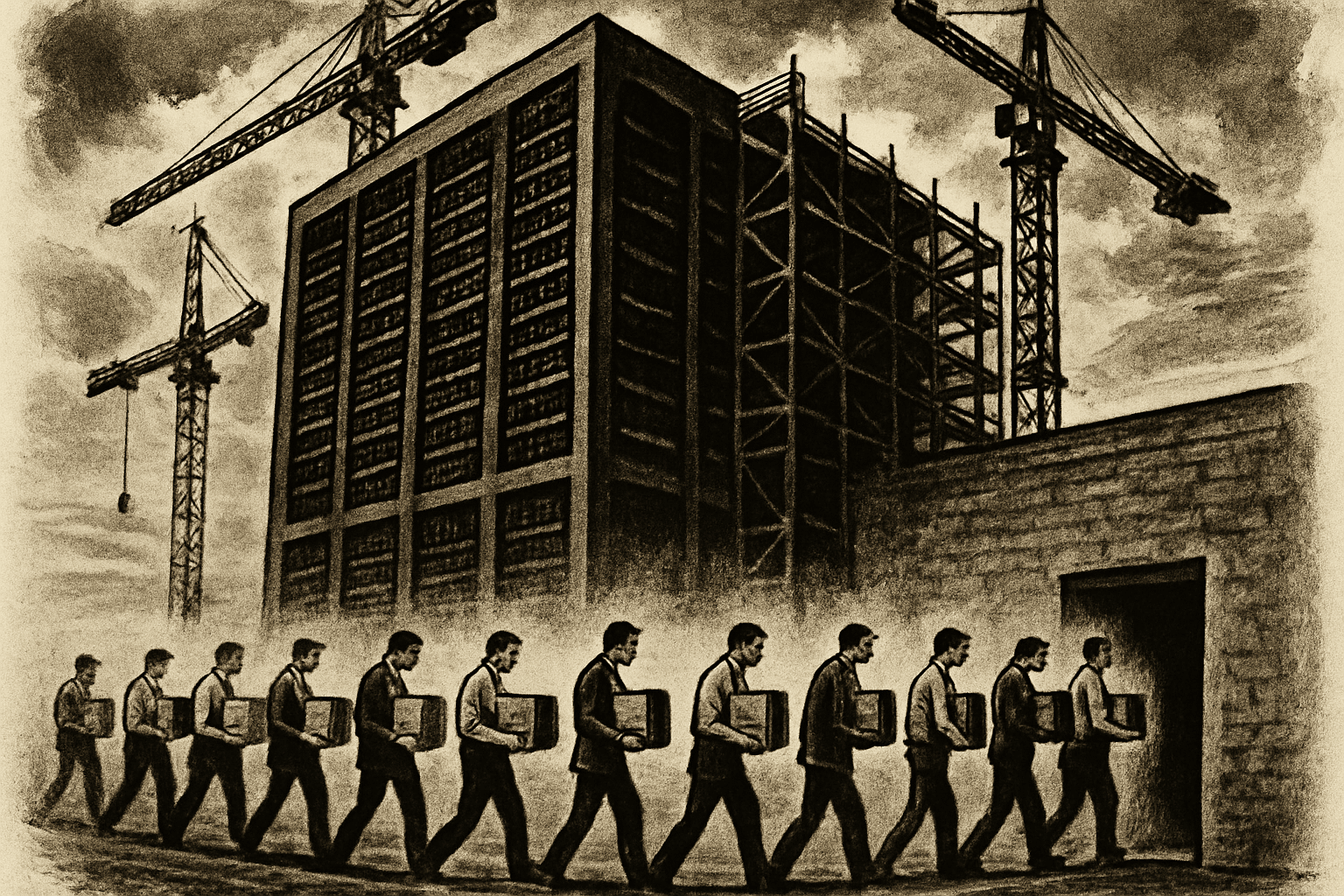
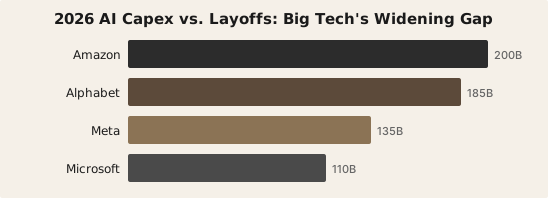
On April 23, Meta and Microsoft delivered a message to their combined workforces that was both blunt and historically significant: thousands of jobs were going away. The timing was not coincidental. It landed in the same earnings week that the two companies, alongside Amazon and Alphabet, reaffirmed plans to spend close to $700 billion on AI infrastructure in 2026 - a 60% increase over already record capital expenditures in 2025.[1] The juxtaposition was impossible to miss, and its implications run deeper than a single news cycle.
What did Meta and Microsoft actually announce?
Meta's chief people officer Janelle Gale sent an internal memo on April 23 informing staff that approximately 8,000 employees - 10% of the company's global workforce - would be let go beginning May 20.[2] The memo did not mention AI explicitly, framing the cuts instead as a move to "run the company more efficiently" and "offset the other investments we're making." Those other investments are considerable: Meta has committed to spending between $115 billion and $135 billion on AI in 2026, roughly 75% above the prior year's capital expenditure.[3] Laid-off employees will receive at least four months of severance, plus two weeks for every year of service.
Microsoft's announcement was structurally different but pointed in the same direction. The company offered voluntary retirement buyouts to U.S. employees at the senior director level and below whose combined age and years of service total 70 or more - a formula that makes roughly 8,750 people, about 7% of its American workforce, eligible.[4] "Our hope is that this program gives those eligible the choice to take that next step on their own terms, with generous company support," wrote Amy Coleman, Microsoft's chief people officer, in a memo viewed by CNBC.[4] This is the first buyout program in Microsoft's 51-year history, arriving less than a year after the company cut 9,000 jobs in summer 2025. Analysts now estimate Microsoft's 2026 AI infrastructure spend at $110 billion to $120 billion, up from an initial $100 billion forecast made in July 2025.
Why are these cuts happening alongside record spending?
The rationale cuts in two directions at once. Capital expenditure on this scale is straining cash generation - but it is also beginning to validate the workforce math. At LlamaCon in April 2025, Microsoft CEO Satya Nadella disclosed that between 20% and 30% of code in Microsoft's repositories is now written by AI - a figure he shared after Zuckerberg asked him directly how much of Microsoft's code was AI-generated.[5] When Nadella turned the question back on Zuckerberg, the Meta CEO said he didn't know Meta's current figure, but offered a forward projection: he expected AI to handle roughly half of Meta's software development within a year.[5] The productivity gains are already showing up in Meta's financials: on the company's January 2026 earnings call, Zuckerberg disclosed that output per engineer had increased 30% since the start of 2025, driven by AI coding tools.[6] The workforce implication is implicit but legible: fewer engineers can produce more.
Months earlier, on that same January earnings call, Zuckerberg had been direct about what this trajectory means for team structure: "We're starting to see projects that used to require big teams now be accomplished by a single very talented person."[6] The financial logic is not hard to follow. Barclays analysts project Meta's free cash flow to drop nearly 90% in 2026 as capex surges.[1] Morgan Stanley sees Amazon turning cash-flow negative this year for the first time in recent memory, projecting a deficit of $17 billion.[1] When the capital requirements of an AI arms race this large start pressing against cash generation, workforce costs become the most legible lever. Headcount is the one major expense line that can be reduced quickly, visibly, and without impeding infrastructure build-out.
How broad is the pattern across the tech industry?
Meta and Microsoft are not isolated cases - they are the highest-profile additions to a wave that has been building throughout 2026. Oracle cut up to 30,000 jobs earlier this year, funded in part by $58 billion in new debt the company took on in just two months to finance an aggressive AI infrastructure buildout.[7] Amazon has eliminated at least 30,000 corporate roles since October 2025, with 16,000 of those cuts announced in January alone. Block CEO Jack Dorsey slashed nearly half the company's workforce in late February, explicitly citing AI's ability to enable smaller teams.[7] Across hundreds of tech firms, the running total for 2026 job cuts already exceeds 90,000 - and the year is not yet half over.
What distinguishes the current wave from prior tech downturns is the stated rationale. In 2022 and 2023, layoffs were framed as corrections to pandemic-era over-hiring. The language now is different. Companies are not saying they hired too many people; they are saying AI has made some of those people redundant. That is a materially different claim, and one that carries long-term implications for how investors, regulators, and workers interpret corporate AI investment.
What does this mean for workers and the broader labor market?
The views from inside these companies are not reassuring. Mustafa Suleyman, Microsoft's AI chief, told the Financial Times in February that he expects AI to reach "human-level performance on most, if not all, professional tasks" within 12 to 18 months.[8] Suleyman is hardly a disinterested observer - he oversees the product line his company is betting on - but the prediction is consistent with what the spending numbers imply. Companies do not allocate $700 billion collectively on the assumption that AI will be a modest productivity supplement.
The severance terms being offered - Meta's four-month floor, Microsoft's rule-of-70 formula - suggest companies are aware that the optics of AI-driven displacement are politically charged. Generous exits are, in part, a reputational calculation. But they do not address the structural question: if the next phase of AI adoption further compresses team sizes in software, marketing, customer service, and operations, the current cuts may be a prelude rather than a peak.
"We are now modeling negative free cash flow for 2027 and 2028 - which is somewhat shocking to us but likely what we eventually see for all companies in the AI infrastructure arms race." - Barclays analysts[1]
Is the investment justified?
That remains the central unanswered question. The $700 billion being committed across the four hyperscalers is not speculative in the way early-stage AI startup funding is speculative - these are companies with hundreds of billions in revenue and existing AI products generating real, growing income. AWS revenue grew 24% in Q4 2025, its fastest growth in 13 quarters, driven by surging demand for AI infrastructure.[9] Amazon added nearly four gigawatts of computing capacity in 2025, according to AWS CEO Matt Garman. On the same earnings call, Jassy said the company plans to double that figure again by the end of 2027, with $200 billion earmarked for 2026 capital expenditure alone.[9] There is genuine demand underpinning the build-out.
But the math of free cash flow compression is real, and it concentrates risk. If AI adoption among enterprise customers plateaus or slows, the companies that have most aggressively trimmed their workforces while loading up on infrastructure will have the least organizational flexibility to respond. The layoffs that look like rational optimization today could become a liability if the revenue ramp takes longer than the capex schedule assumed. For now, the bet is being made - loudly, expensively, and with human costs that are just beginning to register.
Sources
CNBC: Tech AI spending approaches $700 billion in 2026, cash taking big hit Inline ↗
The Guardian: Microsoft and Meta announce large staff reductions as they spend big on AI Inline ↗
NBC News: Meta says it will lay off 10% of its workforce Inline ↗
CNBC: Microsoft plans first-ever voluntary employee buyout for up to 7% of U.S. workforce Inline ↗
TechCrunch: Microsoft CEO says up to 30% of the company's code was written by AI (LlamaCon, April 2025) Inline ↗
Motley Fool: Meta Q4 2025 Earnings Call Transcript (January 28, 2026) Inline ↗
Firstpost: Tech layoffs 2026 - Oracle, Amazon, Meta and more slash jobs as AI reshapes workforce Inline ↗
Fortune: Microsoft AI chief gives it 18 months for all white-collar work to be automated Inline ↗
CNBC: Amazon cloud unit beats on revenue and profit as parent company ramps up AI spending (Q4 2025) Inline ↗
Get this every weekday.
The Omniscient Bulletin: consequential AI, explained and evaluated. 5 to 7 items a day with the take, not the recap.