Industry
Japan's Humanoid Reckoning: A Nation That Invented the Robot Races to Catch Up
Tips, corrections, or questions? support@omniscient.media
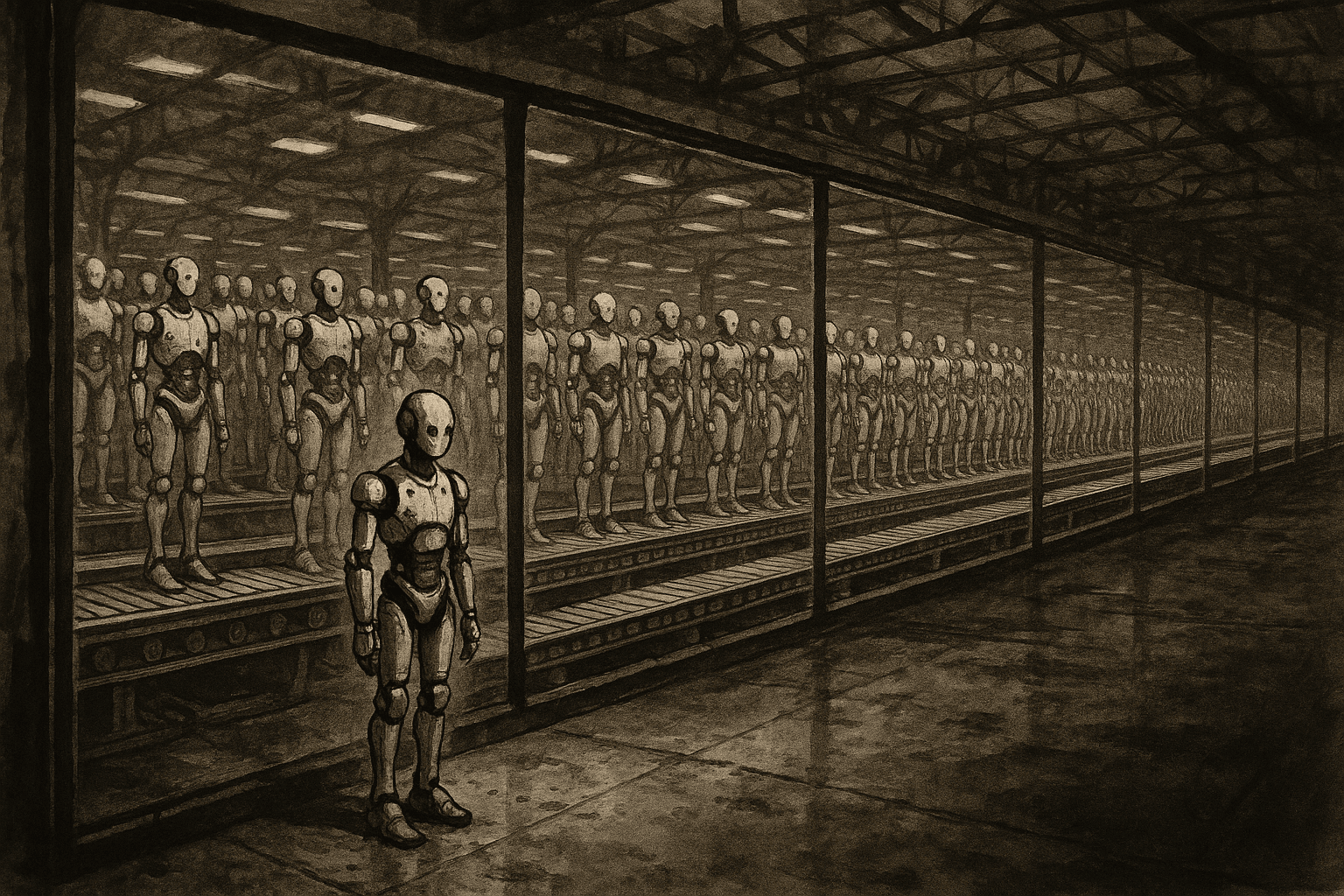
There is something quietly uncomfortable about the fact that Japan, which gave the world Honda's ASIMO, Murata Manufacturing's bicycle-riding Murata Boy, and SoftBank's Pepper - certified by Guinness World Records as the first mass-produced humanoid service robot - is now scrambling to hold its place in the industry it helped invent. The 1st Humanoid Robot EXPO TOKYO Spring, held April 15-17 at Tokyo Big Sight, was billed as a showcase of Japan's next chapter in robotics. In reality, it was something closer to a national reckoning.
What is the gap between Japan and China in humanoid robotics?
The numbers are stark. China's humanoid robot output is projected to surge 94% in 2026, according to a TrendForce report published this month[1]. Unitree Robotics and AgiBot alone are expected to account for nearly 80% of global shipments. Unitree - valued at $1.7 billion after its Series C, with an IPO valuation target of roughly $7 billion on China's STAR market - has committed to annual capacity of 75,000 humanoid robots[1]. AgiBot rolled out its 10,000th general-purpose robot in late March, having scaled from 1,000 units in 2025 to 5,000, then doubled again to 10,000 within three months[1]. These are not demo numbers. They are manufacturing numbers.
Contrast that with Japan's posture. The Kyoto Humanoid Association (KyoHA), launched in July 2025 by Waseda University, tmsuk, and Murata Manufacturing, is still in the prototype phase[2]. Its two robot types - a 250-centimeter disaster-response model capable of lifting 50 kilograms, and a human-scaled research robot with greater agility - were targeted for prototype completion by March 2026. Mass production, the government says, is a 2027 goal[2]. China, by that point, will have spent two years at scale.
Why did Japan fall behind?
Japan's original robotics leadership was built on precision hardware: servo motors, sensors, control systems. That foundation remains real - companies like Renesas Electronics and Sumitomo Heavy Industries have joined KyoHA precisely because their component expertise is valuable[2]. But the shift that mattered happened in software. Rapid advances in multimodal AI and vision-language-action models moved the center of gravity away from mechanical precision and toward data and iteration. China's EV manufacturing boom had quietly built exactly the hardware supply chain - sensors, batteries, actuators - that humanoid robots need, giving Chinese firms a structural advantage that has nothing to do with robotics per se[3].
The structural advantage underlying China's lead has little to do with robotics history. "China has a more robust hardware supply chain - much of it built up through the EV sector - and the world's strongest manufacturing base, allowing companies to iterate far faster than Western competitors," Selina Xu, China and AI policy lead at the office of Eric Schmidt, told TechCrunch[3]. The practical consequence, she added, is that Unitree alone shipped roughly 36 times more units last year than U.S. rivals Figure and Tesla combined. Japan, which does not appear in that tally at all, is caught between two competitors with entirely different structural foundations[3].
"This is Japan's last chance to build robots as a unified effort." - Yoichi Takamoto, Chairman, tmsuk[2]
That quote, from tmsuk's chairman and a founding member of KyoHA, carries the weight of a sector that knows it is running late. It is the kind of thing said not by a confident leader but by one who understands the alternative.
Where Japan still has genuine advantages
Japan's situation is not hopeless - it is just structurally different from what the global narrative assumes. Three forces work in its favor that do not apply equally to China or the United States.
First, the demand context. Japan's working-age population is shrinking at a pace with few global parallels, and stricter overtime regulations introduced in 2024 have sharpened labor shortages in construction, logistics, and healthcare[2]. This creates genuine pull-through demand rather than speculative deployment. Waseda University's AIREC robot - a 150-kilogram humanoid developed under Japan's Moonshot R&D Program, funded by the Japan Science and Technology Agency and built on NVIDIA hardware - is specifically designed for eldercare, including tasks like repositioning bedridden patients[4]. This is not a demo use case. Japan's demographic pressure makes it the world's most urgent real-world testing environment for care robots.
Second, cultural reception. Coral Capital CEO James Riney, who invests in Japanese tech companies, identifies a factor rarely quantified in industry reports: "The widespread cultural view of robots as our friends - more Doraemon than Terminator - drives adoption in ways that policy cannot manufacture[3]." Public comfort with humanoid robots in homes and care facilities is meaningfully higher in Japan than in most Western markets.
Third, component depth. Japan remains dominant in many parts of the robotics supply chain - precision motors, sensors, and control systems - the same upstream position it occupies in semiconductors. The question is whether that upstream strength translates into system-level leadership, or whether Japan becomes a component supplier to Chinese assemblers, much as it did in consumer electronics.
Toyota's CUE7 and the question of national ambition
Toyota's CUE7, unveiled April 12 and demonstrated at the Humanoid Robot EXPO, is a useful case study in Japan's ambitions and their limits. The robot - a basketball-playing humanoid that has lightened from 120 kilograms to 74 kilograms, adopted an inverted two-wheel structure, and now uses a hybrid control system combining reinforcement learning with model predictive control - is genuinely impressive engineering[5]. CUE6 set a Guinness record for the longest basketball shot at 24.55 meters. CUE7 builds on that platform with improved sensing, AI integration, and real-world adaptability.
But CUE7 is a testbed, not a product. Toyota has been explicit that the basketball robot serves as a research platform for vision systems and motion control that could eventually inform broader robotics applications[5]. That framing captures Japan's current predicament neatly: world-class engineering in service of long-term capability building, while Chinese manufacturers are already shipping to automotive factories and logistics warehouses at commercial scale.
The software ceiling nobody wants to talk about
There is one area where China's lead is less clear, and it deserves honest scrutiny. Vision-language-action models - the AI systems that allow humanoid robots to interpret their environment and make decisions - remain genuinely nascent everywhere[3]. Unlike large language models, humanoid robots cannot train on scraped internet data. They require physical interaction data, which is scarce, expensive, and difficult to synthesize convincingly. NVIDIA currently leads the integrated software stack for humanoid control, and most Chinese humanoid startups depend on NVIDIA's Orin chips[3]. That dependency is a meaningful vulnerability.
"Because of the data scarcity problem, humanoids are still far away from autonomy. The hardware is currently ahead of the software," Xu told TechCrunch[3]. The robots that broke down visibly at humanoid marathons earlier this year were a public illustration of that gap. Japan's precision hardware culture, and its access to real-world eldercare deployment data through programs like AIREC, could prove more valuable in closing the software gap than pure manufacturing scale.
What the 2027 target actually means
Japan's government plans to release a formal AI Robotics Strategy in fiscal 2026, with proposed measures including creating early demand in disaster response and infrastructure inspection, and funding a general-purpose humanoid AI prototype by 2030 under the Cabinet Office's Moonshot R&D Program[2]. These are serious institutional commitments. They are also, by the standards of China's current production pace, slow.
The 2027 mass production target is achievable. But the more important question is what market position Japan occupies by then. If Chinese firms have already locked up automotive manufacturing and logistics warehousing - the highest-volume near-term use cases - Japan's window may narrow to the niches it is best suited for: eldercare, disaster response, and precision industrial tasks where reliability matters more than price. Those are not small markets. Japan's demographic crisis alone could sustain a substantial domestic robotics industry.
But the country that invented the humanoid robot as a cultural and engineering aspiration is now in a position where its best near-term strategy may be to specialize rather than compete across the board. For a nation whose robotics identity runs deep, that is a significant adjustment - and the Humanoid Robot EXPO in Tokyo this week was, in its quiet way, the moment that adjustment became undeniable.
Sources
TrendForce: China's Humanoid Robot Output to Surge 94% in 2026; Unitree and AgiBot to Capture Nearly 80% Market Share (April 9, 2026) Inline ↗
Japan Forward: Japan to Mass-Produce Humanoid Robots by 2027 (February 20, 2026) Inline ↗
TechCrunch: Why China's Humanoid Robot Industry Is Winning the Early Market (February 28, 2026) Inline ↗
Interesting Engineering: Toyota's CUE7 Robot Uses Smart Vision and Control to Make Precise Shots (April 13, 2026) Inline ↗
Get this every weekday.
The Omniscient Bulletin: consequential AI, explained and evaluated. 5 to 7 items a day with the take, not the recap.