Industry
The CPU Is Back: How Intel Turned the AI Boom Into Its Own Story
Tips, corrections, or questions? support@omniscient.media
Intel's April 23 earnings report arrived at a peculiar moment for the company: a period when its strategic liabilities - late to GPUs, battered by AMD on x86, and carrying a loss-making foundry - had become so well-documented that any genuine positive surprise carried outsized weight. The quarter delivered that surprise, and then some. What it has not yet delivered is certainty about whether Intel's recovery is structural or situational.
First-quarter revenue came in at $13.6 billion, $1.4 billion above the midpoint of Intel's own guidance and well ahead of the $12.36 billion Wall Street had penciled in.[1][6] Shares climbed more than 16% in after-hours trading before closing up 23.6% in the following session - Intel's best single-day gain since 1987 - and have now posted roughly 210% over the trailing twelve months.[2] The stock crossed a threshold not seen since the dot-com era. None of it was driven by a new product reveal or a surprise acquisition. It was driven by demand for chips Intel has been making for decades.
Why is the CPU suddenly indispensable again?
The central processing unit (CPU) is the general-purpose chip that has underpinned computing since the 1970s - and which spent much of the generative AI boom playing second fiddle to Nvidia's graphics processing units (GPUs), which proved far better suited to training large models in parallel. The reversal happening now is a consequence of where the AI market is in its maturation cycle.
Training frontier models - the work that made GPUs indispensable - is increasingly a fixed cost for a small number of labs. The far larger and faster-growing market is inference: running those models at scale for billions of queries. And inference, it turns out, leans heavily on CPUs. Intel CFO David Zinsner noted on the Q1 earnings call that while training workloads deploy roughly seven or eight GPUs for every CPU, inference deployments run closer to three or four GPUs per CPU.[3] For agentic AI workloads - where models orchestrate tasks, call tools, and reason across long contexts - Zinsner suggested the ratio could reach parity or even flip.
"The CPU now serves as the orchestration layer and critical control plane for the entire AI stack," CEO Lip Bu Tan told investors. "This is not just our wishful thinking; it is what we hear from our customers, and it is evident in the demand profile for our products."[3]
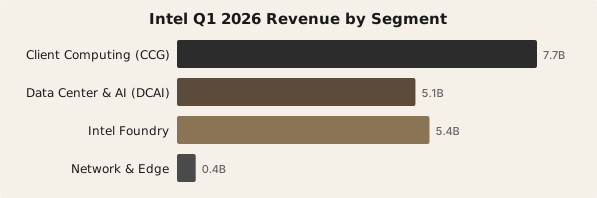
Intel's Data Center and AI (DCAI) segment posted $5.1 billion in Q1 revenue - a 22% year-over-year gain that outpaced analyst estimates of $4.41 billion by nearly $700 million.[1][6] The segment's operating profit reached $1.5 billion, a 31% margin. More telling still: Intel's collective AI-driven businesses now represent 60% of total company revenue and grew 40% year over year, according to Zinsner.[3]
What does Intel's foundry revival mean for AI infrastructure?
The Intel Foundry segment - the division that manufactures chips for external customers, competing with Taiwan's TSMC and South Korea's Samsung - posted $5.4 billion in revenue, up 16% year over year, with its ASIC business nearly doubling.[4][6] External foundry revenue remains modest at $174 million for the quarter, but the deal pipeline has shifted materially.
The headline win came the day before earnings, when Elon Musk confirmed on Tesla's own Q1 call that Tesla would use Intel's next-generation 14A manufacturing process - capable of producing chips with 1.4 nanometer circuits - for its $20 billion TeraFab AI complex in Austin.[5] SpaceX and xAI are also part of the TeraFab consortium.[6] It represents Intel's first major external foundry win on an advanced node from a high-profile customer - the proof point Intel's manufacturing turnaround narrative had been lacking.
Tan was characteristically measured on the earnings call, declining to confirm specific 14A commitments. "My style is underpromise, over delivering," he said. "We have no plans to announce the customer unless a customer wants to announce it."[2] Still, he acknowledged a deep working relationship with Musk: "Elon and I share a strong conviction that global semiconductor supply is not keeping pace with the rapid acceleration in demand."[3]
Intel also disclosed a multi-year strategic agreement with Google for volume server CPU deployments and collaborative custom IPU development - one of several long-term supply contracts, typically spanning three to five years, signed during the quarter.[4][6] In February, the company entered a partnership with AI chip startup SambaNova Systems on heterogeneous compute architectures, and earlier in Q1 it repurchased the 49% stake in its Fab 34 facility in Ireland for $14.2 billion, consolidating full control over a key node in its European manufacturing network.[4][6]
How significant is Intel's comeback compared to its recent struggles?
Context is essential here. The Q1 beat is Intel's sixth consecutive quarter of exceeding financial guidance - but the company still posted a net loss attributable to Intel of roughly $3.7 billion for the quarter - with a total GAAP net loss of $4.3 billion once non-controlling interests are included - and Intel Foundry's operating loss alone accounted for $2.4 billion of the segment-level shortfall.[6] The foundry business is capital-intensive, structurally loss-making, and under enormous pressure to execute on advanced node yields before competitors extend their leads further. Nvidia has begun shipping standalone Grace CPUs at scale - Meta was among the first hyperscalers to deploy them in production - with server-grade standalone CPU products under the Vera brand planned for broader availability, adding a new competitive dimension in a market Intel has long dominated. AMD continues to take x86 market share. ARM-architecture server chips are proliferating across cloud hyperscalers.
CFO Zinsner flagged several near-term headwinds on the call: rising costs for memory, wafers, and substrates that "could impact demand at some point in the year"; an expected double-digit decline in full-year PC unit volumes; and operating expenses running above the prior $16 billion target due to inflation and variable compensation.[3] Intel is guiding Q2 revenue of $13.8 to $14.8 billion - the midpoint implies sequential growth, but non-GAAP gross margin is expected to compress to around 39% from Q1's 41% non-GAAP figure - with GAAP gross margin guided even lower, at 37.5%.[6]
Supply, not demand, is now Intel's binding constraint - a problem most companies would prefer to the alternative. "Q1 revenue would have been meaningfully higher, but demand continues to outpace our growing supply," Zinsner said.[3] Tan put it more bluntly: "A year ago the conversation around Intel was about whether we could survive. Today it's about how quickly we can add manufacturing capacity and scale our supply to meet enormous demand for our products."[2]
What this tells us about the broader AI chip market
Intel's quarter is significant not just as a corporate turnaround story but as a signal about the shape of AI infrastructure investment. The buildout is entering a phase where inference and orchestration workloads are scaling faster than training - and that shift structurally advantages general-purpose silicon over specialized accelerators. Nvidia's dominance is not under threat; its GPU revenue continues to grow at extraordinary rates. But the winner-take-all framing of the past few years - one chip type to rule all AI workloads - is giving way to something more heterogeneous.
For Intel, the question has always been whether its turnaround was driven by genuine competitive recovery or simply by a rising tide lifting all semiconductor boats. The answer, based on Q1 evidence, is probably both - and that may be sufficient for now. Tan invoked Andy Grove's famous "only the paranoid survive" doctrine in his opening remarks, signaling a cultural reset toward the engineering-first discipline that made Intel dominant in the first place.[2] Whether that ethos translates into 14A yields, foundry profitability, and sustained CPU market share over the next eighteen months will determine whether this quarter was an inflection point or a strong print on a still-fragile recovery.
"Intel is now a very different company than when I first joined over a year ago. We have taken, and continue to take, deliberate steps to rebuild Intel into a more competitive and more profitable company." - Lip Bu Tan, Intel CEO, Q1 2026 Earnings Call
Sources
Intel Newsroom: Intel Reports First-Quarter 2026 Financial Results (April 23, 2026) Inline ↗
Intel CEO Lip Bu Tan crushed earnings targets on 1-year anniversary - Fortune Inline ↗
Intel (INTC) Q1 2026 Earnings Call Transcript - Motley Fool via The Globe and Mail Inline ↗
Strong data center growth helps Intel post Q1 revenue of $13.6bn - Data Center Dynamics Inline ↗
TechCrunch: Intel signs on to Elon Musk's Terafab chips project (April 7, 2026) Inline ↗
Intel Reports First-Quarter 2026 Financial Results - Intel Corporation (Official Press Release) Inline ↗
Get this every weekday.
The Omniscient Bulletin: consequential AI, explained and evaluated. 5 to 7 items a day with the take, not the recap.