AI Policy
America Is Winning the AI Race While Dismantling the Conditions That Made It Possible
Tips, corrections, or questions? support@omniscient.media
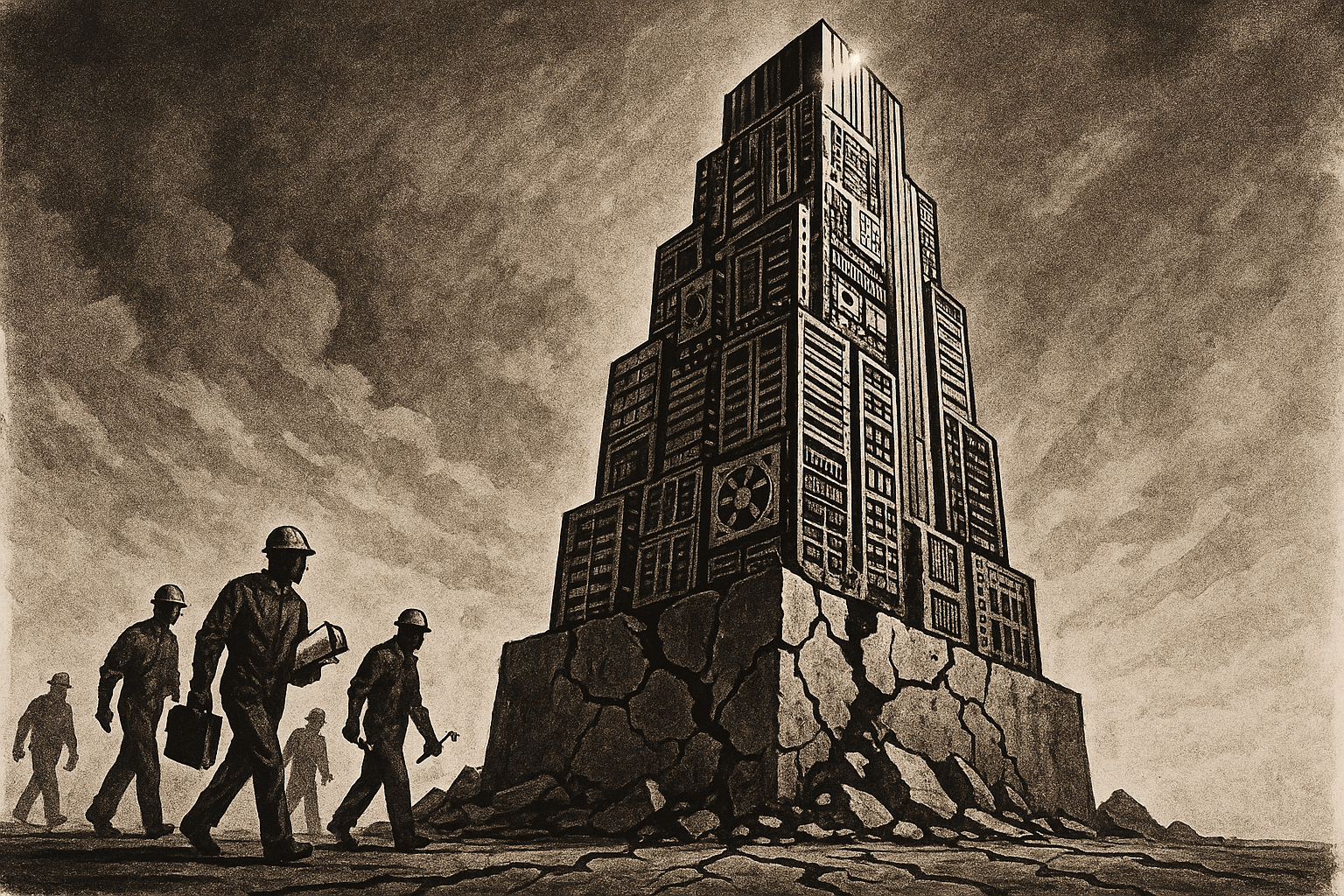
When the Stanford Institute for Human-Centered AI released its annual AI Index this month, the headline that traveled fastest was the narrowing of the U.S.-China model gap: Anthropic's top model leads its nearest Chinese counterpart by just 2.7 percentage points as of March 2026, down from a substantial double-digit lead in mid-2023, when GPT-4 and the top Chinese models were separated by hundreds of Arena Elo points.[1] That compression is striking on its own. But the more unsettling finding runs in the opposite direction: not how close China has come, but how much of the foundation for American AI leadership is quietly eroding.
What does the money actually buy?
U.S. private AI investment reached $285.9 billion in 2025, a figure 23 times larger than China's $12.4 billion.[2] By that measure, the United States should be lapping the field. Instead, performance rankings between U.S. and Chinese models have traded places multiple times since early 2025. DeepSeek-R1 briefly matched the top American model in February of that year, and the trajectory since suggests continued convergence rather than divergence.[1]
The investment gap is real, but it is also misleading in isolation. China supplements private capital with government guidance funds that direct resources strategically across sectors; those funds deployed an estimated $184 billion into Chinese AI firms between 2000 and 2023, a figure the report notes likely understates Beijing's true AI commitment given that the funds' total deployment across all industries runs far higher.[2] And on measures where raw spending matters less than institutional depth: publication volume, patent output, citations, industrial robot installations - China now leads the United States outright.[3] Capital can compress timelines; it cannot substitute for scientific infrastructure built over decades.
The talent signal that should be alarming everyone
The most consequential number in the 2026 report may not be a model benchmark score. The annual inflow of AI scholars into the United States has contracted 89 percent since 2017, and the pace of that contraction has accelerated sharply, with roughly four-fifths of the total decline concentrated in the past twelve months.[3] The United States still hosts the largest concentration of AI researchers of any country. But that stock is a legacy asset. The flow - the new researchers arriving to extend and renew it - has nearly stopped.
This is not an abstract concern about future competitiveness. Frontier model development is intensely talent-concentrated. The teams building the most capable systems are small, and the marginal value of an additional world-class researcher is enormous. If that pool stops refreshing itself through immigration, the compounding advantage the U.S. has accumulated over two decades begins to decay: slowly at first, then faster than the investment figures alone would predict.
The United States is spending 23 times more than China on AI while running an 89 percent deficit in the talent pipeline that makes that spending productive.
What policy has - and has not - done
The talent decline does not have a single cause, but it has specific accelerants that are matters of deliberate policy choice. In September 2025, the Trump administration introduced a $100,000 fee on new H-1B visa petitions - the primary pathway through which U.S. AI labs hire skilled researchers from abroad.[5] The fee is effectively prohibitive for startups and research institutions, which cannot absorb per-hire costs that large technology companies treat as rounding errors. Y Combinator CEO Gary Tan said at the time that the fee "won't bother big tech" but would "kneecap startups." The predictable consequence is twofold: concentration of AI talent within a handful of incumbent firms, and redirection of that same talent toward competing hubs in Canada, the UK, and Europe.[5]
Simultaneously, the administration has dismantled the institutional infrastructure that gave U.S. AI leadership its credibility abroad. The U.S. AI Safety Institute (AISI), created in late 2023 to develop safety standards and conduct model evaluations in partnership with OpenAI, Anthropic, Google, Meta, and Apple, was gutted by DOGE-directed layoffs in February 2025 - most of its staff were still on probation and therefore easy targets for probationary dismissals.[6] By June, what remained was rebranded as the Center for AI Standards and Innovation (CAISI), with its mandate reoriented toward commercial competitiveness and voluntary industry guidelines, and its focus on bias, disinformation, and broader societal risks largely excised.[7] Commerce Secretary Howard Lutnick framed the change as liberating innovators from regulatory constraint. What it also removed was the only U.S. government body with the technical depth to evaluate frontier models before deployment - a function China's government, notably, has not abandoned in its own AI governance framework.
Export controls on advanced semiconductors have produced a more contested strategic picture. Restrictions on Nvidia chip sales to China, tightened progressively since 2022, were designed to widen the hardware gap between U.S. and Chinese AI development. On one reading, they are working: a December 2025 analysis by CFR Senior Fellow Chris McGuire found that Huawei's best chips are currently five times weaker than Nvidia's by total processing performance, that gap will widen to seventeen times by 2027, and Huawei's next-generation chip will actually be less powerful than its current best - suggesting SMIC has hit a fabrication ceiling it cannot break through at 7nm.[8] Even under the most aggressive production assumptions, Huawei would account for roughly 5 percent of Nvidia's aggregate AI computing output in 2025, falling to 2 percent by 2027. On another reading, the controls have produced an unintended industrial policy for China: manufacturers are on track to triple domestic AI chip output, DeepSeek's efficiency-first architecture has become a software-hardware co-design standard that Huawei, Cambricon, and others are building toward, and the strategic pressure to achieve self-sufficiency has intensified rather than abated.[9] Whether the controls ultimately widen or narrow the gap depends on whether SMIC can break through its fabrication ceiling - a question the evidence does not yet settle.
Capability gains that the index cannot fully explain
Against this backdrop, the capability advances documented in the report are remarkable. On OSWorld, the benchmark the report uses to track agents completing real computer tasks across operating systems, accuracy rose from roughly 12 percent in 2024 to 66.3 percent - within six percentage points of human performance. On Cybench, which tests agents against professional-level cybersecurity challenges, the solve rate reached 93 percent, up from approximately 17.5 percent when the benchmark launched in 2024.[1] Frontier models now meet or exceed human performance on PhD-level science questions, AIME competition mathematics, and multimodal reasoning tasks.[1]
These gains are real and significant. But they are also the product of investment cycles and research directions set several years ago, when the talent pipeline was fuller and the geopolitical context was different. The question the index implicitly raises - but stops short of answering - is how much of today's capability growth is consuming accumulated advantage rather than building new foundations.
The labor displacement that is already underway
The age-stratified employment data in the report's economy chapter is particularly stark: software developers between 22 and 25 have seen their ranks thin by nearly 20 percent from 2024, while colleagues a decade older have been largely unaffected.[2] The same pattern holds in customer service and other occupations where AI exposure is high. Employer surveys compound the picture: one-third of respondents expected to reduce headcount over the coming year, with anticipated cuts running ahead of reductions already made.
This creates a compounding problem that the investment figures obscure. The U.S. is simultaneously importing less talent from abroad and producing fewer entry-level practitioners at home, as AI automates away the junior roles through which domestic talent has historically developed. The workforce disruption, the report notes carefully, "is targeted and just beginning."[2]
What the numbers add up to
The 2026 AI Index is, on its surface, a record of extraordinary progress. Global corporate AI investment hit $581.7 billion in 2025, up 130 percent from the prior year.[2] Generative AI reached 53 percent population adoption in three years, faster than the personal computer or the internet.[2] AI is running weather forecasting pipelines end-to-end, accelerating drug discovery, and reducing physician documentation burden by up to 83 percent in some hospital systems.[4]
But the same report documents a country spending record sums on AI while the scientific talent that built the field is choosing to go elsewhere, while the junior workforce that would carry it forward is being displaced before it forms, and while the models it produces are converging toward parity with rivals spending a fraction as much. Three specific policy choices - a punishing visa fee, the dismantling of the government's only frontier model evaluation body, and export controls whose long-term strategic effect remains genuinely uncertain - sit alongside those trends not as coincidences but as causes or compounding factors. The U.S. may still be winning. The more probing question is whether anyone in a position to shape that trajectory is paying attention.
Sources
Stanford HAI: 2026 AI Index Report - Technical Performance Inline ↗
Stanford HAI: 2026 AI Index Report - Research and Development Inline ↗
Fortune: Trump's $100,000 H-1B fee rattles Silicon Valley and threatens AI startups (September 2025) Inline ↗
Fortune: AI safety advocates slam Trump administration's targeting of NIST/AISI (February 2025) Inline ↗
Nextgov/FCW: Commerce rebrands its AI Safety Institute as CAISI (June 2025) Inline ↗
CFR: China's AI Chip Deficit - Why Huawei Can't Catch Nvidia and U.S. Export Controls Should Remain (December 2025) Inline ↗
Mexico Business News / Financial Times: China to triple AI chip output amid U.S. export controls (August 2025) Inline ↗
Get this every weekday.
The Omniscient Bulletin: consequential AI, explained and evaluated. 5 to 7 items a day with the take, not the recap.