AI Policy
Vol. 1·Tuesday, March 31, 2026
The Missing Rung: AI Is Eliminating the Entry-Level Job, and the Consequences Will Compound
Noah Ogbi9 min read
Tips, corrections, or questions? support@omniscient.media

Tips, corrections, or questions? support@omniscient.media
Get this every weekday.
The Omniscient Bulletin: consequential AI, explained and evaluated. 5 to 7 items a day with the take, not the recap.
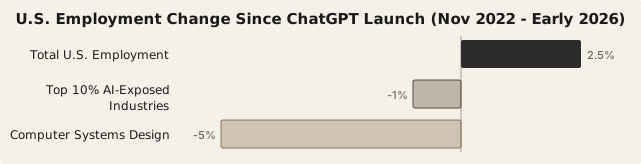
Total U.S. employment has grown approximately 2.5 percent since ChatGPT's release in late 2022.[1] In the computer systems design sector, it has fallen 5 percent over the same period.[1] Across the top 10 percent of AI-exposed industries, employment is down 1 percent.[1] These numbers look modest in aggregate. But they are not evenly distributed, and that unevenness is the story.
Workers aged 22 to 25 in the most AI-exposed occupations have experienced a 16 percent relative employment decline since 2022, according to Stanford University researchers using payroll data from 25 million workers.[2] Employment for older workers in those same fields has held steady or grown. The mechanism is not mass layoffs - it is something quieter and harder to reverse. Young workers are simply failing to find their way in. The job-finding rate for labor market entrants in high-AI-exposure occupations has declined by more than 3 percentage points since its peak in late 2023, while the equivalent rate for entrants in low-exposure fields has held flat.[2]
In practical terms: a computer science graduate today is not being fired. They are not being hired in the first place.
The labor market in AI-exposed fields is producing something that standard substitution theory cannot easily explain: wages rising while employment falls. If AI were simply replacing workers wholesale, you would expect both to decline together. Instead, nominal weekly wages in computer systems design have grown 16.7 percent since late 2022 - more than double the national average of 7.5 percent[1] - while the sector sheds jobs. The resolution to this paradox lies in who, specifically, is being displaced.
The distinction that matters is between codified knowledge - the kind learned from textbooks and replicated accurately by AI - and tacit knowledge, the judgment built through years of doing.[1] For a junior analyst, data scientist, or software developer, codified tasks are the skilled part of the job: writing boilerplate code, summarizing documents, running standard analyses. For a senior engineer or experienced attorney, those same tasks are the routine part - the grunt work they can now hand off, freeing time for higher-judgment work. AI is simultaneously substituting for junior workers and augmenting senior ones. The wage premium accrues to those who already have the tacit knowledge; the employment loss falls on those who have not yet had the chance to acquire it.
But this framework carries an assumption worth interrogating: that tacit knowledge remains AI-resistant indefinitely. The Anthropic data on computer programmers - who have already reached 75 percent observed task coverage[3] - introduces real tension here. Programmers are among the occupations with the steepest experience premiums, yet AI has already automated three-quarters of their observable task load. If the codified/tacit boundary is itself moving, the window during which senior workers retain their augmentation advantage may be narrower than the current wage data suggests.
The most clarifying number in Anthropic's March 2026 labor market research is not a displacement figure - it is a distance measurement.[3] The paper introduces a metric called observed exposure: the share of an occupation's tasks that AI is not merely capable of performing, but is actively performing in automated, work-related workflows. For computer and mathematical occupations, the theoretical ceiling is 94 percent of tasks. The current floor is approximately 33 percent.[3] That 61-point gap is the territory AI has yet to cross - and the direction of movement tells you everything about where it is heading.
The gap matters because it reframes the debate. Skeptics of AI displacement have correctly noted that theoretical capability has historically outrun actual adoption; the same task-based exposure models that flagged a quarter of U.S. jobs as vulnerable to offshoring a decade ago proved largely wrong.[3] Anthropic's observed exposure metric is designed precisely to address this critique - it measures what is actually happening in live workflows, not what is theoretically possible. That 33 percent is not a ceiling; it is a starting point with documented upward momentum. Among individual occupations, computer programmers have already reached 75 percent observed task coverage,[3] suggesting that for at least some roles, the gap between capability and deployment has effectively closed.
The direction of traffic confirms the trend. Coding tasks are migrating out of Claude.ai - where humans use AI as an assistant - and into first-party API workflows, where AI operates with minimal human input.[4] The share of computer and mathematical tasks in API traffic rose 14 percent between August 2025 and February 2026, while the equivalent share in Claude.ai fell 18 percent over the same period.[4] The significance is architectural: consumer usage reflects augmentation; API usage reflects automation. The same work is being reclassified from a tool that helps people to a system that replaces the need for them.
In late February 2026, Jack Dorsey announced that Block, the payments company he leads, would cut more than 4,000 employees - roughly 40 percent of its workforce - explicitly citing AI as the enabling force.[5] Shares surged roughly 24 percent in after-hours trading on the announcement.[5] The market's interpretation was clear: a company capable of doing the same work with 40 percent fewer people is a more valuable company.
Block's case is not isolated. The economics are the same across the knowledge economy: AI tools are most cost-effective when they replace the structured, learnable work traditionally assigned to junior staff. The hiring freeze at the bottom of the org chart does not show up as a layoff statistic. It shows up, eventually, as a shortage of experienced talent - because there is no longer a pipeline to produce it.
This is the structural problem that aggregate employment figures obscure. White-collar career development in the U.S. has, for decades, followed a specific pattern: graduates take entry-level jobs, perform codified tasks, and accumulate the tacit knowledge that eventually makes them valuable senior employees. That model is predicated on firms finding it cost-effective to hire and train junior workers. As the Dallas Fed's Davis notes, AI is making that calculation "cost-ineffective, at least in the short run."[1]
The long-run implication is one the current moment has not yet priced in. If the cohort entering the labor market today in computer science, data analysis, legal research, and financial services cannot accumulate experience, the supply of capable senior talent in those fields will contract sharply in roughly a decade. The productivity gains captured now by replacing junior workers with AI tools may be partially offset by future shortages of the experienced professionals AI cannot replace. The firms eliminating entry-level positions are, in effect, borrowing against the future workforce they will need.
There is an additional distributional concern embedded in Anthropic's labor market data. The workers most exposed to AI displacement are disproportionately female, more educated, and higher-paid - the demographic profile that benefited most from the knowledge economy's expansion over the past thirty years.[3] The sector that represented upward mobility for many of those workers is now the sector where entry is hardest.
The Dallas Fed is careful to note that current aggregate effects remain small - the employment decline among highly AI-exposed young workers accounts for roughly 0.1 percentage points of the overall unemployment rate.[2] The structural concern is not today's unemployment numbers. It is the trend line and its direction.
Anthropic's own research concedes that "leaving new employees off the job ladder is not sustainable in the long run," and that AI adoption will require "rethinking how entry-level employees gain experience on the job."[1] What that rethinking looks like in practice - apprenticeships restructured around AI oversight, synthetic experience through simulation, new credentialing models - remains largely unaddressed by either industry or policymakers. The ladder has been pulled up. No one has yet agreed on what to put in its place.
Dallas Fed: "AI is simultaneously aiding and replacing workers, wage data suggest" - Scott Davis, Feb. 24, 2026 Inline ↗
Dallas Fed: "Young workers' employment drops in occupations with high AI exposure" - Atkinson & Yamco, Jan. 6, 2026 Inline ↗
Anthropic: "Labor market impacts of AI: A new measure and early evidence," Mar. 5, 2026 Inline ↗
Anthropic Economic Index: "Learning curves," Mar. 24, 2026 Inline ↗
AP News: "Fintech company Block lays off more than 4,000 people, citing AI" Inline ↗