AI Policy
Vol. 1·Sunday, May 3, 2026
The $1 Million Server: How Washington Finally Made Its Chip Embargo Hurt
Noah Ogbi7 min read
Tips, corrections, or questions? support@omniscient.media
Tips, corrections, or questions? support@omniscient.media
Get this every weekday.
The Omniscient Bulletin: consequential AI, explained and evaluated. 5 to 7 items a day with the take, not the recap.
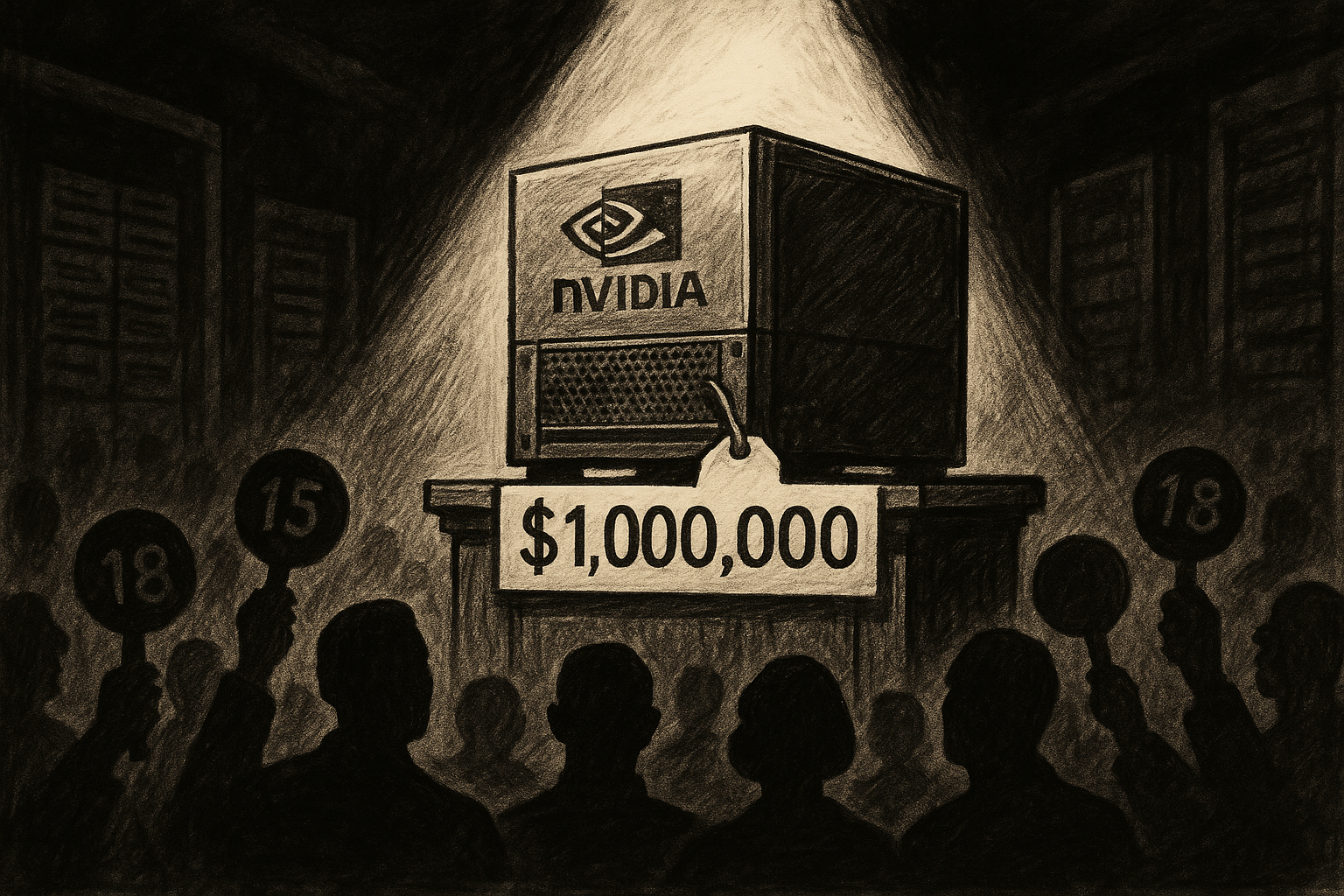
The gap between U.S. export control policy and its practical effect on China's AI hardware access has been the defining tension of technology competition since October 2022. For most of that period, the gap was wide. The B300 server market offers the clearest measure of when it began to close: prices in China have reached roughly 7 million yuan - around $1 million per unit - compared with a U.S. list price of approximately $550,000, a premium that did not exist at the same scale a year ago.[1]
The inflection point was not a new regulation. It was an arrest.
On March 19, 2026, federal agents took Yih-Shyan "Wally" Liaw, 71, into custody at a Northern California courthouse. Liaw is a co-founder of Super Micro Computer - the San Jose server manufacturer that assembles a substantial share of the world's Nvidia-powered AI infrastructure. Alongside him, prosecutors unsealed an indictment charging him with conspiring to divert $2.5 billion in Supermicro servers to Chinese buyers between 2024 and 2025, in violation of U.S. export control laws.[2]
The mechanics of the alleged scheme were elaborate. According to the Department of Justice, Liaw and Supermicro's Taiwan general manager Ruei-Tsang "Steven" Chang directed executives at an unnamed Southeast Asian company to place purchase orders as if it were the end user. Servers assembled in the U.S. would ship to Supermicro's Taiwan facilities, then on to the Southeast Asian intermediary - which would repackage them in unmarked boxes before forwarding them to China. To keep auditors at bay, the defendants allegedly staged thousands of dummy servers - non-functional physical replicas - in warehouses, going so far as to use a hair dryer to loosen and reapply serial-number stickers from real units onto the replicas before government inspectors arrived.[2]
Between late April and mid-May 2025 alone, prosecutors allege, roughly $510 million in servers assembled in the United States were shipped to China under this arrangement. Liaw and co-defendant Ting-Wei "Willy" Sun have pleaded not guilty; Chang remains a fugitive.[3] Supermicro, which is not named as a defendant, said it is cooperating with investigators; Liaw resigned from the board the following day. Its stock fell roughly 12% in after-hours trading when the indictment was unsealed.
The smuggling operation Liaw allegedly ran was not an isolated anomaly - it was an infrastructure. Brokers, logistics companies, and Southeast Asian pass-through entities had built a functioning parallel supply chain precisely because the official one was closed. When the DOJ unsealed the indictment and made the scale of enforcement visible, every participant in that network faced a new calculation: the U.S. government was actively watching, had surveillance footage, and was prepared to prosecute co-founders of publicly traded companies.
The effect on grey-market supply appears to have been immediate. B300 rental prices in China have climbed to as high as 190,000 yuan per month on short-term contracts, a figure that reflects genuine scarcity rather than speculative pricing.[1] Chinese technology companies are structuring deals specifically to avoid holding Nvidia hardware directly on their balance sheets, fearing sanctions exposure. The premium they are now paying to access restricted compute is, in their own calculus, still cheaper than falling behind on AI inference economics.
The B300 scarcity compounds a separate restriction that preceded it. On April 9, 2025, the U.S. government informed Nvidia that it required a license to export its H20 chips to China - the GPU Nvidia had specifically engineered to satisfy prior export control thresholds.[4] The H20 was the only Nvidia chip Chinese companies could legally purchase; its restriction eliminated compliant access to new Nvidia hardware entirely. Nvidia took a $4.5 billion charge in Q1 FY2026 on stranded H20 inventory and purchase obligations as a direct result.[4]
The logic behind the H20 restriction was partly informed by DeepSeek: multiple government officials had cited evidence that the H20 was used in training DeepSeek's R1 reasoning model, which rattled U.S. AI markets when it launched in January 2025. Closing the H20 window was, in part, an attempt to prevent a repeat.
Together, the two actions - H20 licensing requirement and the collapse of the B300 grey market - have produced a situation where Chinese AI companies face no legal path to new Nvidia hardware and a dramatically more expensive and risky illegal one. Domestic Chinese AI accelerators remain competitive for some inference workloads but are not yet regarded as peers to Nvidia's highest-end systems for frontier training runs.
The policy environment is tightening further. On April 22, the House Foreign Affairs Committee advanced the MATCH Act - described by lawmakers as the largest semiconductor export control markup in congressional history.[5] The bipartisan bill would require the Netherlands and Japan to align their chip equipment restrictions with U.S. rules, which would effectively cut off ASML's remaining sales of deep ultraviolet lithography machines to Chinese chipmakers and ban the servicing of equipment already installed in China. China's Ministry of Commerce has warned that the legislation would "severely disrupt" global supply chains.
If enacted, the MATCH Act would constrain not just China's access to finished AI chips but its ability to manufacture competitive chips domestically - closing the longer-term escape route that Chinese policymakers have been investing in for years.
A $1 million server price is not a supply-demand equilibrium settling toward some natural clearing level. It is a rationing price set by desperation - what happens when buyers with no legal options and degraded illegal ones still need the hardware to compete. The premium tells you less about Nvidia's pricing power than it does about how Chinese AI companies have internally priced the risk of falling behind.
For U.S. policymakers, the price surge is a perverse form of validation: the controls are finally biting. The Supermicro indictment is the most significant enforcement action yet under the export control regime that has been tightening since October 2022, and its deterrent effect on grey-market intermediaries appears to be real and measurable. Whether that deterrent holds - or whether new smuggling pipelines emerge over time - is the test that will define the practical ceiling of export control policy as a tool of great-power competition.
TNW: Nvidia B300 servers sell for $1 million in China, nearly double the US price (April 30, 2026) Inline ↗
U.S. Department of Justice: Three Charged with Conspiring to Unlawfully Divert U.S. AI Technology to China (March 19, 2026) Inline ↗
Fortune: Supermicro's cofounder was just arrested for allegedly smuggling $2.5 billion in GPUs to China (March 19, 2026) Inline ↗
Nvidia Newsroom: NVIDIA Announces Financial Results for First Quarter Fiscal 2026 (May 28, 2025) Inline ↗
TechWire Asia: MATCH Act Clears Committee: Toughest Semiconductor Export Controls Yet (April 2026) Inline ↗