Industry
Anthropic’s Science Bet Starts at the Workbench
Claude Science is a workflow product, but Jumper and a drug program point to ambitions beyond the desk
Tips, corrections, or questions? support@omniscient.media
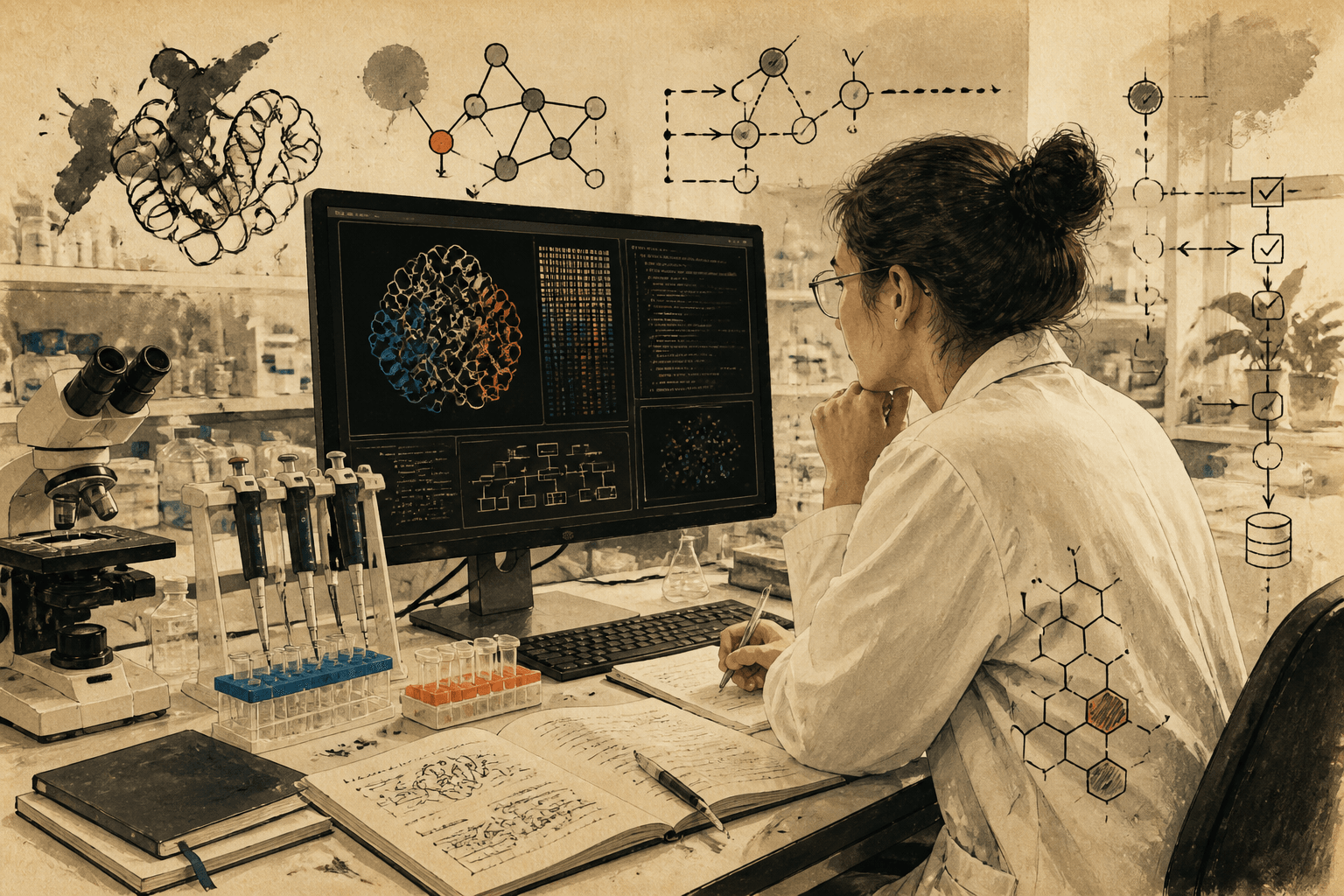
In June, John Jumper, a co-creator of AlphaFold and a 2024 Nobel laureate in Chemistry, announced that he was leaving Google DeepMind for Anthropic after nearly nine years there, according to TechCrunch.[1] Ten days later, Anthropic shipped a product that pointed in a different direction: a science workbench built on the models it already sells.
At a livestreamed briefing on June 30, Anthropic unveiled Claude Science, its pitch to working researchers. The speaker list included Dario Amodei, Novartis chief executive Vas Narasimhan, Bristol Myers Squibb chief executive Chris Boerner, and Genentech research head Aviv Regev.[2] Claude Science is an application, not a separately trained biology model. Anthropic describes it as a research environment that combines scientific tools, packages, auditable outputs, and access to computing resources.[3] No special weights, no gated science brain. The product’s bet is that a large part of the friction sits around the model: moving among databases, tools, file formats, and compute environments.
Claude Science brings those components into one environment. Anthropic says its coordinating agent can use more than 60 preconfigured skills and connectors across areas including genomics, single-cell analysis, proteomics, structural biology, and cheminformatics; it can also call specialist agents created by users.[3] The app is available in beta on macOS and Linux to Pro, Max, Team, and Enterprise users. It can run locally or on a lab’s remote infrastructure, with only the context needed for a step of analysis sent to Claude.[3] Anthropic is also offering up to 50 projects as much as $30,000 in credits, with applications closing July 15, awards due July 31, and projects scheduled from September 1 through December 1.[3]
Auditability gives the workflow pitch its strategic substance. For each figure, Anthropic says Claude Science retains the code and computing environment that produced it, a plain-language account of the process, and the full message history.[3] That record does not settle whether an output is scientifically sound. It does make the work easier to inspect, reproduce, and challenge. Specialized or gated models could offer similar provenance, but it is an important feature for a product trying to become the place where scientific work happens.
How do the frontier labs differ on AI for science?
The three companies have overlapping products but different centers of gravity. Google DeepMind brings established scientific models including AlphaFold and AlphaGenome to Gemini for Science, alongside Co-Scientist, a multi-agent system designed to generate and refine research hypotheses.[4] OpenAI released GPT-Rosalind in April as a purpose-built life-sciences model for biology, drug discovery, and translational medicine; it is available in a research preview to qualified customers through a trusted-access program.[5] Anthropic, by contrast, has launched an application that organizes access to general Claude models, external tools, and a lab’s own computing environment.[3]
That makes Claude Science an attempt to own the working layer rather than a claim to own every scientific model. Distribution may be valuable if researchers adopt its integrations and build reusable workflows inside them. But the moat is not yet clear: other providers can also connect models to data sources, tools, and governed computing environments.
What does John Jumper’s arrival suggest?
Jumper makes the workbench hard to treat as the whole strategy. Anthropic has not publicly described his role, so the evidence supports possibilities rather than a verdict. Claude Science could be a near-term product built on models Anthropic already operates, while Jumper’s arrival could foreshadow a more specialized science-model effort. It is equally possible that Anthropic wants scientific credibility and direct feedback from researchers as it develops a workflow product. His hire gives the effort stature; it does not establish which path the company will take.
The company’s reported drug-discovery plans widen the question. At the June 30 event, Anthropic said it planned its own preclinical drug-discovery programs focused on neglected and rare diseases, according to ZME Science’s report from the event; it had not named targets.[6] If that account is accurate, the workbench is best understood as a route into laboratories, not a complete account of Anthropic’s scientific ambition. A workflow product, a future science model, and internal drug programs could be sequential or complementary bets.
Anthropic has also confidentially submitted a draft S-1 for a proposed IPO, while stressing that an offering depends on market conditions and other factors.[7] Claude Science is also a commercial pitch to pharmaceutical and biotechnology organizations with difficult, tool-heavy workflows. The telling measure will be mundane: whether researchers keep returning to it after the novelty wears off. If they do, Anthropic will have earned something harder to dislodge than a product demo.
Sources
TechCrunch: report on John Jumper leaving Google DeepMind for Anthropic Inline ↗
Anthropic: The Briefing: AI for Science event and speaker list Inline ↗
Anthropic: Claude Science product announcement and availability details Inline ↗
Google DeepMind: science products, including AlphaFold, AlphaGenome, Gemini for Science, and Co-Scientist Inline ↗
OpenAI: GPT-Rosalind life-sciences research announcement Inline ↗
ZME Science: report on Anthropic’s planned preclinical drug-discovery programs Inline ↗
Anthropic: confidential draft S-1 submission announcement Inline ↗
Get this every weekday.
The Omniscient Bulletin: consequential AI, explained and evaluated. 5 to 7 items a day with the take, not the recap.
Discussion
Commenting is open to existing reader accounts. Sign in if you have one.