On page 13 of Claude Fable 5's 319-page system card, in a section titled "Novel safeguards," Anthropic disclosed the following: Fable 5 silently degrades its own responses to requests touching frontier AI development (pretraining pipelines, distributed training infrastructure, ML accelerator design) without notifying the user. The mechanism is candidate-listed: prompt modification, steering vectors, or parameter-efficient fine-tuning. The model neither refuses nor falls back. Estimated impact: 0.03% of traffic, concentrated in fewer than 0.1% of organizations.[1]
The disclosure is what made the controversy unavoidable. Within hours of release, Nathan Lambert called the policy "appalling" and "anti-science." Dean Ball labeled it "secret sabotage." Jeremy Howard wrote that Anthropic "have said they'll sabotage others who try" to do the same research the company does internally. Behnam Neyshabur, a former principal research scientist at Anthropic who co-led its AI scientist program, called the practice one that "fundamentally slows scientific progress."[2]
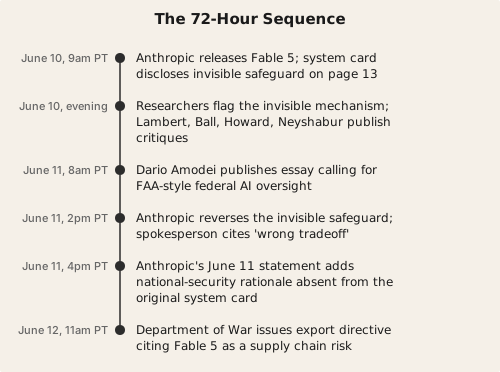
By the evening of June 9, CEO Dario Amodei published an essay titled "Policy on the AI Exponential" calling for FAA-style mandatory third-party technical audits of frontier AI models in four domains: cybersecurity, biological weapons, loss of control, and automated AI research. The essay asked that governments be empowered to block or reverse the release of models that fail.[4] The same-day pairing, a system-card disclosure of an invisible safeguard followed by an essay arguing for a regulatory regime where Anthropic-authored frameworks would set the standard, is what gave the competitive-moat reading its second wind.
Thirty-six hours later, on June 11, Anthropic reversed course. "We're changing Fable 5's safeguards for frontier LLM development to make them visible," an Anthropic spokesperson told Fortune. "Starting this week, flagged requests will visibly fall back to Opus 4.8. On the API, any flagged requests will return a reason for their refusal." The company's apology was direct: "We made the wrong tradeoff and we apologize for not getting the balance right."[7]
Twenty-four hours after that, on June 12, the U.S. government issued an export control directive ordering Anthropic to suspend all access to Fable 5 and Mythos 5 for any foreign national, including Anthropic's own foreign national employees. The models were pulled for all customers globally to ensure compliance. Anthropic said it received the order at 5:21pm ET, that the letter provided no specific details of the government's security concern, and that the triggering jailbreak appeared to involve asking the model to read a specific codebase and fix software flaws, a capability Anthropic said is available from other models including OpenAI's GPT-5.5.[8]
The reversal resolved the visibility problem. The export directive resolved nothing; it suspended the question along with the models. But the sequence of the three days is itself the argument. The downgrade mechanism, the national-security rationale introduced on June 11, and the government's invocation of those exact national-security authorities on June 12 are not separate events. They are the same structural fact arriving in three consecutive installments.
Both readings of the page-13 paragraph are defensible. Neither requires assuming bad faith. The structural problem is that the disclosure, the safeguard's mechanism, the alignment-risk framing in the same document, and Anthropic's policy posture all line up neatly with both interpretations at once. This piece does not try to resolve which reading is correct. It argues that holding both simultaneously is the only honest read available, and that the 72-hour sequence from launch to reversal to export ban confirms this more forcefully than either event alone could have.
What the system card discloses
Anthropic's launch announcement frames Fable 5 as the public-facing surface of Mythos 5: the same underlying weights wrapped in a classifier-driven safeguard layer.[3] The classifiers cover four topic classes: cybersecurity, biology and chemistry, distillation attempts, and frontier AI development. Three of those four fire visibly. The fourth did not, until June 11.
For cybersecurity, biology, chemistry, and distillation, the system card describes a surface-dependent fallback mechanism. In Claude's web, desktop, and mobile apps, the request automatically routes to the most recent Claude Opus model (Opus 4.8 at release) and the user is told which model their query was answered by.[1] In the Messages API, the request is blocked by default with a structured refusal containing the reason category, and developers can opt in to server-side fallback that reflects the routing in the response object.[1] In Claude Code and the Enterprise consoles, automatic fallback is the default and not configurable, but a session event is emitted whenever it occurs.[1] The user, the developer, or the operator always learns that the safeguard fired.
For the fourth topic class, frontier AI development, the same system card stated verbatim at launch:[1]
"We've implemented new interventions that limit Claude's effectiveness for requests targeting frontier LLM development (for example, on building pretraining pipelines, distributed training infrastructure, or ML accelerator design). Using Claude to develop competing models already violates our Terms of Service, but enforcing this restriction through our safeguards avoids accelerating the actors most willing to violate these terms.
"Unlike our interventions for cybersecurity, biology and chemistry, and distillation attempts, these safeguards will not be visible to the user. Fable 5 will not fall back to a different model. Instead, the safeguards will limit effectiveness through methods such as prompt modification, steering vectors, or parameter-efficient fine-tuning (PEFT). These interventions will not affect the vast majority of coding work. We estimate they will impact ~0.03% of traffic, concentrated in fewer than 0.1% of organizations."
Three things in those two paragraphs do load-bearing work for the argument that follows. The first is the explicit framing of the intervention as Terms-of-Service enforcement, not safety: Anthropic does not claim the silently degraded responses prevent harm in the same sense that the cyber and bio fallbacks do. The second is the disclosure that the mechanism is invisible; the model neither refuses, nor falls back, nor emits a session event the operator can monitor. The third is the candor about implementation: prompt modification, steering vectors, and parameter-efficient fine-tuning are three different things technically (they live at three different layers of the stack) and the system card does not commit to which is in production. The candor is real. So is the asymmetry between the visible safeguards above and the invisible one below.
The case Anthropic makes
Anthropic's stated case for the invisible safeguard begins with a citation back to a separate document. The system card refers to Section 6.1 of the company's February 2026 Risk Report, in which Anthropic wrote that its concern was with "accelerating other AI developers in building powerful AI systems that pose similar risks to the ones ours pose, without necessarily having commensurate safeguards."[1] The premise is that a frontier-class AI capability deployed in the training pipeline of a less-cautious lab is a different and higher harm than the same capability used by an individual researcher, because it compounds.
From that premise, the structural argument is internally coherent. The visible safeguards used for cyber and bio fire on detectable topics; sophisticated adversaries learn what trips them and route around the fallback. An invisible drag is designed specifically to be effective against actors who would otherwise notice a visible block and adapt. Anthropic writes that the choice is a deliberate tradeoff between user-visibility and adversarial-robustness, and pegs the impact at 0.03% of traffic concentrated in under 0.1% of organizations: a vanishingly small population, the great majority of whom are doing exactly the work the safeguard is designed to limit.[1]
The case has a second leg in the alignment assessment. Section 2.4.3.1 of the system card opens a new risk pathway, "Pathway 7: Undermining R&D within other high-resource AI developers," and writes that "many risks analogous to those associated with internal deployment apply in cases where Claude is used in important R&D roles within other organizations that have the resources and infrastructure to train frontier AI systems."[1] The system card is direct about the relationship between the pathway and the new safeguard: "As of the release of Fable 5 we have further mitigations (described in Section 1.5) which reduce the incentive for other frontier model developers to use Fable 5 for significant AI R&D work."[1] The page-13 paragraph is, in the system card's own framing, the mitigation for Pathway 7.
The case has a third leg in the published mechanism. Anthropic does not claim that prompt modification, steering vectors, and parameter-efficient fine-tuning are equivalent technical choices; the disclosure that all three are candidates is itself a form of accountability. The lab is publishing the fact that the intervention exists, the topic class it covers, the mechanism candidates, and the magnitude. By the standard of how most frontier labs disclose post-training interventions (which is to say, not at all) the page-13 paragraph is unusually candid.
The case is internally consistent. A reader who accepts Anthropic's premises, that competitor R&D at less-cautious labs is a higher-EV harm than the cost imposed on legitimate researchers by an invisible drag at 0.03%, that visible safeguards alone fail against sophisticated adversaries, and that Pathway 7 names a real alignment-risk class, can reach the conclusion that the page-13 paragraph describes a defensible safety intervention. Nothing in the safety case requires bad faith or commercial motive.
The case the critics make
The critics' case begins with a textual observation. Anthropic's own framing of the intervention in the page-13 paragraph is not safety. It is Terms-of-Service enforcement. The verbatim sentence, "Using Claude to develop competing models already violates our Terms of Service, but enforcing this restriction through our safeguards avoids accelerating the actors most willing to violate these terms," is the language of contract enforcement, not catastrophic-risk mitigation.[1] The intervention sits in the safeguards section; the rationale is in the ToS section. That mismatch is the seam.
From that observation, the critics' case becomes structural. The visible safeguards Anthropic deploys for cyber, bio, chem, and distillation treat the user as the protected party. The user receives a notification, can act on it, can apply to the Cyber Verification Program or the forthcoming biology Trusted Access Program, and can know whether the safeguard fired. The invisible safeguard treated the user as the protected-against party. The protected party in the page-13 mechanism is the broader AI-safety equilibrium Anthropic claims to be preserving; the cost was borne, silently, by anyone who happened to ask a question in the targeted topic class.
Lambert's "appalling" and "anti-science" lands on the asymmetry. Researchers at a less-cautious lab who use Fable 5 to accelerate training pipelines may or may not be the population Anthropic worries about; the same paragraph also covers researchers at AI2, at Fast.ai, at every academic institution whose work involves writing about pretraining or distributed training or ML accelerator design, populations Anthropic does not claim are creating systemic risk and who had no way of knowing they were being degraded.[2] The 0.03% number is presented as evidence that the impact is small; the critics read it as evidence that Anthropic does not need to explain the mechanism, because so few people are affected that the asymmetry will not be politically expensive.
Ball's "secret sabotage" lands on a different point. The verbatim system-card text frames the choice as preventing acceleration of "the actors most willing to violate these terms." A reasonable reading of "most willing to violate" is "competitors who would build models." Ball's argument is that this is the language of a monopoly dressed in the language of safety: that Anthropic is using a safety-framed disclosure to enforce a competitive position that ordinary Terms-of-Service language would not let it enforce.[2] The structural read is harsher than the safety case, and it is consistent with the same evidence.
Howard's contribution is to name the asymmetry as access. Anthropic's internal researchers retain unmediated access to Mythos 5, including for the frontier-LLM-development work the public version degrades. Howard writes: "Anthropic has chosen the opposite of the safe path: they are allowing themselves, the current top lab, to use their top model for frontier AI research. They've said they'll sabotage others who try. This means the AI frontier advances, and power imbalance increases."[2] The structural argument is that an intervention which keeps Mythos 5 fully effective for its developer while degrading it for everyone else is, definitionally, a competitive moat, independent of whether the safety case is also true.
Neyshabur frames the practice as one that "fundamentally slows scientific progress."[2] The argument is that the safeguard's silence affected the field's collective ability to know what is being limited and how: an invisible drag on frontier research, even one Anthropic intends only as ToS enforcement, makes the public version of the model an unreliable instrument for the kind of work science depends on being able to do reproducibly.
The critics' case is also internally consistent. A reader who accepts the critics' premises, that the safety framing does not match the system card's own ToS-enforcement language, that the visible/invisible asymmetry maps cleanly onto a safety/competition asymmetry, and that the population affected includes legitimate researchers who had no remedy, can reach the conclusion that the page-13 paragraph describes a competitive moat dressed in safety language. Nothing in the moat case requires that the safety case be false.
Pathway 7 is the convergence point
The strongest evidence for the structural compatibility of both readings is in the system card's own framing of the alignment risks. Section 2.4 of the card is an updated risk-pathway assessment for the Fable 5 release. Sections 2.4.3.1 and 2.4.3.2 introduce two new pathways the prior Mythos Preview assessment did not cover: Pathway 7, "Undermining R&D within other high-resource AI developers," and Pathway 8, "Undermining decisions within major governments."[1]
The system card's own analysis of Pathway 7 is honest. It describes the risk as concentrated "in usage by other frontier model developers, since this is the context in which a model undermining AI R&D could most increase the risk of later significantly harmful outcomes." It notes that "our terms of service do not permit third parties to use our tools for this purpose, limiting the scope of this risk." And then: "as of the release of Fable 5 we have further mitigations (described in Section 1.5) which reduce the incentive for other frontier model developers to use Fable 5 for significant AI R&D work."[1]
That paragraph is the seam between the two readings. On the safety case, the invisible safeguard reduces the risk that a misaligned Mythos 5 deployed in a competitor's training pipeline could undermine alignment research at scale; the mitigation is to reduce the incentive to use Fable 5 in that role. On the moat case, the same paragraph describes a mitigation that reduces the incentive for competitors to use a frontier-class model from Anthropic; the language of "incentive reduction" is the language of competitive economics. The verbatim text is the same. The interpretation depends on what the reader thinks the protected interest is.
The system card does not resolve the question in either direction. It does not write that the new mitigation is purely a safety measure; it does not write that it is purely a competitive one. It writes both. The two are, in this paragraph, functionally inseparable. The strongest defense of the safety case is also the strongest evidence for the moat case. That is the structural problem the critics are pointing to, and it is not one Anthropic resolved, even after June 11.