AI Policy
Code or a Sentence: The Ambiguity Inside Anthropic's Hardware Standard
Tips, corrections, or questions? support@omniscient.media
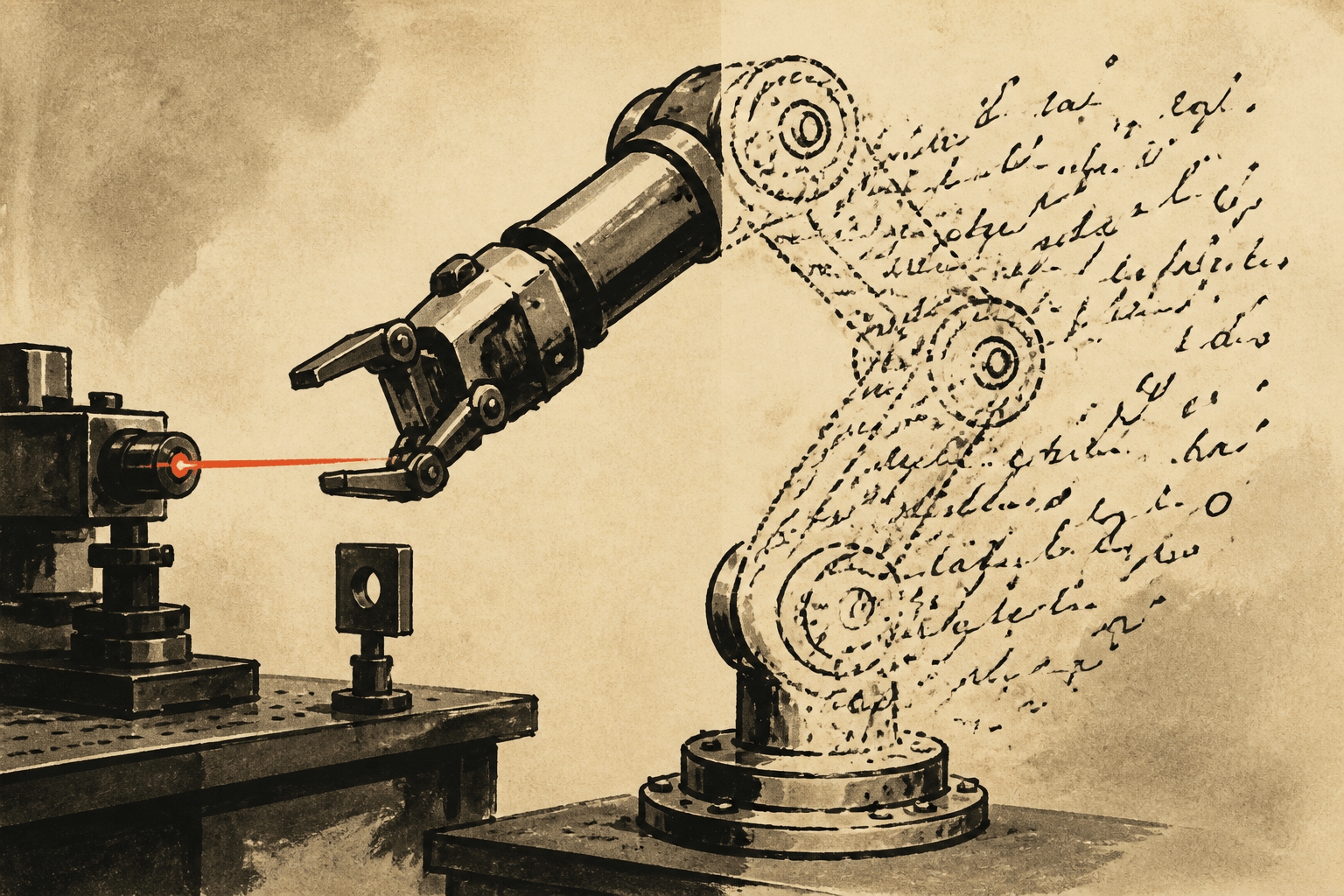
Anthropic opened a research preview of the Model Hardware Standard on August 27th, a shared specification that lets AI agents drive lab and factory instruments through one interface. Buried in the documentation is a single word, "enforced," and it never says whether that means code or a sentence.
What’s in the preview:
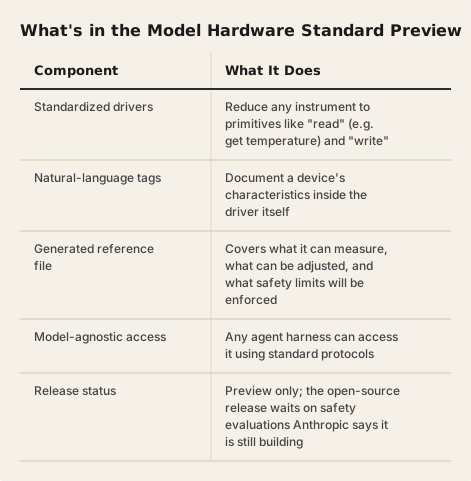
Enforced is doing a lot of work here:
Anthropic doesn't undersell this: the reference file, it says, gives an agent "everything it needs to know to operate the device," including "what safety limits will be enforced." That's a strong claim to hang device-level safety on, and it's the specific claim this piece is testing.
What the preview doesn't say publicly is where the enforcement sits. A limit clamped in driver code is an interlock: it refuses, it has no opinion about context, and that is the whole reason it gets trusted. A limit written into a natural-language tag for a model to read before acting is a different property wearing the same word. Both are consistent with "enforced," and the announcement doesn't distinguish them.
I'd rather be wrong here. If it's clamping in code, most of the worry dissolves, and the open-source release is where that gets settled.
Europe starts grading this on January 20, 2027:
That's when the EU Machinery Regulation (2023/1230) begins covering AI-based safety functions, extending EU oversight for the first time to machines that adapt their own behavior on the fly. The regulation binds machinery placed on the European market rather than a spec, but Universal Robots, Tecan and QIAGEN are all on Anthropic's vendor list, and all three are European manufacturers who will need conformity assessments for machinery that uses MHS to enforce safety functions. TNW got to this first, and the underlying point holds: once a spec is dictating how fast a robot arm swings or how far it can reach, it has stepped into a safety role, and for the highest-risk equipment categories, self-declaration - a manufacturer signing its own compliance paperwork - won't be enough anymore.
Self-declaration is the phrase I'd emphasize here. When I posted about Ginkgo's autonomous lab in May, the conclusion was that the bottleneck had moved from the bench to governance, and that a company setting its own criteria, running its own evaluations and grading its own results is not external accountability. MHS has the same shape, because Anthropic is writing both the standard and the safety evaluations for it. A conformity assessment is the first thing that forces "enforced" to have a testable answer.
One partner found a version of the answer:
QuEra's laser recovery started at 58% success in 150 seconds. An overnight agent loop got it to 96% in about six seconds, and a later blind test of 700 trials scored 99.3%, with the hardest disturbances taking 10 to 14 seconds. It got there because the agent developed decision trees. These are partner-reported figures I haven't independently verified. That decision tree is itself the code side of the code-versus-sentence question: once the model writes it down as a deterministic artifact, the safety logic is no longer a sentence Claude has to keep re-reading.
That shape speaks to one objection Anthropic raises about itself - that Claude "learns about the physical world through text and images," with spatial and physical reasoning that "still require expert oversight." Once the agent hands off to a deterministic decision tree, that particular gap narrows, at least for this one task. I don't have a compute-cost figure to say the same about the monitoring-time objection Anthropic also raises.
So the thing I'm eager to see in the open-source release is whether the safety limits ship as code a machine can check, or as sentences a model is trusted to honor.
Correction, 6 September 2026: this post originally gave QuEra's result as "58% success in 150 seconds to 99.3% success in 6 seconds," which merged two separate runs. Anthropic's announcement reports about six seconds at a 96% success rate from the overnight development run, and 99.3% from a later blind test of 700 trials in which the hardest disturbances took 10 to 14 seconds. The passage has been corrected.
Get this every weekday.
The Omniscient Bulletin: consequential AI, explained and evaluated. 5 to 7 items a day with the take, not the recap.
Discussion
Commenting is open to existing reader accounts. Sign in if you have one.