Industry
Everyone Is Building Nvidia's Replacement. Amazon Just Offered to Sell You One.
Tips, corrections, or questions? support@omniscient.media
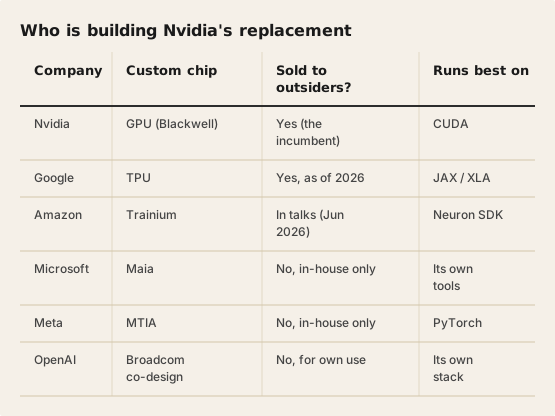
On June 18, 2026, Amazon signaled it may start selling its Trainium chips to outside data centers, not just renting them through its own cloud.[1] Google has its TPUs, Amazon its Trainium, Microsoft its Maia, Meta its MTIA: the largest buyers of Nvidia's chips have spent the past three years quietly building their own, and until now the logic was purely defensive. Every accelerator a hyperscaler designs in-house is one it does not have to buy from Nvidia at a gross margin in the mid-70s percent.
The shift sounds incremental. It is not. Using your own chips to cut your own Nvidia bill is cost control. Selling those chips to everyone else is a declaration that you intend to compete with Nvidia in the open market. Nvidia's customers are becoming its rivals, and the question now hanging over the most valuable franchise in technology is no longer whether a credible alternative chip exists. It is whether Nvidia's real moat was ever the silicon at all.
What Amazon actually said
The signal came from two places. AWS spokesperson Doron Aronson confirmed the company is reconsidering a long-standing policy: "While we've historically declined requests to sell chips directly, Andy noted it's quite possible we'll sell racks of them to third parties in the future." Peter DeSantis, who runs AWS's core infrastructure, separately confirmed to Bloomberg that talks are underway, though he said they remain early and would not name potential buyers.[1]
The "Andy" is Amazon chief executive Andy Jassy, who set up the move in his April shareholder letter. "If our chips business was a standalone business," he wrote, "and sold chips produced this year to AWS and other third parties (as other leading chips companies do), our annual run rate would be about $50 billion."[1] That is a striking figure and a revealing one. Fifty billion dollars would make Amazon's silicon unit a major chip company on its own. It is also less than a sixth of Nvidia's roughly $326 billion revenue run rate, a measure of how far ahead the incumbent still sits.[1]
Amazon is following Google, not leading
Amazon is not opening this door first. Google already walked through it. On its first-quarter 2026 earnings call, Sundar Pichai told analysts Google Cloud would begin selling TPUs to a select group of customers to install in their own data centers, turning a long-running internal project into a merchant product.[2] The customer list is already real: Anthropic committed to as many as a million TPUs in an October 2025 expansion of its Google Cloud partnership,[11] while Apple and Safe Superintelligence are among the others reported to be running workloads on Google's silicon.[12] Meta separately signed a multibillion-dollar deal in February to lease Google TPUs for its own data centers,[13] and in May, Google and Blackstone went further, forming a joint venture backed by $5 billion in equity to build TPU capacity that other companies can rent.[14]
The pattern is industry-wide, and it kept moving after Amazon's signal. OpenAI, the single largest consumer of Nvidia compute, first laid out a ten-gigawatt program of OpenAI-designed accelerators with Broadcom back in October 2025.[3] On June 24 that program went from blueprint to hardware, when the two companies unveiled Jalapeño, an inference chip designed end to end in nine months with help from OpenAI's own models. Broadcom chief executive Hock Tan called demand for such chips "simply insatiable" and said deployment would "really ramp up" in 2027 and hit "full tilt" in the first half of 2028; OpenAI president Greg Brockman framed it as part of a plan to "build the full stack" behind the company's own models and products.[7]
Anthropic now spreads its workloads across three platforms at once, Google TPUs, Amazon Trainium, and Nvidia GPUs, and has contracted for multiple gigawatts of TPU capacity through Broadcom and Google.[4] It is no longer only a customer, either. The Information reported on July 2 that Anthropic has opened early talks with Samsung Electronics on a custom chip of its own and has hired at least one engineer off OpenAI's chip program, though Anthropic told TechCrunch its existing multi-vendor hardware stack "will continue to be pivotal" regardless of what the talks produce.[8] Meta, meanwhile, is reportedly negotiating a roughly $6.5 billion deal with Samsung Foundry to build the third generation of its MTIA chip on a 2-nanometer process, a shift away from longtime manufacturer TSMC.[9] That two of Nvidia's largest customers have now converged on the same Korean foundry for their own silicon is telling: the contest is no longer just chip against chip, it is over who controls the manufacturing capacity to build alternatives at all. Everyone with the capital to build Nvidia's replacement is building it, and financing the buildout too. Alphabet's $80 billion equity raise in June, later upsized to roughly $85 billion, was explicitly earmarked for AI compute expansion as demand outruns supply.[5]
Why the chips stayed captive, and why that is changing
Until now there was a clear line. Google sold TPU access only through its own cloud; Amazon and Microsoft kept their chips entirely in-house and had not made custom silicon available to outside data centers at all.[12] The chips were a cost weapon, not a product. The reason was economics. Nvidia holds an estimated 80 to 90 percent of data-center GPU revenue and posts company-wide gross margins in the mid-70s.[6] For a hyperscaler running millions of accelerators internally, designing a good-enough chip to displace even a fraction of that spending pays for the entire program.
Going merchant is a different and more aggressive bet. It means chasing the margin Nvidia collects rather than merely avoiding it, and it implies confidence that your silicon is competitive enough that outsiders will choose it on the merits. Amazon's willingness to entertain it, and Google's decision to do it, suggests the hyperscalers now believe their chips have crossed from internal cost-savers into genuine market products.
The moat is software, not silicon
Which brings us to the real question. Nvidia's durable advantage was never only its chips; it was CUDA, the software layer it has cultivated for nearly two decades, with millions of developers and thousands of optimized libraries that assume Nvidia hardware underneath.[6] A competitor can match transistors faster than it can match an ecosystem. Custom accelerators tend to run best on their owner's own software stack, with TPUs paired to Google's frameworks and Trainium to Amazon's Neuron toolchain. Selling a rack of Trainium to a third party means exporting that porting cost along with it, and asking the buyer to rebuild on unfamiliar tools.
That is exactly why Amazon's move is a real test rather than a press release. Anthropic already shows the model can work; it runs Claude across TPUs, Trainium, and Nvidia GPUs at the same time.[4] But Anthropic is uniquely motivated and uniquely resourced, with billions in backing from both Amazon and Google and every reason to diversify away from any single supplier. The open question is whether an ordinary enterprise, one without a hyperscaler patron underwriting the engineering, will accept the software tax to save on hardware.
Nvidia has also just handed the skeptics something to point to beyond spreadsheets. SemiAnalysis reported on July 5 that Kyber, the rack system meant to house 2027's Rubin Ultra chips, has slipped more than a year to 2028. The cause is a specialized circuit board at its core, the PCB midplane, that has proven difficult to manufacture at volume. A stopgap design bolting together two current-generation racks was reportedly scrapped. Cloud customers reportedly rejected it as awkward and costly to operate. Nvidia disputed the report, saying its roadmap is "intact," and its stock barely moved.[10] SemiAnalysis said the setback gives AMD and Google a rare technical opening at the high end of the market, precisely where CUDA's grip is thinnest and where a chip is more likely to be judged on raw throughput than on software convenience. A delay is not a defection, but it is the first sign that Nvidia's execution, not just its economics, has room to slip.
The threat to Nvidia was never that someone would build a faster chip. It is that its biggest customers have the volume, the capital, and now the willingness to sell substitutes, and that the inference workloads driving the next wave of demand are more portable than the training runs that built CUDA's lock. For today, the incumbent's $326 billion run rate says the moat is holding.[1] The thing to watch is narrower and more telling: whether a single buyer with no stake in Amazon ever puts Trainium racks in its own data center. The day that happens, the silicon stops being a cost center and starts being competition.
Sources
TechCrunch, "Amazon hopes to challenge Nvidia more directly by selling its AI chips," June 18, 2026 (Aronson quote; DeSantis confirms early talks; Jassy's April shareholder letter and the ~$50B run-rate figure; Nvidia's ~$326B revenue run rate) Inline ↗
Data Center Dynamics, "Google to sell TPUs to a 'select group of customers' for their data centers, increases capex forecast" (Sundar Pichai's Q1 2026 earnings call remarks announcing TPU sales to outside customers) Inline ↗
OpenAI, "OpenAI and Broadcom announce strategic collaboration to deploy 10 gigawatts of OpenAI-designed AI accelerators," October 13, 2025 (original program announcement; OpenAI designs the accelerators, Broadcom builds and deploys) Inline ↗
Anthropic, "Anthropic expands partnership with Google and Broadcom for multiple gigawatts of next-generation compute," April 7, 2026 (multi-gigawatt TPU capacity via Broadcom and Google; three-platform strategy across TPU, Trainium, and Nvidia) Inline ↗
Alphabet, "Alphabet Announces Proposed $80 Billion Equity Capital Raise to Expand AI Infrastructure and Compute," June 1, 2026 (raise later reported upsized to roughly $84.75B; purpose is AI compute expansion) Inline ↗
Silicon Analysts, "NVIDIA AI GPU Market Share 2026" (data-center GPU revenue share estimated in the 80 to 90 percent range; the CUDA ecosystem and its switching costs) Inline ↗
CNBC, "OpenAI unveils first chip as part of Broadcom deal in effort to 'build the full stack,'" June 24, 2026 (Jalapeño chip unveiled; nine-month design timeline; Brockman and Tan quotes; 2026-2028 deployment ramp) Inline ↗
TechCrunch, "Anthropic is discussing a new custom chip with Samsung," July 2, 2026 (citing The Information's exclusive report; early-stage Samsung talks; hire of Clive Chan, formerly of OpenAI's custom chip team; Anthropic says its existing multi-vendor stack remains pivotal) Inline ↗
Seoul Economic Daily (Sedaily), "Samsung Foundry Emerges as AI Chip Powerhouse, Wooing Anthropic and Meta," July 3, 2026 (Meta reportedly negotiating a ~$6.5B, third-generation MTIA deal with Samsung Foundry on a 2nm process) Inline ↗
CNBC, "Nvidia's next-gen AI rack system delayed to 2028 on manufacturing snags, SemiAnalysis says," July 6, 2026 (Kyber NVL144 delay to 2028; PCB midplane manufacturability issue; scrapped bolted-rack backup design; Nvidia's denial that its roadmap is intact; SemiAnalysis's read on AMD and Google's opening) Inline ↗
Anthropic, "Expanding our use of Google Cloud TPUs and Services," October 23, 2025 (commitment to up to one million TPUs and more than a gigawatt of capacity coming online in 2026) Inline ↗
Data Center Dynamics, "Google offers its TPUs to AI cloud providers - report," September 8, 2025 (Apple, Anthropic, and Safe Superintelligence named as known TPU customers; Microsoft and Amazon had not yet made custom silicon available to third-party cloud providers) Inline ↗
Reuters, "Meta signs multi-billion-dollar deal to rent Google AI chips, The Information reports," February 26, 2026 Inline ↗
Blackstone, "Blackstone Announces Joint Venture with Google to Create New TPU Cloud," May 18, 2026 ($5 billion initial equity commitment; 500 MW of capacity targeted for 2027) Inline ↗
Get this every weekday.
The Omniscient Bulletin: consequential AI, explained and evaluated. 5 to 7 items a day with the take, not the recap.
Discussion
Commenting is open to existing reader accounts. Sign in if you have one.