Mistral AI has spent the past year fragmenting its open-source lineup - Magistral for reasoning, Devstral for agentic coding, and Mistral Small for instruct - into a growing portfolio of specialized models that each excel in a narrow lane. Mistral Small 4, released March 16, is a reversal of that philosophy. It collapses all three into a single 119B-parameter Mixture-of-Experts model, adding native multimodal capability in the process and asks a direct question: is a unified model that does everything well more valuable than a collection of models that each do one thing brilliantly?[1]
The answer, based on the architecture and benchmarks Mistral has published, is a cautious yes - with one important caveat about what "Small" actually means in 2026.
Architecture: Efficient by Design
The MoE architecture is the key to making unification practical. Small 4 has 128 experts total, with just 4 active per token - meaning only 6.5B of its 119B parameters (8B including embedding and output layers) fire on any given inference pass.[1] This keeps compute costs closer to a mid-sized dense model than the headline parameter count implies. The context window stretches to 256k tokens, covering most enterprise document workflows without chunking.[2]
The model's most consequential design choice is the reasoning_effort parameter: a per-request toggle between "none" (fast, conversational responses) and "high" (deep chain-of-thought reasoning).[2] In practice, this means a single deployment can serve a customer support chatbot and a research assistant simultaneously, without routing logic or separate inference endpoints. That is a genuine operational advantage for teams managing multiple AI workloads.
Performance: Output Efficiency Is the Real Story
Mistral's benchmark comparisons position Small 4 against GPT-OSS 120B across three evaluations: the AA LiveCodeBench Ranking (LCR), LiveCodeBench, and AIME 2025. The headline claim is that Small 4 matches or exceeds GPT-OSS 120B on all three, but the more interesting data point is output length.[1]
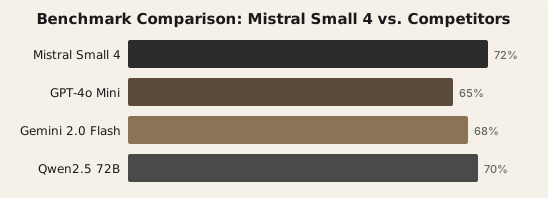
On AA LCR, Mistral Small 4 scores 0.72 using just 1,600 characters of output. Comparable Qwen models require 5,800-6,100 characters for equivalent scores - 3.5 to 4 times more verbose.
AA LCR benchmark scores across leading open-weight models at comparable parameter scales.
On LiveCodeBench, Small 4 outperforms GPT-OSS 120B while generating 20% less output.[2] This matters practically: shorter outputs translate to lower latency, reduced token costs at inference, and less post-processing burden. For a model priced at $0.15 per million input tokens and $0.60 per million output tokens on the Mistral API, token efficiency is a direct cost lever.[3]
On GPQA Diamond (graduate-level science reasoning), Small 4 scores 71.2 with reasoning enabled, and 78 on MMLU-Pro.[2] These are solid marks for a model designed to run on as few as two NVIDIA HGX H200 nodes - or a single DGX B200 for smaller teams.[1]
The "Small" Misnomer
At 119B parameters total, Mistral Small 4 is not small by any ordinary definition. The name reflects Mistral's internal tier taxonomy - Small sits below Medium and Large in its lineup - but it invites confusion for buyers used to equating "small" with lightweight, consumer-deployable models. At minimum configuration, Small 4 requires 4x NVIDIA HGX H100 units.[1] That is an enterprise-grade hardware floor, not a laptop inference story.
For self-hosting teams, vLLM and llama.cpp support is available, and Mistral has published a custom Docker image (mistralllm/vllm-ms4:latest) to handle tool calling and reasoning parsing until upstream vLLM patches land.[2] The setup is workable but requires hands-on configuration - this is not a plug-and-play release for smaller engineering teams.
Open Source and the Nemotron Coalition
Small 4 ships under the Apache 2.0 license, preserving the full permissiveness that has made Mistral's open releases attractive to enterprise buyers wary of restrictive use clauses.[1] Alongside the release, Mistral announced it is joining the NVIDIA Nemotron Coalition as a founding member - an alliance of eight AI labs committed to the collaborative development of open frontier models.[4]
The coalition membership is strategically significant. It gives Mistral a closer optimization path with NVIDIA hardware and aligns the company with an emerging counterweight to closed-model ecosystems. For buyers evaluating Small 4 for on-premises deployment, NVIDIA NIM containerized inference and NeMo fine-tuning support are available day one.[1]
Verdict
Mistral Small 4 makes a compelling case for model consolidation over specialization. The token efficiency argument alone - producing correct outputs in materially fewer characters than comparably-sized competitors - has real cost consequences at scale. The Apache 2.0 license and broad inference framework support (vLLM, llama.cpp, SGLang, Transformers) lower the integration barrier for teams that have already invested in open-weight infrastructure.
The honest limitation is the hardware requirement. Teams that genuinely need a "small" footprint should look elsewhere. But for enterprises running multi-workload AI deployments who want to simplify their model roster, Small 4 is the most credible consolidation play in the open-weight tier today.