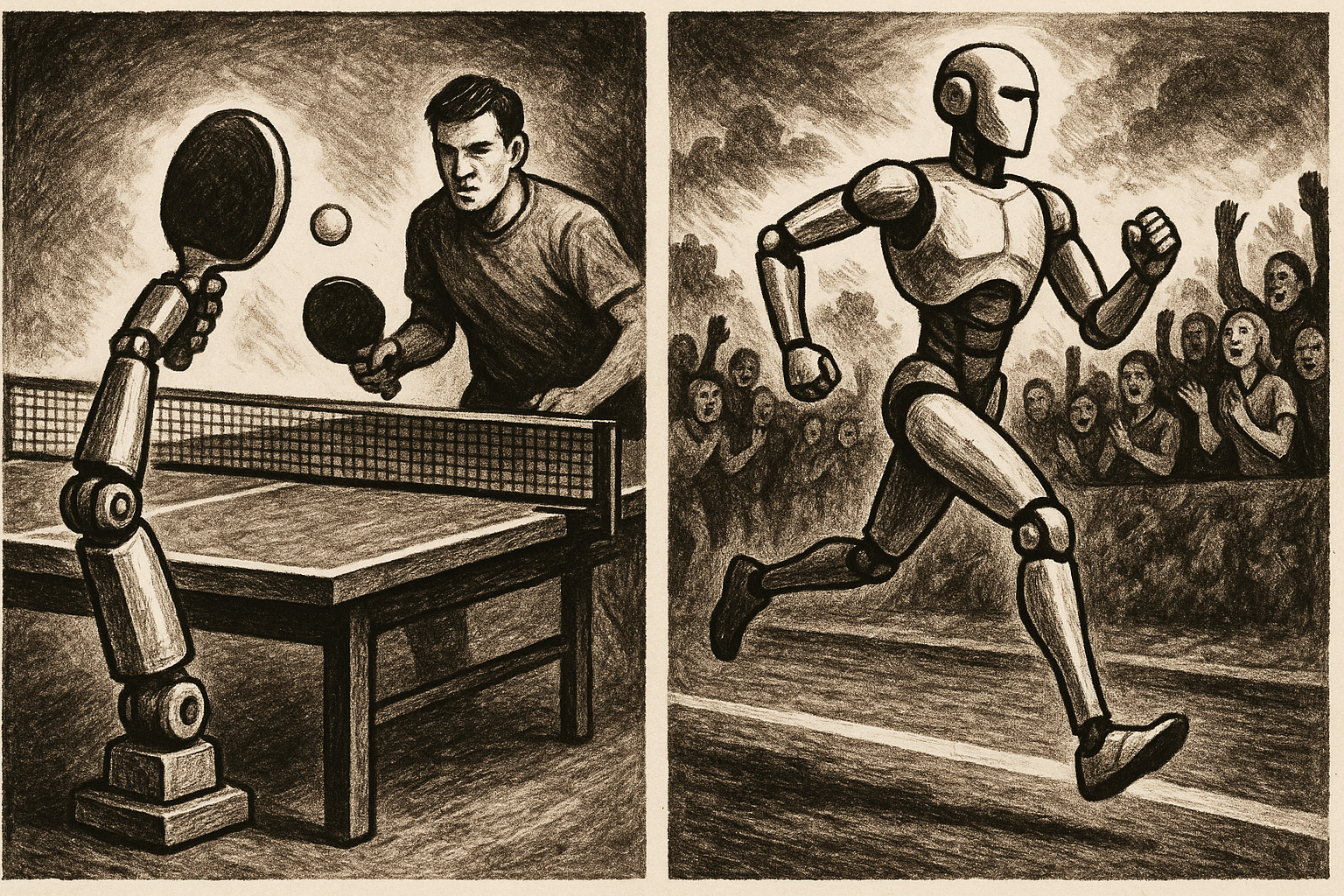
Within a few weeks of each other, two AI-powered robots did something no algorithm could accomplish from a server rack: they showed up in person, played by the rules, and won. One story unfolded on a table tennis court in Tokyo last spring; the other on a Beijing road course on April 19. Sony's Ace robot defeated elite human table tennis players under official International Table Tennis Federation conditions. And in Beijing, a humanoid named Lightning didn't just cross the finish line first at a half marathon - it crossed it seven minutes faster than any human ever has.
These are not the same story. But they rhyme so loudly it's hard not to read them as a single dispatch from the physical frontier of AI.
What happened at the table?
Sony AI has been quietly building Ace since 2020. The project, published on the cover of Nature in April, represents more than five years of convergent work on perception hardware, reinforcement learning, and custom robotics.[1] The result is an arm-mounted system that tracks a table tennis ball 200 times per second, measures its spin at up to 700 Hz, and reacts with an end-to-end latency of 20.2 milliseconds - roughly eleven times faster than a human player's response time of around 230 milliseconds.[2]
Ace competed against seven players in Tokyo: five elite-level athletes and two professionals. It won three of the five matches against the elite players and lost both against the professionals - a result the team frames not as a ceiling, but as a baseline. In the months since the paper was written, the robot has continued to improve.[3]
What makes Ace genuinely interesting is how it wins. Not by brute speed - though it is faster - but through invention. 1992 Olympian Kinjiro Nakamura, who watched Ace compete, was struck by its unorthodox shot selection: "No one else would have been able to do that. I didn't think it was possible."[1] The robot varied its spin, altered its returns, and consistently placed the ball in ways that disrupted human rhythm. A player who had trained ten thousand hours to read human opponents found himself reading something altogether different.
The engineering behind those shots is layered. Ace uses nine synchronized frame-based cameras alongside three event-based vision sensors - the latter fire only when motion is detected, giving the system the temporal resolution to capture spin at speeds that would blur in conventional footage. Its robotic arm is entirely custom-built; off-the-shelf hardware, the team found, wasn't precise or fast enough for the task. The control policy was trained entirely in simulation using deep reinforcement learning, then transferred to the real robot without additional fine-tuning - a sim-to-real transfer that the researchers describe as one of the project's core technical achievements.[2]
"Speed in robotics that is not predetermined is one of the last frontiers in robotics. Robots are still slow. It's difficult for them to interact with the environment - let alone with people - at the speed we are accustomed to." - Michael Spranger, President, Sony AI
What happened on the road?
On April 19, in Beijing's E-Town technology district, more than 300 humanoid robots lined up alongside 12,000 human runners for the second annual Humanoid Robot Half Marathon.[4] The winner, an autonomous robot called Lightning built by Honor - a Chinese consumer electronics company that only entered humanoid robotics in 2025 - finished the 13.1-mile course in 50 minutes and 26 seconds.
The human world record, set by Ugandan Olympic medalist Jacob Kiplimo in March 2026, is 57 minutes and 20 seconds.[7] Lightning beat it by nearly seven minutes.
One year earlier, the fastest robot at the same event needed two hours and 40 minutes to finish. That improvement - from 2:40 to 0:50 in a single year - is the number that should give pause. Honor didn't even begin working on humanoid robotics until 2025.[4] Lightning's design borrows from elite human biomechanics: legs nearly a meter long, an advanced balance system, and a liquid cooling mechanism (adapted from smartphone thermal management) to prevent overheating during sustained exertion. The autonomous version of the robot navigated the course in real time using AI systems that adjusted its pace, maintained balance, and avoided the other robots on the track.
Not every robot had a clean race. Some fell. Several veered off course. Many required technical assistance. Even Lightning fell once - needing its handlers to set it upright before continuing on to victory.[5] Roughly 40 percent of the field ran autonomously - a figure that would have been unthinkable a year earlier, when the robots were remotely piloted and only six crossed the finish line at all.[6]
Why does any of this matter beyond the spectacle?
Both Sony and the Beijing race organizers have been at pains to say the same thing: the goal was never sport. "Sports are just a proxy for what we want," said Esther Colombini of the University of Campinas, who reviewed the Ace research. The real objective is physical AI that operates fluently in the unpredictable real world - robots that can navigate hospitals, assemble components, assist with disaster response, or simply coexist with people without knocking things over.
The table tennis result is particularly rich in that regard. Ace's architecture - low-latency multi-modal sensing, sim-to-real reinforcement learning, purpose-built hardware - maps almost directly onto the requirements of next-generation industrial and collaborative robots. The half marathon result speaks to a different but equally important dimension: endurance, real-time balance under varying conditions, and the ability to recover from falls without human intervention.
Sony AI's Chief Scientist Peter Stone has placed Ace within a lineage of AI milestones: Deep Blue's defeat of Kasparov in 1997, AlphaGo's mastery of Go in 2016, and Sony's own GT Sophy, which surpassed the world's best Gran Turismo drivers in 2022. Each milestone moved the goalposts for what "AI mastery" meant. What's different now is the address: not a server farm or a simulated track, but a real table, a real court, a real road in Beijing.[2]
The question is no longer whether AI can beat humans in physical domains. It's which ones remain, and for how long.
Sources