Industry
SK Hynix Warns of a Worse Shortage. Its New Contracts Give It More Exposure to One.
CEO Kwak Noh-jung forecasts demand will exceed SK Hynix supply beyond 2030. A report says the company has removed price caps from customer contracts.
Tips, corrections, or questions? support@omniscient.media
On July 10, the day SK Hynix's American depositary receipts began trading on the Nasdaq, its chief executive told Reuters that 2027 will be "the worst year in the industry's history" for memory supply, and that customer demand will keep outrunning the company's production capacity beyond 2030[1]. The market's initial reaction was positive: the stock rose 13 percent on its first day, closing at $168.01 against a $149 offering price[2].
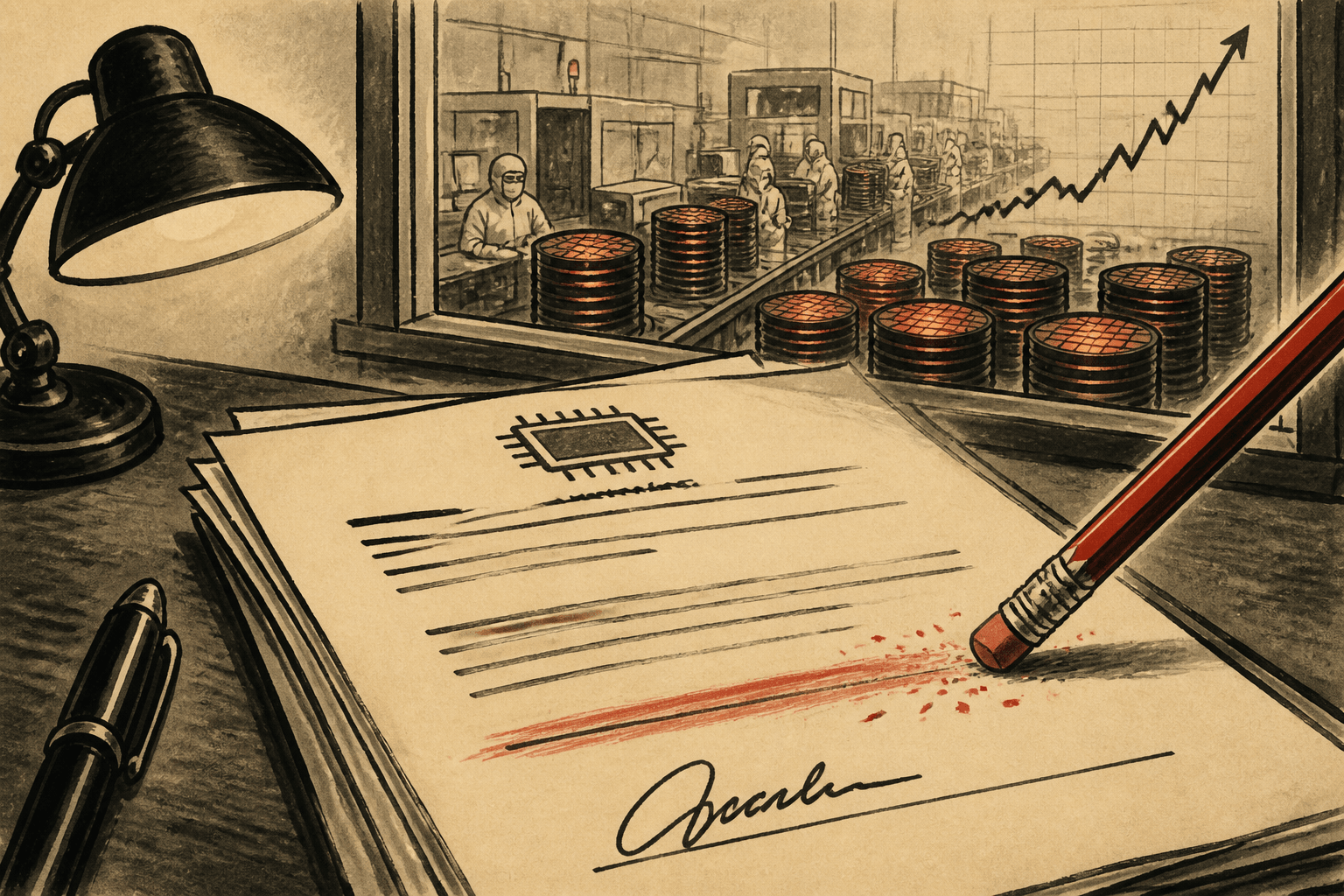
That response puts the reported changes to SK Hynix's supply contracts in sharper relief. According to an industry report from TrendForce, the company has stripped the price ceiling out of its long-term supply agreements, breaking from the common practice of using price ceilings to limit volatility during a shortage[3].
A forecast of scarcity used to be a risk memory makers hedged against. Under the contracts TrendForce describes, a prolonged shortage could instead leave SK Hynix's customers more exposed to rising prices.
What exactly did SK Hynix's CEO say?
Kwak Noh-jung's remarks to Reuters were specific and unhedged: "We forecast that next year will be the worst year in the industry's history from the supply perspective," he said. "Our customer demand continues to go up, while our capacity has limitations. We still forecast that customer demand will remain higher than our supply capacity even beyond 2030. But we are doing our best to solve the problem."[1] The remarks came in a wire interview on the day of the Nasdaq listing, ensuring that they traveled with the listing story.
SK Group chairman Chey Tae-won struck the same note in a separate interview with CNBC that day, framing the shortage as structural rather than cyclical: customers who heard SK Hynix would double its wafer capacity within five years told him, in his words, "that's not enough, man." He said demand for HBM was growing "exponentially" and that he saw no sign of it shrinking[2]. The offering raised $26.5 billion, the largest-ever US listing by a foreign company[2]. SK Hynix has separately announced an estimated $3.87 billion advanced-packaging and R&D facility in Indiana and approximately $21.5 billion for the first fab in its Yongin cluster[4][5].
How does the shortage forecast align with SK Hynix's financing and contracts?
A credible, extended shortage supports the case for raising $26.5 billion from public markets and gives customers a reason to consider multi-year supply agreements. SK Hynix's valuation has climbed more than sevenfold over the past year[2]. The offering also converts a supplier's forecast into a claim that public shareholders can price. That does not make the shortage fabricated, nor does it establish why the forecast and contract changes appeared when they did. It does show how the same expectation of constrained supply can reinforce SK Hynix's investment case and the appeal of longer contracts.
What changed in SK Hynix's contracts, and why does it matter more than the forecast itself?
Long-term supply agreements exist to trade certainty for both sides: the buyer locks in volume, while the supplier gains a more predictable revenue stream. Micron's Strategic Customer Agreements retain price bands for many existing products, with a ceiling at the second-quarter 2026 market price and a floor through the contract term[6]. SK Hynix's reported contracts drop the ceiling entirely, according to TrendForce, letting spot-market increases be fully reflected in contract prices while lengthening terms from the traditional one year to three to five years[3]. For customers, a longer contract with an open-ended price offers less protection from the cost of a sustained shortage.
TrendForce's own pricing data shows why that distinction matters. Its July 3 forecast for the third quarter of 2026 put conventional DRAM contract prices up 13 to 18 percent quarter over quarter, with gains moderating partly because a portion of server DRAM procurement is governed by long-term supply agreements[7]. Capped LTAs can act as a shock absorber, limiting how quickly contract prices follow a tightening market. The reported SK Hynix terms would leave customers without that ceiling.
The risk in the reading
The interpretation above treats SK Hynix's forecast and its contract redesign as a mutually reinforcing story. That reading has real limits. The shortage is not solely SK Hynix's forecast: Micron has separately said that it expects tight conditions for DRAM and NAND to persist beyond calendar 2027[6]. Uncapped pricing can also be read as a response to the capital requirements of expanding supply, rather than as opportunism. SK Hynix is committing substantial capital in Indiana and Yongin, and it has a legitimate case for seeking more pricing flexibility rather than absorbing shortage risk itself[4][5].
There is no evidence of coordination between the forecast's timing and the reported contract change beyond proximity, and proximity is not proof of intent. The narrower reading is that the shortage forecast, the public financing, and the reported contract changes all depend on the same proposition: that tight supply will endure. The test is what comes next: whether these reported terms become standard in customer agreements, and whether the shortage proves as durable as those agreements assume. If it eases before 2027, the forecast that accompanied the listing will become a number the market has to reassess.
Sources
Reuters: Kwak Noh-jung's July 10, 2026 forecast for memory supply and demand Inline ↗
CNBC: SK Hynix's July 10, 2026 Nasdaq ADR debut and Chey Tae-won interview Inline ↗
TrendForce: reported SK Hynix long-term agreement terms Inline ↗
SK hynix: estimated $3.87 billion Indiana advanced-packaging and R&D facility Inline ↗
SK hynix: approximately $21.5 billion investment for Yongin's first fab Inline ↗
Micron Q3 2026 earnings-call prepared remarks: strategic customer agreement terms and supply outlook Inline ↗
TrendForce: July 3, 2026 forecast for third-quarter DRAM contract prices Inline ↗
Get this every weekday.
The Omniscient Bulletin: consequential AI, explained and evaluated. 5 to 7 items a day with the take, not the recap.