Industry
Vol. 1·Thursday, June 18, 2026
When the Chip Vendor Underwrites the Demand: Inside NVIDIA's Credit-Support Model
Noah Ogbi10 min read
Tips, corrections, or questions? support@omniscient.media
CompaniesNVIDIA

Tips, corrections, or questions? support@omniscient.media
Get this every weekday.
The Omniscient Bulletin: consequential AI, explained and evaluated. 5 to 7 items a day with the take, not the recap.
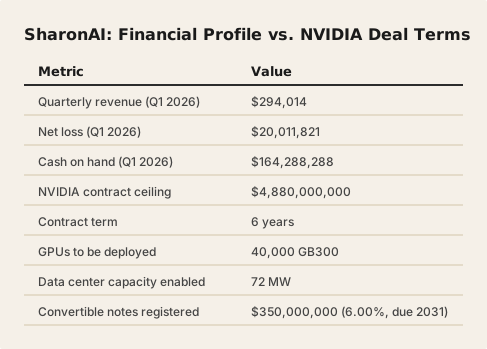
On June 12, 2026, SharonAI Holdings Inc., an Australian cloud-compute company trading on Nasdaq as SHAZ, announced a six-year strategic compute collaboration with NVIDIA, governed by a Master Cloud Services Agreement and an order form dated June 8, with a contract value of up to $4.88 billion.[1] In its most recent quarter, the company reported revenue of $294,014.[2] The number is not a typo. A company with roughly a quarter of a million dollars in quarterly revenue committed to a purchase valued in the billions, and the press release explained how: the deal is "structured so that Sharon AI can commit to large-scale NVIDIA infrastructure while aligning economics through a revenue-sharing and credit-support model."[3]
NVIDIA is no longer only selling chips. In a growing number of arrangements, it is underwriting the demand for them.
NVIDIA and SharonAI will enable 72 megawatts of new data center capacity in Australia, deploying NVIDIA's DSX AI factory design and scaling up to 40,000 Grace Blackwell GB300 GPUs.[3] The press release states that total AI factory capacity has risen to 132 megawatts, of which 102 is contracted to end customers, with more than 55,000 NVIDIA GPUs expected deployed by mid-2027.[3]
The financing language is worth reading closely. NVIDIA, the company writes, "will earn both standard product revenue and a share of the cloud revenue on the supported capacity."[3] The 8-K adds the operational fine print: certain capacity reserved for NVIDIA may be sold to third parties, and the arrangements "include revenue share, reporting and audit mechanics" that the company concedes "may increase administrative burden, create disputes and make revenues and cash flows less predictable."[1] The same filing states the company will need to "secure financing (which may be in the form of debt and/or equity) including secured or asset-backed options" to deliver the deployments.[1] This is a supplier taking a share of its customer's revenue and lending credit support to its customer's purchase: the chip vendor sits on both sides of the same transaction.
For the quarter ended March 31, 2026, the company reported total revenue of $294,014, a net loss of $20,011,821, and cash of $164,288,288.[2] The entity is recent, having reached public markets through a de-SPAC after operating as Roth CH Acquisition Co., which domesticated and renamed itself SharonAI Holdings upon completing the business combination.[4] A sub-$300,000-quarterly-revenue company does not finance a six-year, multi-billion-dollar GPU commitment out of operations. It finances it out of capital markets, and out of the credit support of the counterparty selling it the hardware.
The capital-markets side was visible the same week. On June 11, 2026, the company registered for resale the shares underlying $350 million of 6.00% Convertible Senior Notes due 2031.[5] The same day, it issued 7,649,523 shares upon conversion of approximately $97,475,184 of earlier convertible notes, at $12.53 per share.[6] A company building toward billions in committed purchases was, in those same days, converting notes into stock and registering more convertible paper.
The market read the dilution, not the headline. Shares had closed near $71.51 the prior session and traded up roughly 8% before the opening bell on news of the deal.[7] They did not finish there. The stock closed down about 12.85% on the day, at $62.32, as the overhang of new and convertible securities outweighed the contract announcement.[8] A $4.88 billion compute headline produced a down day: the supply of new equity claims, not the demand for compute, set the price.
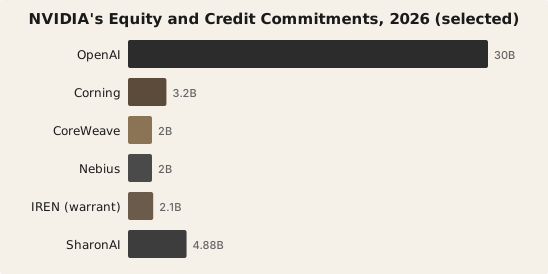
SharonAI is the small, legible version of an arrangement NVIDIA has been building at far larger scale. According to reporting compiled in May 2026, NVIDIA committed more than $40 billion to AI equity investments in the first four months of 2026, the single largest line being the roughly $30 billion it put into OpenAI in late February.[9] The mechanics repeat:
The CoreWeave stake, $2 billion in January, was valued at roughly $4.4 billion by May and represented about 28% of NVIDIA's listed equity portfolio; CoreWeave separately signed a $6.3 billion capacity-purchase agreement with NVIDIA.[9]
The Nebius investment, roughly $2 billion in March, came with a multi-gigawatt deployment commitment.[9]
NVIDIA received a five-year warrant for up to 30 million IREN shares at a $70 strike, worth up to roughly $2.1 billion if fully exercised.[10]
NVIDIA committed up to $3.2 billion to Corning, which supplies optical fiber for data-center networks.[9]
The shape is consistent across all of them. NVIDIA takes a stake in a buyer, or extends credit support to it; the buyer signs a long-term commitment for NVIDIA hardware or NVIDIA-powered capacity; revenue then flows back to NVIDIA, partly as product sales and partly as a return on the position it just took. The same dollars circulate between vendor and customer, and the loop is recorded as backlog.
When a supplier finances its customers, takes equity in them, and books their purchase commitments as future revenue, the distance between demand and subsidy narrows. An order signed by a counterparty the seller has itself capitalized is not the same independent signal as one from an unrelated buyer paying with its own money. And the $4.88 billion is a phased ceiling, not a sum earned: the filing notes NVIDIA may terminate upon "certain events of insolvency or material adverse changes in financial condition," and that "any events giving rise to a material breach may be out of the Company's control."[1]
That structural fragility sits inside a broader shift in how AI infrastructure gets funded. The Bank for International Settlements, in a January 2026 bulletin, described leading technology firms that "have historically financed much of their investments internally out of operating cash flows" now "seeking external sources of funding," increasingly through debt, given the scale of AI-related capital needs.[11] Morgan Stanley projects AI-related global debt issuance approaching $570 billion in 2026, having already reached nearly $236 billion as of May 31, roughly four times the level a year earlier.[12] Vendor financing is the sub-channel where that debt shift and the question of independent demand converge: NVIDIA's credit support is not merely a financing convenience, it is the mechanism that makes otherwise unfinanceable commitments countable as backlog.
The word "circular" belongs to the analysts, not to NVIDIA. The BIS bulletin raises concerns about "the circular financing within the AI ecosystem," attributing the observation to Bloomberg reporting, and warns that higher leverage among firms that have long run on internal cash flows could "amplify shocks and affect the health of financial intermediaries if expected returns on AI investments fail to materialise."[11] NVIDIA frames the same arrangements as capital efficiency and expanded access for customers "that historically lacked access to capital-intensive AI infrastructure."[3] Both descriptions can be accurate at once.
The precise term matters. A "credit-support model" is narrower than a guarantee and narrower than a loan: NVIDIA is not, on the face of these filings, lending SharonAI the purchase price or guaranteeing its debt outright.[3] And the figures for the broader pattern rest on secondary reporting, not a single consolidated disclosure.
When the entity supplying the chips also capitalizes the customers, shares their revenue, and counts their orders as demand, a stumble at any one contracted operator stops being local. The mechanism that made SharonAI's commitment possible is the same one that links dozens of NVIDIA-backed operators' balance sheets back to a single counterparty. The line that runs back to the vendor runs back to everyone holding the vendor.
The trigger to watch is not a grand revelation but a small one: a contracted operator missing a payment, a deal restructured at worse terms, or a write-down on one of NVIDIA's equity stakes. Any of those would force a public reckoning with how much of the AI infrastructure buildout is demand, and how much is financing wearing demand's clothes.
SharonAI Holdings Inc., Form 8-K, Items 7.01 and 9.01, June 12, 2026 - sec.gov Inline ↗
SharonAI Holdings Inc., Form 10-Q for the quarter ended March 31, 2026, May 15, 2026 - sec.gov Inline ↗
SharonAI Holdings Inc., Press Release: Sharon AI Announces Six Year Strategic Compute Collaboration with NVIDIA (Exhibit 99.1 to Form 8-K), June 12, 2026 - sec.gov Inline ↗
U.S. Securities and Exchange Commission, EDGAR, SharonAI Holdings Inc. (CIK 0002068385) filing history and former names, accessed June 15, 2026 - sec.gov Inline ↗
SharonAI Holdings Inc., Prospectus (Form 424B3): $350,000,000 Principal Amount of 6.00% Convertible Senior Notes due 2031, June 11, 2026 - sec.gov Inline ↗
SharonAI Holdings Inc., Form 8-K, Item 3.02 Unregistered Sales of Equity Securities, June 12, 2026 - sec.gov Inline ↗
Barchart via Yahoo Finance, "This Tiny Australian AI Stock Up 4,000% in 2026 Just Inked a Nvidia Deal," June 12, 2026 Inline ↗
Simply Wall St via Yahoo Finance, "SharonAI Holdings (SHAZ) Stock After NVIDIA AI Deal: A Fresh Look At An 11.3x P/B Valuation," June 13, 2026 Inline ↗
The Next Web, "NVIDIA has committed more than $40bn to AI equity investments in 2026," May 10, 2026 Inline ↗
The Next Web, "NVIDIA takes up to $2.1bn IREN warrant tied to 5GW Sweetwater AI data centers," May 8, 2026 Inline ↗
Bank for International Settlements, BIS Bulletin No 120: Financing the AI boom: from cash flows to debt, January 7, 2026 - bis.org Inline ↗
TechStartups, "Global AI debt issuance to top $570 billion in 2026, Morgan Stanley says," June 10, 2026 Inline ↗