Industry
Vol. 1·Sunday, April 5, 2026
SoftBank's Borrowed Bet: What a $40 Billion Unsecured Loan Says About the OpenAI Wager
Noah Ogbi8 min read
Tips, corrections, or questions? support@omniscient.media
TopicsIndustry Strategy
CompaniesOpenAI
Tips, corrections, or questions? support@omniscient.media
Get this every weekday.
The Omniscient Bulletin: consequential AI, explained and evaluated. 5 to 7 items a day with the take, not the recap.
On April 1, 2026, SoftBank Group wired $10 billion to OpenAI. It was the first of three equal tranches - July 1 and October 1 bring the next two - completing a $30 billion follow-on commitment announced February 27.[1] When the sequence finishes, SoftBank's cumulative investment in OpenAI will reach $64.6 billion, representing roughly 13% of the company.[1] That number is staggering enough. What deserves sharper scrutiny is where the money came from.
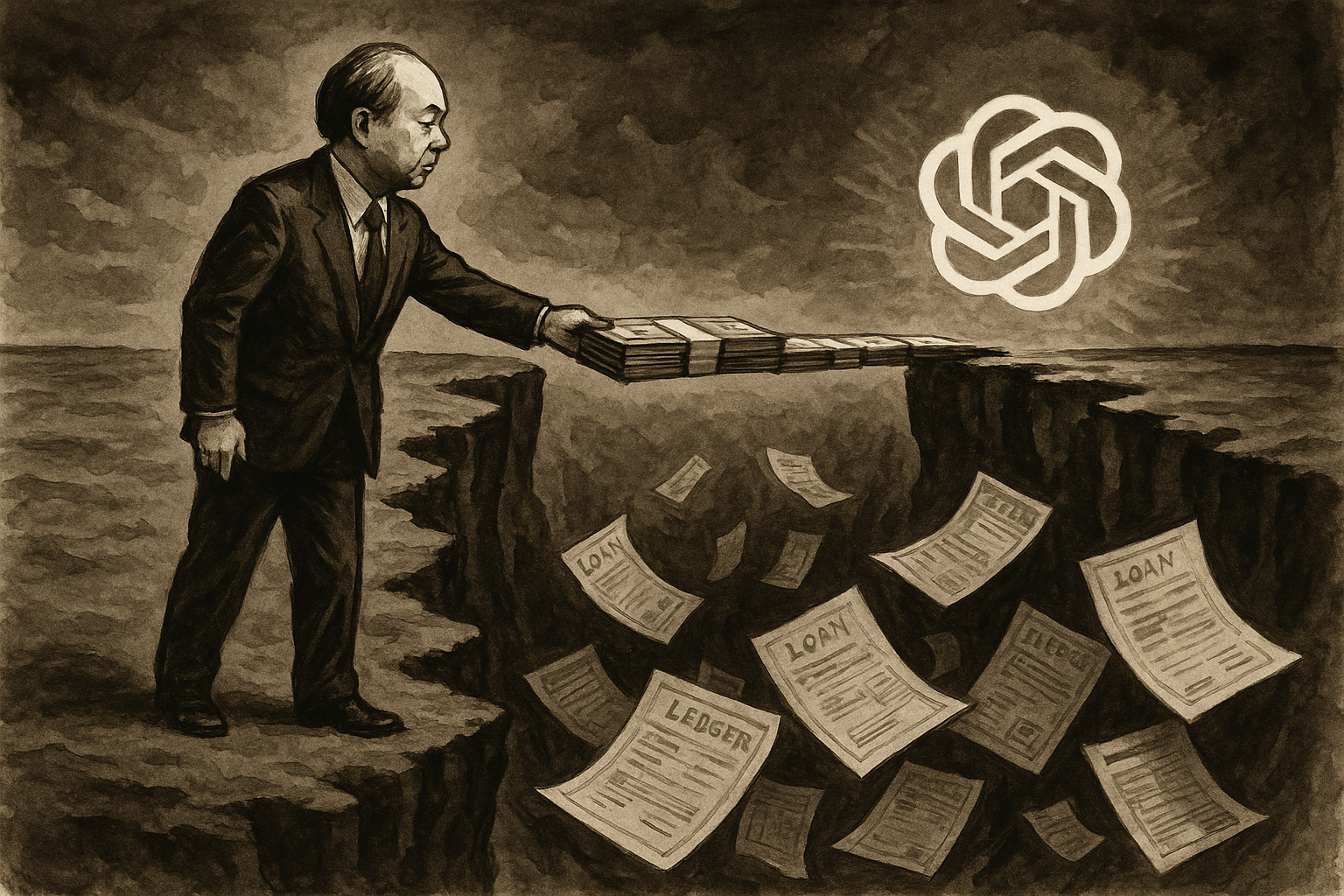
SoftBank did not deploy existing cash. On March 27 - five days before the first tranche closed - it drew down against a $40 billion bridge loan it had arranged with JPMorgan Chase, Goldman Sachs, Mizuho Bank, Sumitomo Mitsui Banking Corporation, and MUFG Bank.[2] The loan is unsecured, carries no collateral, and matures in twelve months: March 25, 2027.[2] SoftBank borrowed to invest in a company that is itself burning capital at scale - and posted no assets against the debt.
A secured loan pledges specific assets; if the borrower defaults, lenders recover against collateral. An unsecured loan at this scale means lenders are betting entirely on SoftBank's balance sheet and future liquidity - and implicitly, on an OpenAI IPO arriving in time to repay the debt. The 12-month maturity is the tell: JPMorgan and Goldman Sachs are not extending credit they expect to carry for years. They are extending credit they expect to be repaid from a liquidity event.[3] OpenAI has been reported to be targeting a Q4 2026 public listing,[4] which would land inside the loan's maturity window - barely.
SoftBank's own press release acknowledges the repayment plan only in outline: borrowings "are expected to be repaid in stages by the maturity date through the utilization of existing assets and other financing measures."[2] That language is deliberately vague. It could mean selling Arm shares, refinancing the bridge, or waiting on an IPO. What it does not mean is that SoftBank has the cash ready.
S&P Global responded to the February announcement by revising SoftBank's outlook from stable to negative, affirming its BB+ long-term issuer credit rating.[5] The agency identified two compounding risks: first, that the additional OpenAI investment would raise SoftBank's LTV ratio above its self-imposed 25% ceiling (the company has an emergency ceiling of 35%); and second, that OpenAI itself represents one of the weakest credit-quality assets in SoftBank's portfolio.[5]
That second finding is worth pausing on. After the $30 billion follow-on closes, OpenAI will represent approximately 30% of SoftBank's total investment assets - equal to its Arm stake.[5] SoftBank sold its entire $5.83 billion Nvidia position in November 2025,[5] a move that, in retrospect, looks less like profit-taking and more like balance sheet preparation for what came next. The portfolio is now heavily concentrated in two assets: one publicly listed semiconductor company and one pre-IPO AI lab that S&P considers credit-weak. Diversification this is not.
The funding round that SoftBank's tranche closes was announced at $110 billion - $50 billion from Amazon, $30 billion from Nvidia, $30 billion from SoftBank - against a $730 billion pre-money valuation.[6] By the time the round formally closed on April 1, the total had grown to $122 billion at a post-money valuation of $852 billion.[7] OpenAI's annualized revenue surpassed $20 billion in 2025,[8] a remarkable pace of growth from near-zero revenue in late 2022.
But revenue growth and profitability are different animals. OpenAI projects losses of approximately $14 billion in 2026,[9] while its infrastructure commitments - data center contracts spanning 2025 to 2035 - total more than $1.1 trillion across seven major vendors.[10] The $122 billion round, read against those figures, is less a sign of financial strength than a forward hedge: capital raised now to fund losses that are already fully projected. The company's own forecasts see cumulative cash burn reaching $115 billion through 2029 before the revenue curve crosses the cost curve.[11] SoftBank is not investing in a company approaching profitability; it is buying a larger share of the losses in exchange for a larger share of the eventual upside.
SoftBank is not investing in a company approaching profitability. It is buying a larger share of the losses in exchange for a larger share of the eventual upside - and doing so entirely with borrowed money.
SoftBank is acquiring preferred shares that automatically convert into common shares upon an OpenAI IPO or related listing transaction.[1] This is standard venture mechanics, but its interaction with the bridge loan's 12-month maturity creates a hard dependency: if the IPO slips past March 2027, SoftBank faces a bridge refinancing before its shares have converted to liquid equity. The company would need to roll the debt, sell other assets, or draw on its cash reserves - all while holding illiquid preferred stock in a company projecting multi-billion-dollar annual losses.
Masayoshi Son framed the investment in characteristically expansive terms - "AI is transforming the world at an unprecedented pace" - and cited SoftBank's goal of becoming the leading platform for the artificial superintelligence era, a phrase Son has used repeatedly across earnings calls and investor communications.[1] What the press release does not mention is that this is the same conviction that produced a $32 billion Vision Fund segment loss in fiscal 2022-23,[12] the largest single-year loss the Vision Fund has recorded, after a generation of similarly confident bets on transformative technology went wrong simultaneously.
The honest answer may be: both, inseparably. The deal's entire financial logic requires an OpenAI public listing to function. The preferred share structure accelerates conversion upon listing. The 12-month bridge loan assumes repayment via a liquidity event. The S&P outlook cut explicitly names an IPO as the condition for restoring SoftBank's credit quality.[5] Strip the IPO scenario out and the deal becomes structurally uncomfortable: $40 billion unsecured, borrowed against a portfolio increasingly concentrated in pre-IPO AI, with a 12-month clock running.
None of this means the bet is wrong. OpenAI's revenue trajectory, user base of 900 million, and dominance of enterprise AI contracts represent genuine fundamentals.[10] A Q4 2026 IPO at an $852 billion post-money valuation would, if it materializes, hand SoftBank a mark-to-market gain and the liquidity to retire the bridge cleanly. Son has made audacious leveraged bets before and been right - Alibaba being the canonical example. But the structure of this transaction leaves almost no margin for error on timing. The bridge matures in March 2027. The IPO is targeted for Q4 2026. If those two dates do not converge, the question becomes not whether the long-term bet on OpenAI is sound, but whether SoftBank can survive long enough to collect on it.
SoftBank Group Corp. - Follow-on Investments in OpenAI (Feb. 27, 2026) Inline ↗
SoftBank Group Corp. - Execution of Bridge Facility Agreement (Mar. 27, 2026) Inline ↗
TechCrunch - Why SoftBank's new $40B loan points to a 2026 OpenAI IPO (Mar. 27, 2026) Inline ↗
Reuters - OpenAI lays groundwork for IPO at up to $1 trillion valuation (Oct. 29, 2025) Inline ↗
Silicon Republic - SoftBank credit outlook hit after betting $30bn more on OpenAI (Mar. 3, 2026) Inline ↗
CNBC - OpenAI announces $110 billion funding round backed by Amazon, Nvidia, SoftBank (Feb. 27, 2026) Inline ↗
HPE News - OpenAI raises $122 billion in boosted funding round (Apr. 1, 2026) Inline ↗
The Information: OpenAI Tops $25 Billion in Annualized Revenue as Anthropic Narrows Gap (March 2026) Inline ↗
RD World Online - Facing $14B losses in 2026, OpenAI seeks $100B in funding (2026) Inline ↗
TechCrunch - ChatGPT reaches 900 million weekly active users (Feb. 27, 2026) Inline ↗
Sahi - Can OpenAI Afford the AI Race? The Burn Rate Explained (2026) Inline ↗
CNBC - SoftBank full year 2022 earnings: Vision Fund posts $32 billion loss (May 11, 2023) Inline ↗