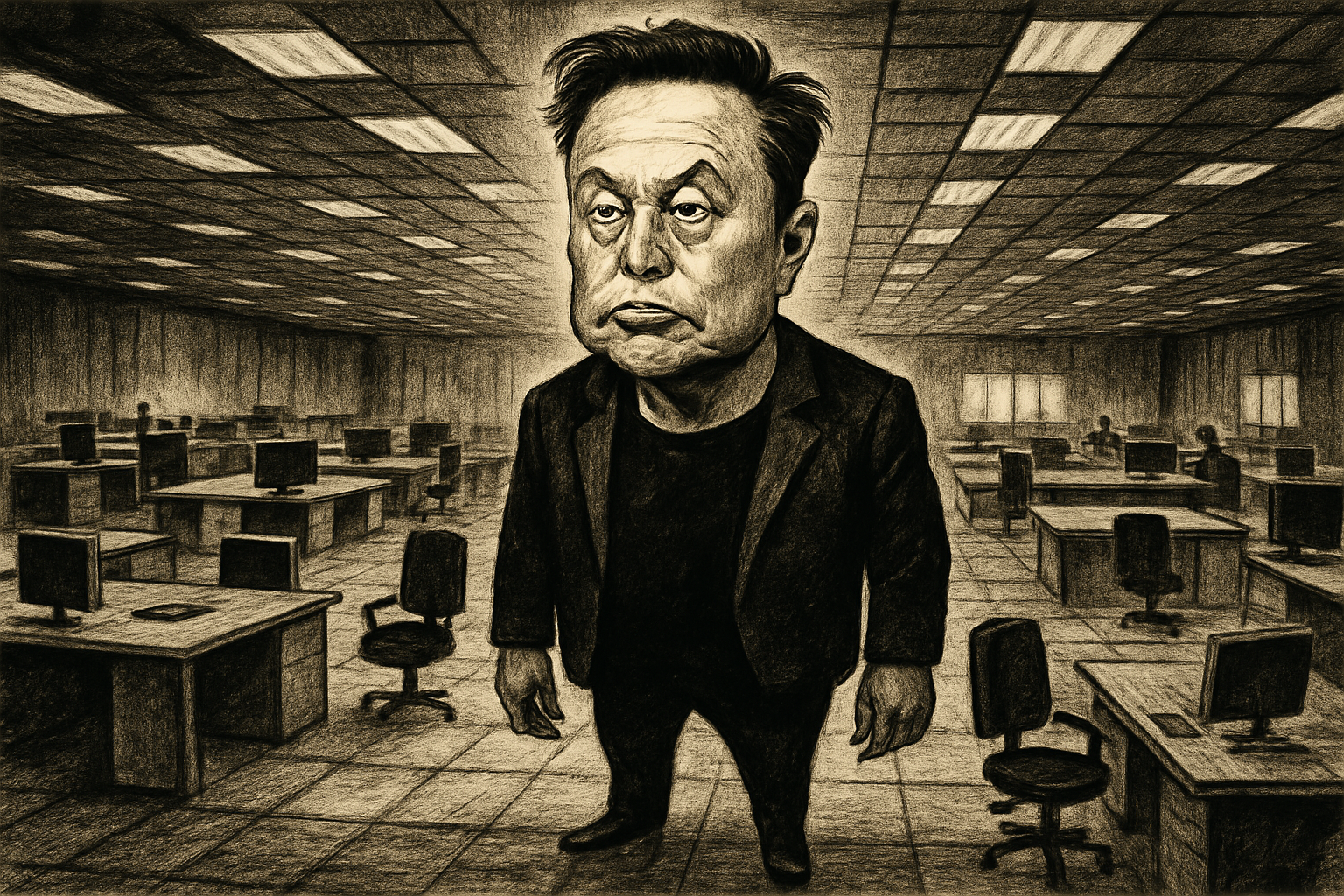
When Elon Musk unveiled xAI in July 2023, he assembled a founding team of twelve - a compact, elite squad drawn from the research floors of Google DeepMind, OpenAI, and Microsoft Research. The pitch was simple: a lean band of world-class scientists could outrun the lumbering incumbents. Less than three years later, ten of those twelve have left. The two who remain are Manuel Kroiss, a former Google and DeepMind software engineer, and Ross Nordeen, the company's technical program manager.[1]
The final wave of departures came in rapid succession this month. Zihang Dai, a former Google research scientist, left earlier this week. On Thursday, Guodong Zhang - who reported directly to Musk and led two of xAI's most prominent consumer products, Grok Code and Grok Imagine - confirmed his exit in a post on X: "Wild journey past three years but excited about next chapter."[2] Their exits followed those of Toby Pohlen (who led Macrohard, xAI's white-collar AI project), Jimmy Ba (who led research and safety efforts and studied under Geoffrey Hinton), and Tony Wu (who led the reasoning team) - all of whom departed since January.[1]
The earlier cohort of departures stretches back further. Kyle Kosic left in April 2024 to return to OpenAI. Christian Szegedy departed in February 2025 for Morph Labs, where he served as chief scientist before leaving to found mathematical AI startup Math Inc. in September 2025. Igor Babuschkin - widely credited as the primary developer of Grok - left in August 2025 to launch Babuschkin Ventures. Greg Yang exited in January citing Lyme disease, though he continues to advise informally.[1]
A Rebuild Musk Admits Was Necessary
Musk did not attempt to minimize the significance of the departures. In a post on X responding to the announcement of two new senior hires, he wrote plainly: "xAI was not built right first time around, so is being rebuilt from the foundations up. Same thing happened with Tesla."[3] The Tesla comparison is notable - it is Musk's preferred frame for a prolonged, painful restructuring that eventually yielded results. Whether the analogy holds for an AI lab competing in real time against OpenAI and Anthropic is a different question.
The structural context for the rebuild is significant. In February, SpaceX acquired xAI in the largest M&A transaction in history, valuing xAI at $250 billion and SpaceX at $1 trillion for a combined entity worth $1.25 trillion.[4] Tesla, which had previously announced a $2 billion investment in xAI, received FTC approval this week to convert that stake into a position in SpaceX ahead of a widely anticipated IPO that could value the combined company at up to $1.5 trillion.[5] xAI now operates as a wholly owned SpaceX subsidiary - a dramatic organizational shift for a company that was an independent startup just weeks ago.
The internal fallout from the reorganization has been candid. At an all-hands in February, Musk offered a corporate euphemism for what was coming: "Because we've reached a certain scale, we're organizing the company to be more effective at this scale. And actually, when this happens, there's some people who are better suited for the early stages of a company and less suited for the later stages."[2] At least one departing technical employee was less diplomatic. Vahid Kazemi, who worked on xAI's audio models, said on X: "All AI labs are building the exact same thing, and it's boring. I think there's room for more creativity."[1]
The Coding Pivot
The two incoming hires signal precisely where Musk intends to focus xAI's rebuild. Jason Ginsberg and Andrew Milich - who both served as Head of Engineering at Cursor, the AI coding assistant that has become one of the fastest-growing developer tools in the industry - have joined xAI to lead its coding efforts.[2] The hire is a direct acknowledgment of a competitive gap. At the Abundance Summit on Wednesday, Musk told the audience bluntly: "Grok is currently behind in coding. The reason I was a bit late for this was that I was just in a giant sort of all-hands on coding just going through all of the things that need to happen to essentially catch up and exceed our competitors on coding, which I think we'll do" - by mid-2026.[2]
The Cursor poach is tactically logical: Ginsberg and Milich have hands-on experience building the kind of developer-facing product xAI is now chasing. But it also underscores a tension at the heart of the rebuild. Zhang, who led Grok Code, is gone. The Macrohard project - xAI's bet on AI for white-collar knowledge work - has stalled following Pohlen's departure, with Musk saying on X that it is now being developed in collaboration with Tesla.[2] Grok Imagine's future is similarly unclear after a round of layoffs specifically targeted at that team.[2]
What Remains
The departure of ten co-founders from a twelve-person founding team in under three years is, by any measure, an extraordinary rate of attrition for a frontier AI lab. The founders who left were not peripheral figures - they built Grok, led reasoning research, ran safety and research programs, and managed engineering infrastructure. What xAI gains from the SpaceX absorption is capital, compute infrastructure, and Musk's personal attention. What it loses in the founder exodus is institutional knowledge, research continuity, and the credibility that comes from keeping the people who built the thing.
Musk's Tesla analogy may yet prove prescient - that company also went through wrenching early restructurings before finding its footing. But Tesla was not racing against OpenAI, Google DeepMind, and Anthropic on a monthly release cadence. The margin for a multi-year rebuild, in the current AI landscape, is considerably narrower.
Sources