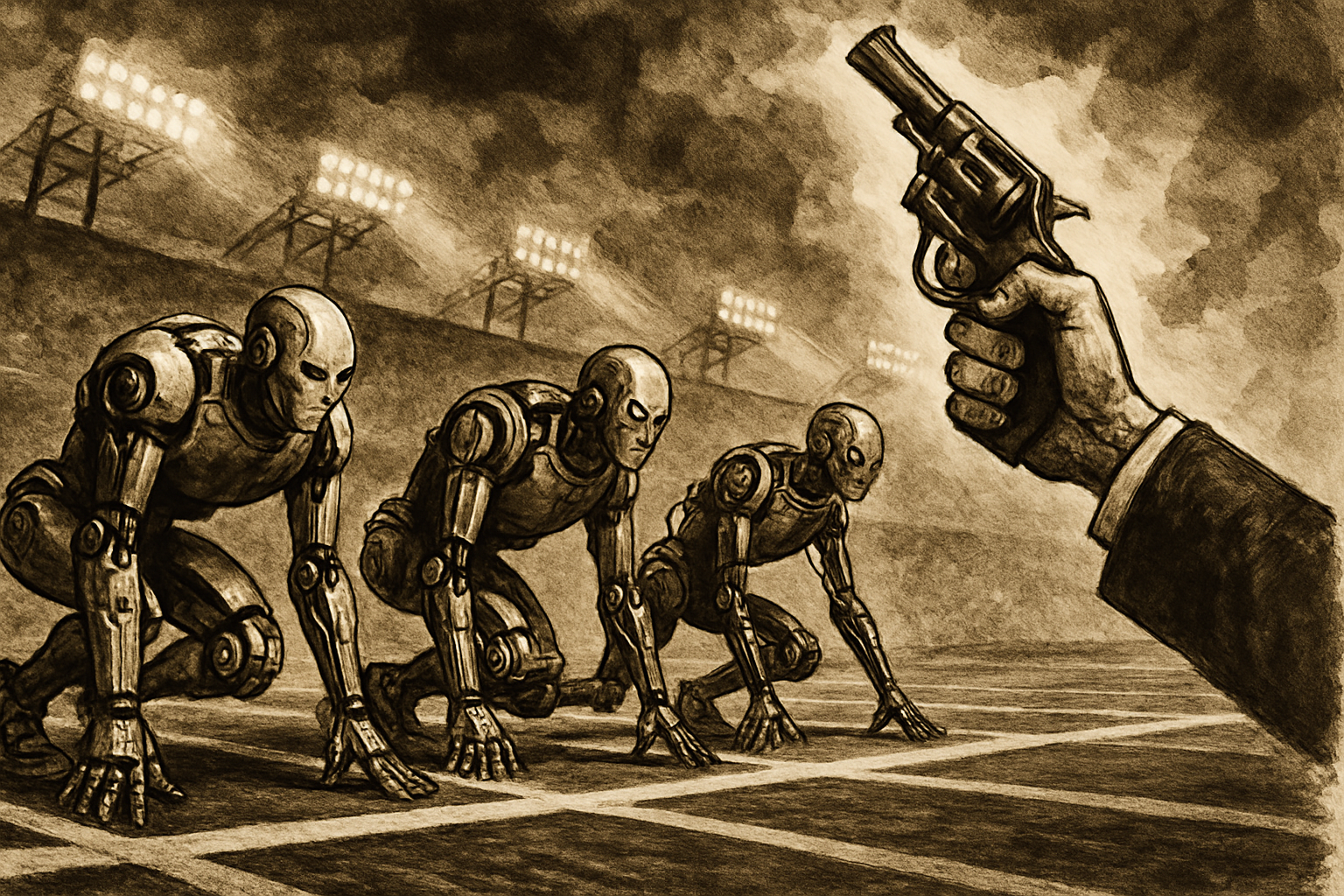
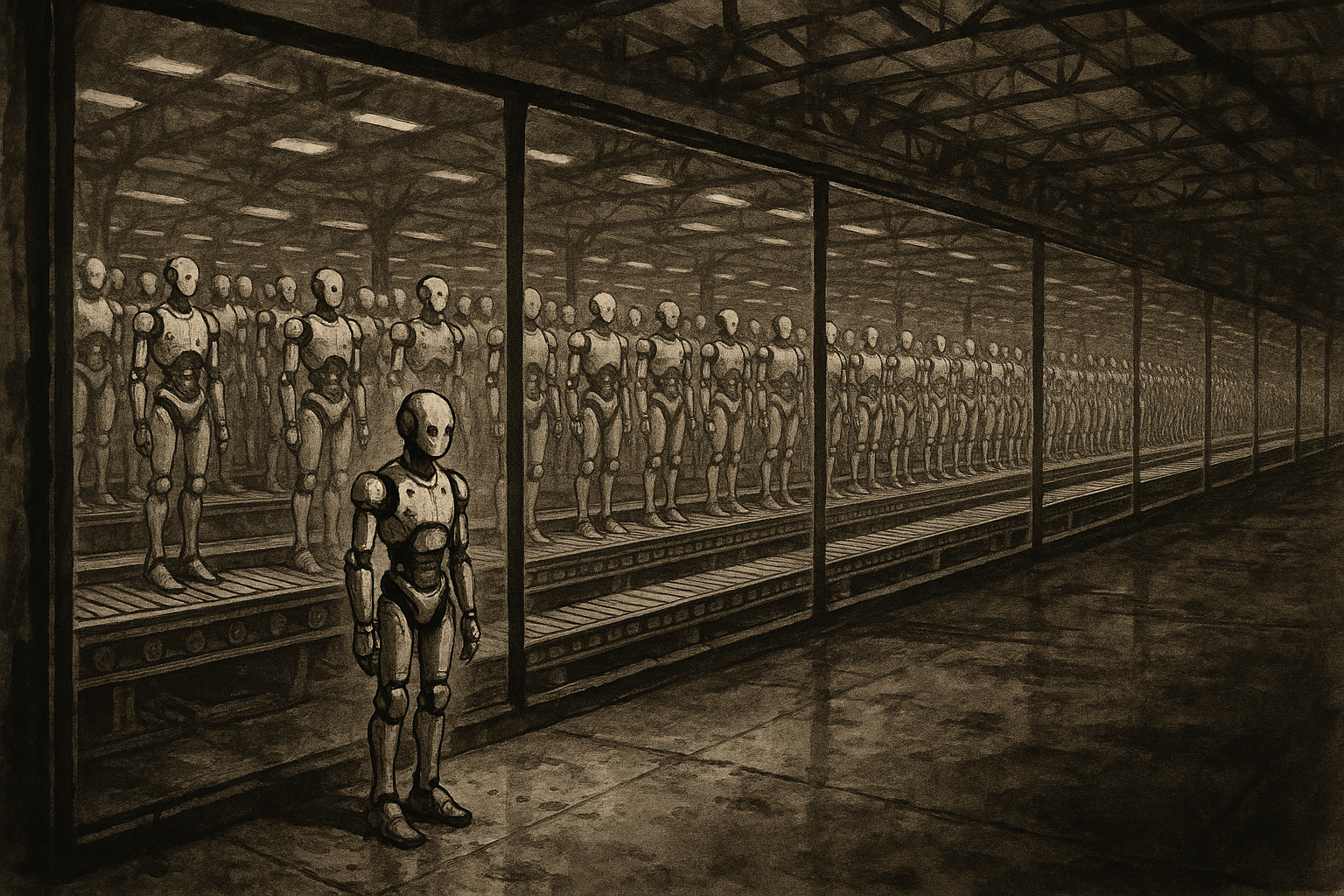
For most of the past decade, humanoid robots existed in a state of perpetual promise: impressive at demos, absent from work floors. That condition is ending in 2026. Tesla, Figure AI, Boston Dynamics, and 1X have each crossed a threshold that matters - from engineered prototypes to designed-for-manufacturing products - and they are doing so within months of one another. The competition is no longer about which robot looks most human. It is about which company can scale.
Tesla Optimus: the manufacturing moonshot
Tesla's Optimus Gen 3 is scheduled to be revealed before the end of Q1 2026, with production beginning at low volumes over the summer and high-volume lines targeting one million units per year set to activate later this year.[1] To free up factory space, Tesla is discontinuing its flagship Model S and Model X, retooling those Fremont lines for Optimus production. A separate Giga Texas facility is earmarked for a future 10-million-unit-per-year operation for subsequent generations.[2]
The engineering emphasis is on dexterity at scale. Tesla engineers have designed the Gen 3 hand with 22 degrees of freedom - close to the human hand's approximately 27 - enabling precision grip, fine manipulation, and load-bearing up to 45 lbs.[1] One Tesla engineer described the target: "It won't even look like a robot. It will look like a human in a superhero suit."[2] The cognitive architecture uses the same neural networks underpinning Tesla's Full Self-Driving system, with xAI's Grok integrated for language reasoning and human interaction.[1]
The rollout strategy is deliberately conservative: factory deployment at Tesla's own facilities first, with the dual purpose of proving the hardware and generating training data. Elon Musk has stated that the robots will not displace human workers but will instead amplify per-worker output.[2] Consumer sales are projected at a $20,000-$30,000 price point - ambitious, though dependent on a manufacturing ramp with no historical precedent in robotics.[1]
Figure 03: built from scratch for the home and factory floor
Figure AI unveiled its third-generation robot in October 2025, and its design philosophy differs materially from Tesla's. Where Tesla leverages existing automotive supply chains, Figure built an entirely new one.[3] Every major module - actuators, batteries, sensors, structural components, and electronics - was designed in-house, with Figure then identifying manufacturing partners capable of meeting the required volumes.
The result, according to Figure, is a 90% reduction in manufacturing cost compared to its second-generation robot, achieved by shifting from CNC-machined parts to tooled processes including die-casting, injection molding, and stamping.[3] Figure 03 is 9% lighter than its predecessor and designed for home safety, with multi-density foam at pinch points, soft textile coverings, and wireless inductive charging via coils in the robot's feet. Its first-generation manufacturing facility, BotQ, is rated for up to 12,000 units per year, with a four-year goal of 100,000 total units.[3]
The AI backbone is Figure's own Helix vision-language-action model, which the company has designed Figure 03's hardware to serve directly. Each hand includes an embedded palm camera for close-range visual feedback, fingertip tactile sensors detecting forces as light as three grams, and a 10 Gbps mmWave data offload link for continuous fleet learning.[3] The bet is that robots trained end-to-end on rich sensory data at home will generalize readily to commercial environments - a less proven path than Tesla's factory-first approach, but potentially more versatile.
Boston Dynamics Atlas: enterprise-grade and sold out
Boston Dynamics took the most direct path to market: skip the consumer pitch entirely and sell to industry. The company unveiled the production version of its new Atlas robot at CES in January 2026, and all 2026 deployments are already committed - fleets shipping to Hyundai's Robotics Metaplant Application Center and Google DeepMind, with additional customers deferred to 2027.[4]
The specs reflect an enterprise design brief: 56 degrees of freedom, a reach of 2.3 meters, a 50 kg lift capacity, and an operating range of -20°C to 40°C.[4] Atlas autonomously navigates to charging stations and swaps its own batteries, eliminating the downtime that typically plagues industrial robot deployments. It integrates directly with MES and WMS systems via Boston Dynamics' Orbit software, and task knowledge learned by one unit replicates instantly across the entire fleet.[4] A new partnership with Google DeepMind is designed to embed foundation models into Atlas for broader cognitive flexibility.
The backing is formidable: majority shareholder Hyundai Motor Group has announced a $26 billion investment in U.S. operations, including a robotics factory targeting 30,000 units per year.[4] Boston Dynamics is not trying to sell to consumers or outprice the competition - it is trying to become the default infrastructure provider for industrial automation at the highest tier of reliability.
1X NEO: the quiet bet on the home
While its rivals chase factories, 1X is targeting the most unstructured environment of all: the private home. The OpenAI-backed Norwegian startup is now taking $200 deposits for NEO, its bipedal home robot, making it the only company in this cohort with an open consumer pre-order.[5] The hardware reflects the mission: at 66 lbs, NEO is the lightest robot in this group, wrapped entirely in a deformable 3D-lattice polymer and a machine-washable knit suit. Its tendon-driven actuators are pinch-proof by design, and the robot operates at 22 dB - quieter than a modern refrigerator.
The AI architecture has evolved significantly in early 2026. On March 17, 1X announced that its World Model - originally developed as a video-prediction and simulation tool - now serves as NEO's cognitive core, enabling the robot to attempt arbitrary voice-commanded tasks fully autonomously without task-specific programming.[6] The underlying generalist model, called Redwood AI, handles chore learning and repetition, while a built-in LLM drives conversation and reasoning. A collaboration with NVIDIA's GEAR Lab, announced in January 2026, has NEO learning household tasks - including dishwashing - directly in employees' homes, using NVIDIA's robotics platform for simulation and onboard inference via the Jetson Thor chipset.[7]
The leadership buildout signals preparation for scale. Mohi Khansari, formerly a Distinguished AI Engineer at 1X, was elevated to Head of Robot Learning in January 2026.[8] Vikram Kothari, who spent over eight years at SpaceX managing supply chains for Dragon, Starship, and Raptor, joined as VP of Operations - a pointed hire for a company approaching production.[8] Where that production will happen and at what volumes remains undisclosed, but the operational groundwork is being laid at the company's Palo Alto headquarters.
1X's wager is distinct from every other player in this race: that the home - chaotic, personal, and trust-dependent - is the market that matters most, and that a robot light enough to be safe, quiet enough to be tolerable, and smart enough to generalize will get there before hardware engineered for factory floors can be retrofitted for living rooms.
The race's real question
The four companies are solving different problems. Boston Dynamics is selling a proven product to deep-pocketed industrial customers with specific use cases. Figure is building a general-purpose platform whose ultimate value is a bet on AI generalization. Tesla is attempting something without precedent: consumer-priced humanoid robots at automotive scale. And 1X is making the quietest but perhaps most audacious wager - that the first humanoid to earn genuine trust in the home will define the category.
What unites them is the timing. Every major player has crossed into production simultaneously, which means 2026 will generate real-world data on what humanoid robots can and cannot do reliably - not in controlled demos, but on actual factory floors and, for Figure and 1X, in homes. That data will be more informative than any benchmark, and it will likely concentrate investment and talent into fewer hands very quickly.
The sprint has started. The distance is unknown.
Sources