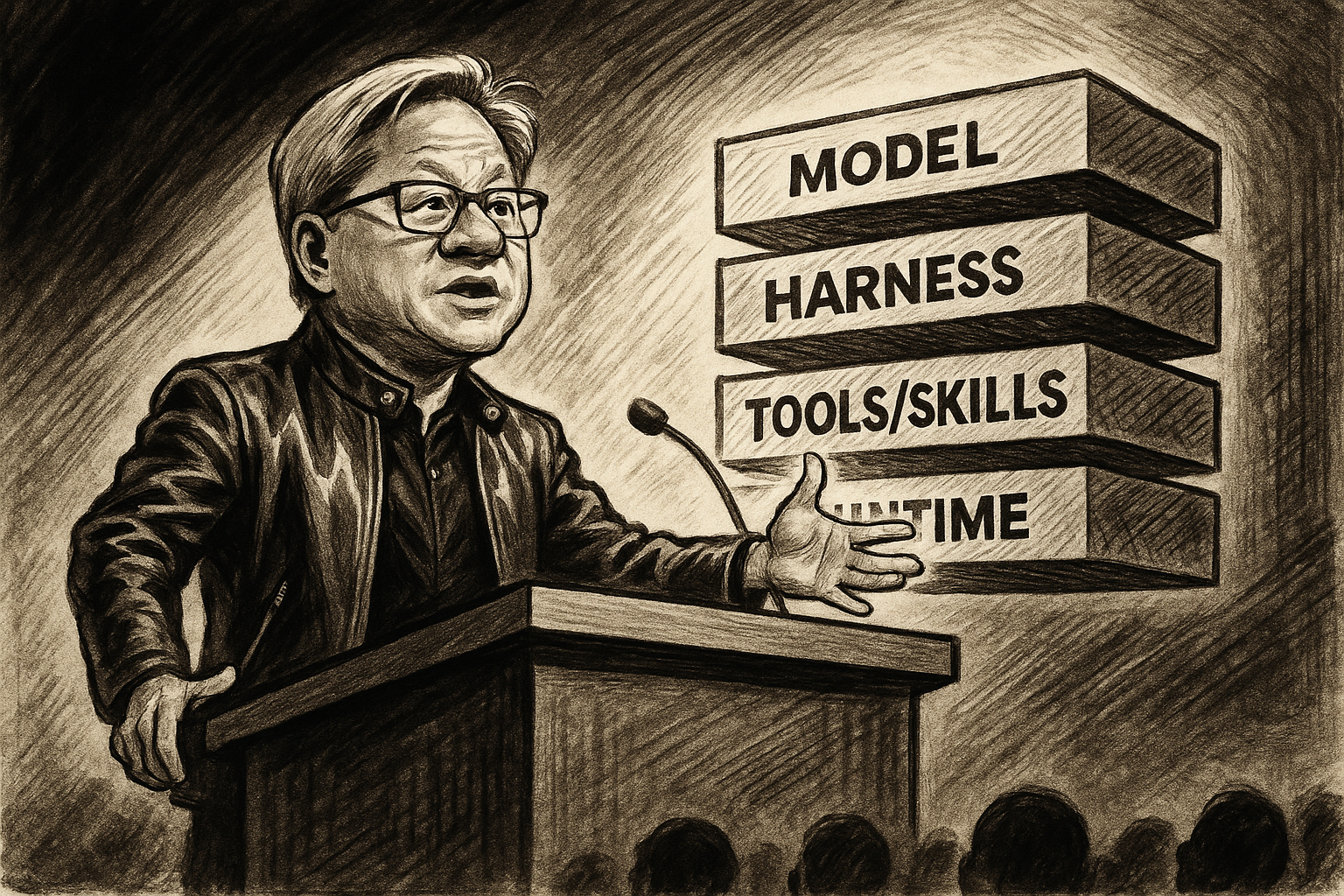
At GTC Taipei in early June, Jensen Huang offered what he called his simplest explanation of an AI agent: a worker in a workshop.[1] The model thinks. The harness gives it form. Tools and skills let it act. The runtime gives it somewhere to get work done. Four layers, one worker.
The metaphor is cleaner than most, and that is partly the point. But strip away the keynote staging and Huang's framing turns out to be more than positioning. It is the organizing logic behind a concrete product announcement, and it reveals something important about where NVIDIA believes the AI business is actually heading.
Why the model is not the agent
The most consequential idea in Huang's formulation is also its quietest one: the model is only one component. A language model left to itself has no memory between sessions, no access to external data, no ability to call a tool, and no policy guardrails. It cannot persist a multi-day task or delegate work to another model. It reasons, but it cannot act.
The harness is what closes that gap. It manages context across long-running workflows, orchestrates handoffs between agents, enforces security boundaries, and translates the model's outputs into real-world operations. The term crystallized in February 2026, when Mitchell Hashimoto published a blog post describing how he had learned to engineer the environment around an AI agent rather than the agent itself - coining "harness engineering" with the caveat that he wasn't sure if the industry had a name for it yet.[2] Huang adopted the term at GTC Taipei because it already had conceptual weight with the audience he wanted to reach.
What Huang added was the other two layers. Tools and skills are distinct from the harness itself: they are reusable capabilities an agent can invoke without being retrained to acquire them. The runtime is the execution environment that holds everything together under enforceable security policies. The four layers are logically separable, which is exactly why NVIDIA structured its Agent Toolkit around all four of them.
What NVIDIA actually shipped
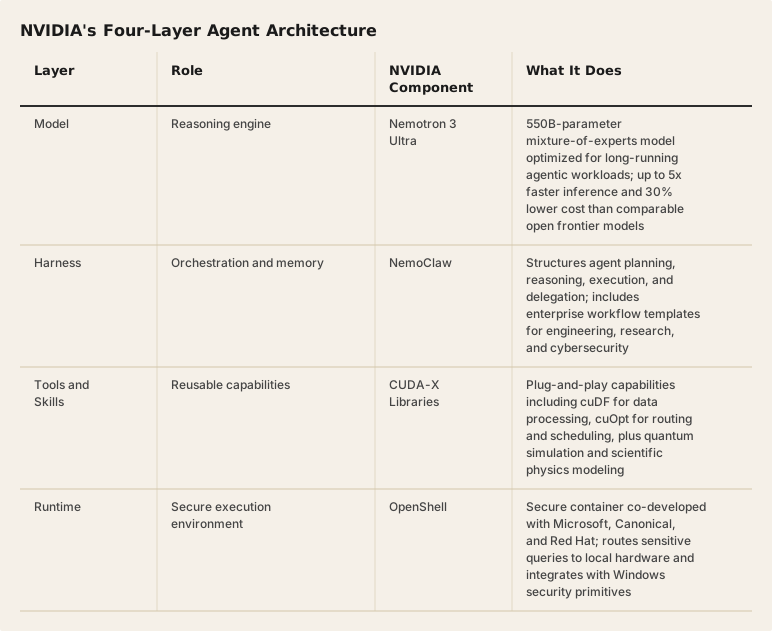
The runtime layer is where NVIDIA made the most security-forward bet. OpenShell is a secure container environment co-developed with Microsoft, Canonical, and Red Hat that routes sensitive queries to local hardware, masks data before it touches cloud models, and integrates with Windows security primitives to keep agents within explicitly authorized boundaries. It launched as an early preview alongside the broader toolkit.[3]
The model layer is served by Nemotron 3 Ultra, a 550 billion-parameter mixture-of-experts model - with 55 billion parameters active per inference pass - built for long-running agentic workloads.[4] NVIDIA claims it delivers up to five times faster inference and roughly 30 percent lower running costs than comparable open frontier models, with particular strengths in coding and research reasoning.[3] It launched June 4, available through Hugging Face, ModelScope, OpenRouter, and NVIDIA's own Build platform.
NemoClaw is the harness blueprint: a framework that structures how agents plan, reason, execute, and delegate, with ready-made templates for enterprise workflows in engineering, research, and cybersecurity.[3] And for tools and skills, NVIDIA exposed several of its CUDA-X libraries as plug-and-play agent capabilities. An agent equipped with cuDF can process massive structured datasets and reason over the results. One with cuOpt can solve routing, scheduling, and resource-allocation problems in real time. Others provide access to quantum simulation, scientific physics modeling, and enterprise research workflows. The point is that an agent does not need to be trained on these capabilities: it can acquire them at runtime like a contractor picking up a new piece of equipment.
NVIDIA's four-layer agent stack, from model down to runtime, with the corresponding product at each layer.
The competitive logic underneath the metaphor
NVIDIA has sold chips into the model training race for years. The Agent Toolkit is a bet that the next race is different, and that the winner will be whoever controls the platform every agent runs on. Not the agent itself, but the substrate beneath it.
Four early adopters NVIDIA was able to name at launch illustrate the ambition: Cadence used OpenShell to deploy a chip-verification super-agent; Siemens built an EDA orchestration agent for PCB workflows; CrowdStrike adapted Nemotron 3 Ultra for continuous security vulnerability remediation; and Palantir integrated multiple models into its Forward Deployed Engineer platform to create autonomous, air-gapped systems.[3] Whether these are production deployments or co-marketing pilots that outlast the keynote cycle is the question that will actually settle the thesis - launch-partner lists tell you who was ready to put their name on a press release, not yet who is committed to the full stack.
That distinction matters because the underlying bet is a familiar one. The model quality race has narrowed to the point where frontier performance is increasingly commoditized. What enterprises cannot easily replicate is a vertically integrated stack where the GPU, the model, the harness, the skills, and the secure runtime all have the same vendor's fingerprints on them. When something breaks, there is one throat to choke. That is an old enterprise sales argument dressed in new architecture.
What the workshop metaphor leaves out
Huang's worker-in-a-workshop frame is useful precisely because it is clean. But practitioners building production systems have already started extending it. Hashimoto's own account of harness engineering points to the gap directly: the harness must not only orchestrate and delegate, it must give the agent fast, high-quality feedback when it is wrong - tools that catch errors before they propagate, scripts that verify outputs, environments that surface failure rather than silently absorb it.[2] That is observability under a different name, and it is conspicuously absent from Huang's four-layer diagram.
Enterprise governance adds another layer the keynote framing glosses over. Routing between agents is the easier half of orchestration. Deterministic control over execution order, under what conditions an agent can escalate or spawn sub-agents, and how conflicting instructions from different principals get resolved - these are the problems that surface after deployment, not before it. A workshop metaphor implies a controlled environment; production AI agents often operate in environments that are neither controlled nor fully legible.
None of this is a knock on the framework. It is a reminder that four-layer diagrams are starting points, not blueprints. The NVIDIA Agent Toolkit ships the model, the harness, the skills, and the runtime. What it cannot ship is the institutional knowledge required to connect them to real business processes and keep them there.
The risk in the reading
The argument here is that NVIDIA's four-layer stack is a deliberate bid for platform control, not just a helpful framework. That reading rests on convergence: a metaphor, a product announcement, and a set of early enterprise adopters all pointing in the same direction. It does not establish intent, and NVIDIA's open-source release of NemoClaw is a genuine tension with the "one throat to choke" thesis. An open-source harness is by definition forkable, and the ecosystem may fragment across vendors in ways that prevent any single platform from achieving the lock-in the argument implies.
It is also worth holding the alternative: that Huang's framework is simply the clearest conceptual map the industry has produced for a genuinely hard problem, and the toolkit that follows is an honest attempt to lower the barrier to production deployment rather than a calculated land-grab.
The observable that will settle it is specific: watch whether the named adopters renew past their pilot terms on the full NVIDIA stack, or whether they use NemoClaw as a starting point and build their own layers on top. NVIDIA is selling the workshop. Whether enterprises decide they want to own one is still an open question.