AI Infrastructure
Vol. 1·Thursday, June 25, 2026
AI's Water Problem Is Real. It's Just Not the One You've Been Told About.
Noah Ogbi16 min read
Tips, corrections, or questions? support@omniscient.media
Tips, corrections, or questions? support@omniscient.media
Get this every weekday.
The Omniscient Bulletin: consequential AI, explained and evaluated. 5 to 7 items a day with the take, not the recap.
Sign in to join the discussion.
Two numbers about artificial intelligence and water are circulating, and they sit about a thousand times apart. One holds that generating a single 100-word email with a chatbot can consume a 500-milliliter bottle of water.[1] The other, offered by OpenAI's chief executive, puts an average query at about 0.000085 gallons, "roughly one fifteenth of a teaspoon."[2] Both come from credible-sounding places. Both, in the way they are usually quoted, miss what actually matters.
The honest account of AI's water use is not in the per-query figure the argument keeps circling. It is in three facts that rarely lead the story. Most of the water is consumed where you cannot see it, evaporated at the power plant rather than inside the data center. The national total is genuinely small, but the local burden is not. And the companies doing the drawing have, until very recently, disclosed remarkably little about it. Put those together and the picture is neither the catastrophe of the viral posts nor the rounding error of the corporate blog. It is a real and fixable problem that almost everyone is describing with the wrong number.
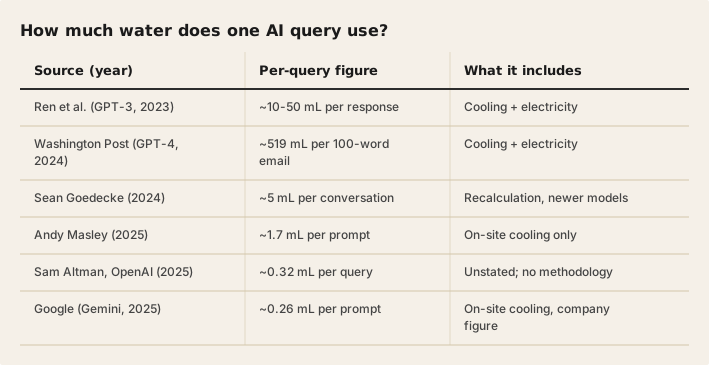
The figure that launched the panic traces to a 2023 paper by Pengfei Li, Shaolei Ren, and colleagues at UC Riverside and UT Arlington, titled "Making AI Less Thirsty."[3] Its headline estimate: training GPT-3 in Microsoft's U.S. data centers could directly evaporate about 700,000 liters of clean freshwater, and roughly 5.4 million liters once the water used to generate the electricity is counted.[3] For everyday use, the authors wrote that GPT-3 "needs to 'drink' (i.e., consume) a 500ml bottle of water for roughly 10 to 50 medium-length responses."[3]
Read that sentence carefully, because almost everyone drops half of it. The bottle covers ten to fifty responses, not one, and the range depends on where and when the model runs. In September 2024 a Washington Post investigation, done with Ren's group, restated the idea for GPT-4 as roughly one 500-milliliter bottle to write a single 100-word email, a number that bundles both on-site cooling and off-site electricity water.[1] That reframing, one email equals one bottle, is the version that went everywhere.
It did not go unchallenged. The engineer Sean Goedecke recomputed the chain and argued that a realistic conversation, on far more efficient modern models, lands closer to 5 milliliters than 500.[4] The writer Andy Masley pointed out that the original figure covered 10 to 50 prompts, not one, and that roughly 85 percent of the water in that accounting comes from electricity generation rather than the data center itself.[5] Then came Sam Altman's teaspoon. In a June 2025 blog post he wrote that an average ChatGPT query "uses about 0.34 watt-hours" of energy and "about 0.000085 gallons of water; roughly one fifteenth of a teaspoon."[2] He offered no methodology, no model, and no hint of whether the figure includes the electricity or only the cooling. Google, publishing measured figures for its Gemini models the same year, put a median text prompt at about 0.26 milliliters, "the equivalent of five drops of water."[6]
Line the estimates up and the spread is almost comic: from a quarter of a milliliter to more than half a liter for "one query." The gap is not fraud. It is the absence of a shared definition. The numbers differ on which model, on whether a "query" is one response or a whole conversation, and above all on whether the count includes the water burned to make the electricity. The per-query figure, in other words, is the least useful number in the entire debate, and it is the one the public fights about.
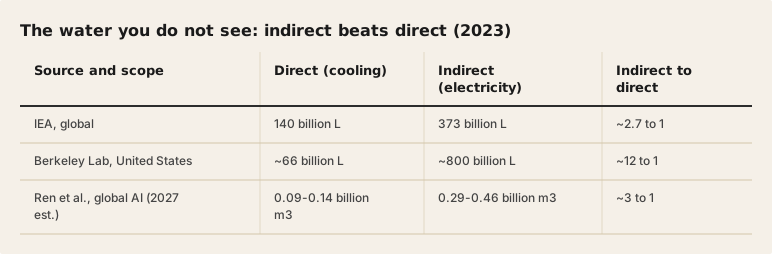
Strip away the per-query noise and the first real finding appears: the water that matters most is not the water that cools the servers. It is the water evaporated at the power plants that feed them. Most electricity in the United States still comes from thermoelectric generation, from coal, gas, and nuclear plants that boil and evaporate water to spin turbines and shed heat. Every kilowatt-hour a data center draws carries that hidden water with it.
The numbers are lopsided. The International Energy Agency estimated that data centers worldwide consumed about 560 billion liters of water in 2023, of which roughly two-thirds was indirect water tied to electricity and only about a quarter was direct cooling water.[7] Lawrence Berkeley National Laboratory put U.S. direct cooling water at about 17.4 billion gallons in 2023, against an indirect figure several times larger.[9] However it is sliced, the indirect water exceeds the direct, often by a wide margin. That ratio also appears to be understated: where the IEA implies roughly 1 liter of water per kilowatt-hour of electricity, Meta's own disclosures imply closer to 3.6, and Berkeley Lab's U.S. figure is about 4.5.[8]
This is why the cleanest-sounding fix can backfire. Cooling a data center with air instead of evaporating water saves on-site water but raises electricity use, and that extra electricity carries its own water at the power plant. Microsoft, announcing a "zero-water" cooling design in December 2024, was candid about the trade. The closed-loop system, it said, is "filled during construction" and then "continually circulate[s] water between the servers and chillers... without requiring a fresh water supply," avoiding "more than 125 million liters of water per year per datacenter."[10] But the company also conceded that replacing evaporative cooling with mechanical cooling would raise its power use, a "nominal increase in our annual energy usage."[10] On a fossil-heavy grid, water saved at the rack can reappear at the generator. There is no free coolant.
At a national scale, data centers are a minor water user. The U.S. Geological Survey put total American water withdrawals at about 322 billion gallons per day in 2015, led by thermoelectric power at 133 billion and irrigation at 118 billion.[11] Against those rivers of water, even the high-end data-center totals are a rounding error, and the direct cooling portion is smaller than what the country's golf courses consume.
The aggregate is the wrong lens, though. As Shaolei Ren and Microsoft's Amy Luers wrote in IEEE Spectrum in 2025, "on the national level, data centers' water use is relatively modest," but "the biggest stress may not be total use, but timing. On hot days when residents and businesses need water most, data-center water demand spikes too."[12] The siting compounds it: by their account, "about two-thirds of U.S. data centers built since 2022 are in high water-stress areas."[12] Much of that water does not come back. Companies estimate that between 45 and 60 percent of the water they withdraw is consumed, evaporated rather than returned to the local source.[12] In Newton County, Georgia, the authors note, "some proposed data centers have reportedly requested more water per day than the entire county uses daily."[12] A use that is trivial as a national average can still drain a single watershed at the worst possible moment.
The abstractions turn concrete in the towns that host the machines. In The Dalles, Oregon, Google fought a legal battle, bankrolling the city's effort to keep its data centers' water use secret, until a 2022 settlement forced disclosure. The records showed the data centers used 355 million gallons in 2021, about 29 percent of the city's entire water supply, after which Google agreed to stop treating site-level water as a trade secret.[13]
In West Des Moines, Iowa, the Associated Press found that in July 2022, the month before OpenAI finished training GPT-4 in Microsoft's cluster there, the site drew about 11.5 million gallons of water, roughly 6 percent of the district's total. The same reporting documented Microsoft's global water use jumping 34 percent in a single year, to nearly 1.7 billion gallons, a rise researchers tied to AI.[14]
In Uruguay, during the worst drought in seven decades, a proposed Google data center planned to draw about 7.6 million liters of potable water a day, the daily supply of roughly 55,000 people, while Montevideo's tap water turned salty enough to trigger government warnings. Protesters adopted the slogan "no es sequia, es saqueo" - it is not drought, it is pillage - and Google later redesigned the project to use air cooling.[15]
In Memphis, Tennessee, xAI's "Colossus" supercomputer draws cooling water from the Memphis Sand Aquifer, the region's sole source of drinking water, even as the company fought separate battles over unpermitted gas turbines. xAI broke ground in October 2025 on an 80-million-dollar recycled-water plant meant to supply the data center with treated wastewater, then paused the project in April 2026 to prioritize a second data center, drawing rebukes from the city and its utility.[16]
The pattern across all four is consistent, and it is not about volume. It is about drawing potable water, in stressed places, at stressed times, with as little public disclosure as the operator can manage.
The disclosure picture has improved, unevenly. Google reported consuming roughly 7 billion gallons of freshwater across its operations in 2024, replenishing about 4.5 billion gallons of that total, representing roughly 64 percent of its freshwater consumption.[17] Microsoft reported consuming about 5,800 megaliters, around 1.5 billion gallons, in fiscal 2024, though that figure dipped partly because the company changed how it estimates sites without meters, not only because it used less.[18] Meta reported about 3,100 megaliters consumed in 2024.[19] Amazon, the laggard, disclosed an absolute figure for the first time only in June 2026, saying it withdrew about 2.5 billion gallons across its global data centers in 2025.[20] The gap between "withdrawal" and "consumption," routinely blurred in coverage, matters: the first is what you take, the second is what you do not give back, and they can differ by roughly half.[21]
All four have pledged to become "water positive," to replenish more water than they consume by 2030, largely by funding restoration projects. The promise is softer than it sounds. The pledges generally exclude the larger indirect water embedded in the electricity these companies buy. And the geographic mismatch is fundamental: a company restoring a wetland in one river basin provides no relief to the aquifer its data center is drawing down in another state. One widely cited survey found that fewer than a third of data-center operators even tracked their water consumption, and while that 2016 finding has improved, site-level disclosure remains the exception rather than the rule.[21]
The engineering answers are real, and each carries a cost. Closed-loop and air-cooled designs, like Microsoft's zero-water sites whose pilot locations began construction in 2026 and are slated to come online in late 2027, can cut on-site cooling water to almost nothing, at the price of more electricity and therefore more indirect water.[10] Recycled and non-potable water can replace freshwater for cooling, as xAI plans in Memphis and as Google and Meta already do at several sites, where supply and permits allow. Smarter siting, putting thirsty workloads in cool, water-rich regions rather than the deserts of the U.S. Southwest, helps most of all. And sheer efficiency moves the needle: Google credits hardware and cooling gains for getting a Gemini prompt down to five drops.[6]
But the central constraint does not disappear. Water and energy are a seesaw. Spend less of one and you usually spend more of the other, and on most grids more energy means more water somewhere upstream. The only real escape is a cleaner grid, since solar and wind consume almost no water per kilowatt-hour, which is why the water question and the carbon question are, in the end, the same question.[8]
So how thirsty is AI, really? Per query, trivially so, somewhere between a few drops and a few milliliters, and the viral "bottle per email" is an artifact of counting a whole conversation plus the power plant behind it. In aggregate, AI's water use is small against agriculture and conventional power. The IEA projects global data-center water consumption will roughly double, to about 1.2 trillion liters, by 2030, which means the window for better siting and disclosure rules is shorter than it looks.[7] The problem that survives scrutiny is none of those headline framings. It is that this water is increasingly drawn from potable supplies, in drought-prone counties that did not choose the burden, at the hottest hours of the year, to power the least visible part of the system, and that the firms doing it have been slow to say how much.
The volume is manageable. The siting, the timing, the source, and the secrecy are not.
The Washington Post, "A bottle of water per email: the hidden environmental costs of using AI chatbots," September 18, 2024 (with Shaolei Ren's group; roughly a 500 mL bottle per 100-word GPT-4 email, counting cooling and electricity water) Inline ↗
Sam Altman, "The Gentle Singularity," June 2025 ("the average query uses about 0.34 watt-hours... It also uses about 0.000085 gallons of water; roughly one fifteenth of a teaspoon"; no methodology provided) Inline ↗
Pengfei Li, Jianyi Yang, Mohammad A. Islam, Shaolei Ren, "Making AI Less 'Thirsty,'" arXiv:2304.03271, Communications of the ACM, 2025 (GPT-3 training roughly 700,000 L on-site and 5.4 million L total; "a 500ml bottle of water for roughly 10 to 50 medium-length responses") Inline ↗
Sean Goedecke, "Talking to ChatGPT costs 5ml of water, not 500ml," October 28, 2024 Inline ↗
Andy Masley, "Using ChatGPT is not bad for the environment," January 2025 (500 mL per 10 to 50 prompts, not per prompt; roughly 85 percent of the figure is electricity generation, not on-site cooling) Inline ↗
Amin Vahdat and Jeff Dean (Google), "Measuring the environmental impact of AI inference," Google Cloud Blog, August 21, 2025 ("the median Gemini Apps text prompt... consumes 0.26 milliliters (or about five drops) of water") Inline ↗
International Energy Agency, "Energy and AI," 2025 (global data-center water consumption about 560 billion L in 2023, split roughly two-thirds indirect and about one-quarter direct; projected to roughly double to about 1.2 trillion L by 2030) Inline ↗
Alex de Vries-Gao, "The carbon and water footprints of data centers and what this could mean for artificial intelligence," Patterns (Cell Press), 2025 (IEA understates indirect water intensity: about 1 L/kWh implied versus Meta's roughly 3.6 to 3.9 and Berkeley Lab's roughly 4.5 L/kWh) Inline ↗
Arman Shehabi et al., "2024 United States Data Center Energy Usage Report," Lawrence Berkeley National Laboratory (LBNL-2001637), December 2024 (U.S. data centers consumed about 66 billion liters of water on-site in 2023, roughly 17.4 billion gallons) Inline ↗
Steve Solomon (Microsoft), "Sustainable by design: next-generation datacenters consume zero water for cooling," December 9, 2024 (closed-loop design; avoids more than 125 million liters per datacenter per year; pilots in Phoenix and Mt. Pleasant begin 2026, come online late 2027; acknowledges nominal increase in energy use) Inline ↗
U.S. Geological Survey, "Estimated Use of Water in the United States in 2015," Circular 1441 (total U.S. withdrawals about 322 billion gallons per day; thermoelectric power about 133 billion and irrigation about 118 billion) Inline ↗
Shaolei Ren and Amy Luers, "The Real Story on AI's Water Use and How to Tackle It," IEEE Spectrum, September 10, 2025 (national use "relatively modest"; timing stress; about two-thirds of U.S. data centers built since 2022 in high water-stress areas; 45 to 60 percent of withdrawn water consumed; Newton County, Georgia example) Inline ↗
Data Center Dynamics, "We now know how much water Google's Oregon data centers use, after city drops lawsuit against journalists," December 19, 2022 (The Dalles: 355.1 million gallons in 2021, about 29 percent of city water) Inline ↗
Associated Press (via Fortune), "AI fuels a spike in Microsoft's water consumption," September 9, 2023 (West Des Moines cluster used about 11.5 million gallons in July 2022; Microsoft global water up 34 percent to nearly 1.7 billion gallons) Inline ↗
Mongabay, "The cloud vs. drought: Water-hog data centers threaten Latin America, critics say," November 2023 (Uruguay data center planned about 7.6 million liters per day, equivalent to roughly 55,000 people's daily supply; the "no es sequia, es saqueo" campaign) Inline ↗
E&E News / Politico, "Musk promised his data center would reuse water. That's now stalled," May 4, 2026 (xAI Colossus Memphis Sand Aquifer; $80 million recycled-water plant groundbreaking October 2025; project paused April 2026 to prioritize Colossus 2) Inline ↗
Google, 2025 Environmental Report (fiscal 2024): replenished approximately 4.5 billion gallons of water, representing roughly 64 percent of Google's freshwater consumption in 2024, implying total consumption of approximately 7 billion gallons Inline ↗
Microsoft, 2025 Environmental Sustainability Report Data Fact Sheet (fiscal 2024): about 5,807 megaliters consumed in FY2024; decline partly reflects updated estimation method for unmetered sites Inline ↗
Meta, 2025 Environmental Data Index (fiscal 2024): about 3,123 megaliters consumed in 2024; pledge to be water positive by 2030 Inline ↗
Amazon, "How much water Amazon's data centers use," June 2026: first absolute disclosure, about 2.5 billion gallons withdrawn globally in 2025, down 2 percent from 2024 Inline ↗
Environmental and Energy Study Institute, "Data Centers and Water Consumption," June 2025 (withdrawal vs. consumption distinction; fewer than a third of operators tracked water consumption as of 2016) Inline ↗