AI Infrastructure
The Permit Built for Dry Cleaners Is Now Powering OpenAI's Biggest Data Center
In Abilene, Texas, a "small first, big later" filing strategy let a gigawatt-scale gas plant skip the environmental review it would otherwise require. Two new EPA rules suggest Washington wants to make that the national default.
Tips, corrections, or questions? support@omniscient.media
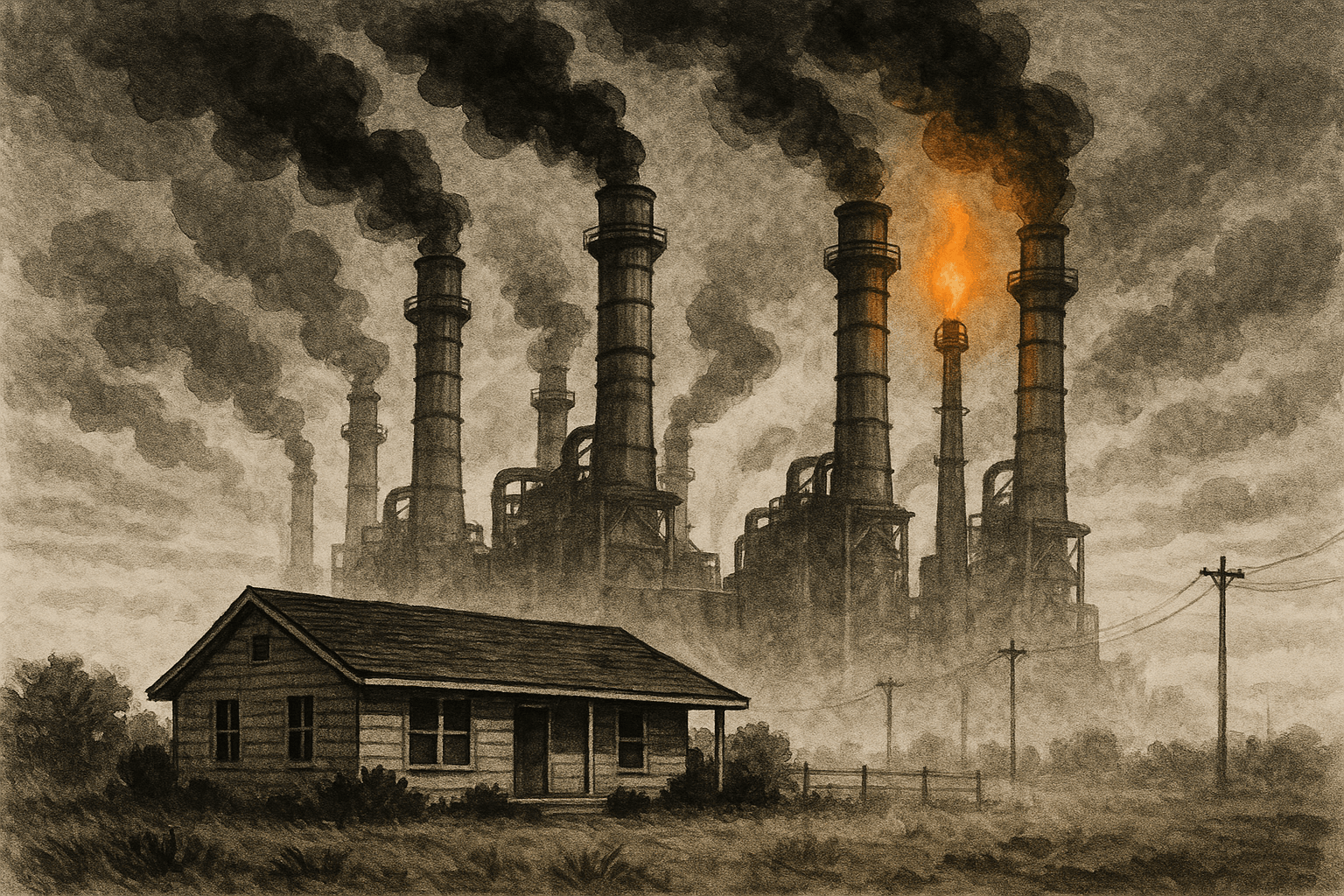
Omaira Garcia found out her Air Force veteran's ranch in Abilene, Texas had a new neighbor when dust clouds started rolling across her property in the summer of 2024. Nobody had told her. Today, ten gas-fired turbines sit roughly 500 yards from her kitchen window, part of the onsite power plant for OpenAI's flagship Stargate data center. "We weren't given any time to understand what this impact was going to be on us," she says. "We're trapped here."[1] The plant that boxed her in was never reviewed as a power plant at all.
What did the Floodlight investigation find at Stargate?
A minor air permit, in Texas environmental law, is the fast-track approval category state regulators reserve for small, common pollution sources: dry cleaners, gas stations, auto body shops. It requires no environmental study, no public notice, and no comment period, because the sources it covers are assumed to be too small to matter. A joint investigation by Floodlight and Wired, published July 9, found that Stargate's developer, Crusoe, used exactly this category to bring ten turbines and 62 backup diesel generators online at the Abilene site, a fleet now permitted to emit more than 1.6 million tons of greenhouse gases and 1,000 tons of combined air pollutants a year.[1] Stargate is not an isolated case: Floodlight counted at least 38 Texas data centers that have used minor permits to stand up onsite power since 2024, authorizing more than 2,100 backup diesel generators statewide.[1]
The scale is the tell. Bruce Buckheit, who ran EPA's air enforcement program across three Republican administrations before leaving the agency, told Floodlight that state agencies built the permit-by-rule process "for small things that happen a lot." Sixty-two backup generators at a single site, he said, is the point where "you start thinking, well, wait a minute, maybe the scale is wrong here."[1] Statewide, Texas now has more than 80 gigawatts of new gas-fired capacity in its construction pipeline, the largest of any U.S. state and, according to the researcher who tracked it, second only to China globally;[1] roughly half of it, 40 gigawatts, is earmarked to directly power data centers, according to Global Energy Monitor.[2]
How does the "small first, big later" strategy work?
File small, build, then expand once the site is already running: that is the sequence Floodlight documented at Stargate, and watchdogs say it is deliberate, not incidental. In 2024, Crusoe secured minor permits for the site's original ten turbines. A year later, with construction essentially complete, it filed its first major permit application, this one for 41 additional turbines and 18 more generators, an expansion that would make Stargate one of the largest fossil-fuel plants in Texas, capable of powering more than a million homes.[1] James Doty, a nearly three-decade veteran of the Texas Commission on Environmental Quality's air-quality monitoring staff, doesn't buy the idea that the timing was coincidental. "I sincerely doubt that the company made some last-minute decision to suddenly expand," he told Floodlight, noting that Stargate's developers were circulating materials as early as May 2025 describing contracts for 1.2 gigawatts of power.[1] The math came first; the paperwork followed.
By regulation, sequential permits for what is functionally one continuous project should be evaluated together under the EPA's "aggregation" policy, precisely to prevent developers from splitting a major source into a string of minor ones. Buckheit calls the practice by the name the agency's own enforcement handbooks use for it: sham permits.[1] More than half the data centers Floodlight examined filed nitrogen-oxide estimates suspiciously close to, but just under, the thresholds that would trigger public review; one San Antonio-area Vantage facility was permitted for 99.8 tons a year against a 100-ton cutoff.[1] By the time a major permit application does arrive and the public comment window finally opens, the plant is already running. "If a data center gets its operating permit, it's too late," Doty said.[1]
Is Texas an outlier, or the model Washington wants to adopt?
The evidence increasingly points to the latter. Two federal moves this year would take the Texas workaround and write it into national rule. On January 15, EPA finalized a New Source Performance Standard for stationary combustion turbines that exempts "low use" turbines from Title V major-source permitting entirely and explicitly recommends that states process the rest through general permits or, by name, permits by rule, the same category Crusoe used in Abilene.[3] Then, on July 7, EPA proposed a separate rule stripping public participation and transparency requirements from minor-source air permitting nationwide, a category the agency's own announcement notes includes the diesel and gas generator fleets data centers rely on.[4] Comments close August 21; a public hearing is set for July 22.[4]
Texas is simply the state where the pattern is furthest along, not the only one running it. Sierra Club's own count found 10,500 diesel generators clustered at Northern Virginia data centers, totaling nearly 27 gigawatts of capacity, with Amazon alone holding minor-source permits allowing its backup fleet to emit as much nitrogen oxide as a mid-sized coal plant, in the middle of the country's seventh-largest metro area.[5] Virginia is no exception, and neither is the Deep South. In Mississippi, the NAACP has sued xAI and MZX Tech over turbines classified as "temporary," a designation that also sidesteps permitting; the Justice Department has signaled it may intervene on the government's side to protect what it calls the country's "global AI dominance."[6] We've written before about local opposition becoming the AI buildout's binding constraint at the siting stage;[7] what Texas and the EPA's own rulemakings show is the industry's answer to that constraint: don't win the fight, avoid triggering it.
Why does the sequencing look like strategy, not an oversight gap?
A single company cutting a permitting corner could be an aggressive lawyer's call. Dozens of companies converging on the identical sequence, filing at thresholds that shave in just under the review trigger, then expanding only once bulldozers have already moved dirt, is something closer to an industry-wide business model. The unit economics favor it: a contested major-permit fight can take years and kill a project outright, as it has in other states;[7] a minor permit clears in weeks with no hearing at all. Once the turbines are running and the campus is drawing power, the political cost of shutting it down rises with every megawatt already delivered to a customer like OpenAI. Filing small is simply the cheaper path to the identical outcome, and enough operators have arrived at it independently that it now reads as the default strategy rather than any one company's exception.
The regulator built to catch this has already conceded it can't. Kathryn Guerra, a former TCEQ staffer now with Public Citizen, told Floodlight the agency is sitting on more than 1,400 unresolved enforcement cases and resolved just 39 of them last year, a clearance rate that would take 35 years to work through the current backlog alone, before a single new case is added.[1] TCEQ disputes the characterization, pointing to more than 100,000 investigations conducted in 2025 as evidence the low enforcement-action count reflects compliance, not neglect.[1] Both things can be true: a high investigation count and a permitting pipeline moving faster than any regulator, however diligent, can review it project by project.
The risk in the reading
The claim that "small first, big later" amounts to a coordinated strategy rests on pattern, not on any document showing companies compared notes. Buckheit's "sham permit" language is his characterization of EPA's own enforcement doctrine, not a legal finding against Crusoe, and Crusoe maintains its turbines are for backup use only, whatever their permitted capacity says. It is possible that dozens of operators reached the identical sequence independently simply because it is the fastest legal path available to everyone facing the same deadline pressure, without any operator intending to evade aggregation review specifically. The counterfactual also matters: if EPA's proposed rule is adopted after the August comment period closes, and if the pending Stargate expansion permit is granted as Guerra expects, the pattern documented in Abilene will not need to be read as an aberration exploiting a gap. It will be the system working exactly as designed, the same system that put ten turbines 500 yards from Omaira Garcia's kitchen window without ever asking her.
Sources
Evan Simon, "Data Centers Are Quietly Taking Over Texas. The Pollution Could Be Catastrophic," Wired/Floodlight, July 9, 2026 Inline ↗
"Betting big on data centers, U.S. now leads world for new gas power development," Global Energy Monitor, January 2026 Inline ↗
"New Source Performance Standards Review for Stationary Combustion Turbines and Stationary Gas Turbines," Federal Register, January 15, 2026 (91 FR 1910) Inline ↗
"EPA Proposes to Streamline State and Local Permitting Process for Minor Sources," U.S. EPA press release, July 7, 2026 Inline ↗
"EPA Proposes Air Pollution Exemption 'Deal' for Data Centers," Sierra Club press release, July 7, 2026 Inline ↗
Patrick J. Larkin and Mark J. Steger, "EPA's New Turbine Rules Provide Air Permitting Relief for Data Centers," Clark Hill, May 27, 2026 (discussing NAACP et al. v. X.AI Corp. and MZX Tech LLC, N.D. Miss.) Inline ↗
Omniscient Media, "AI's Next Bottleneck Isn't Silicon. It's the Zoning Board.", May 2026 Inline ↗
Get this every weekday.
The Omniscient Bulletin: consequential AI, explained and evaluated. 5 to 7 items a day with the take, not the recap.
Discussion
Commenting is open to existing reader accounts. Sign in if you have one.