Industry
Optimus: Five Years of Promises and One Factory Line to Prove Them
Tesla is converting a factory line to prove Optimus can manufacture at automotive scale, but the harder question, five years in, is how much of what the robot does on stage it actually does on its own.
Tips, corrections, or questions? support@omniscient.media
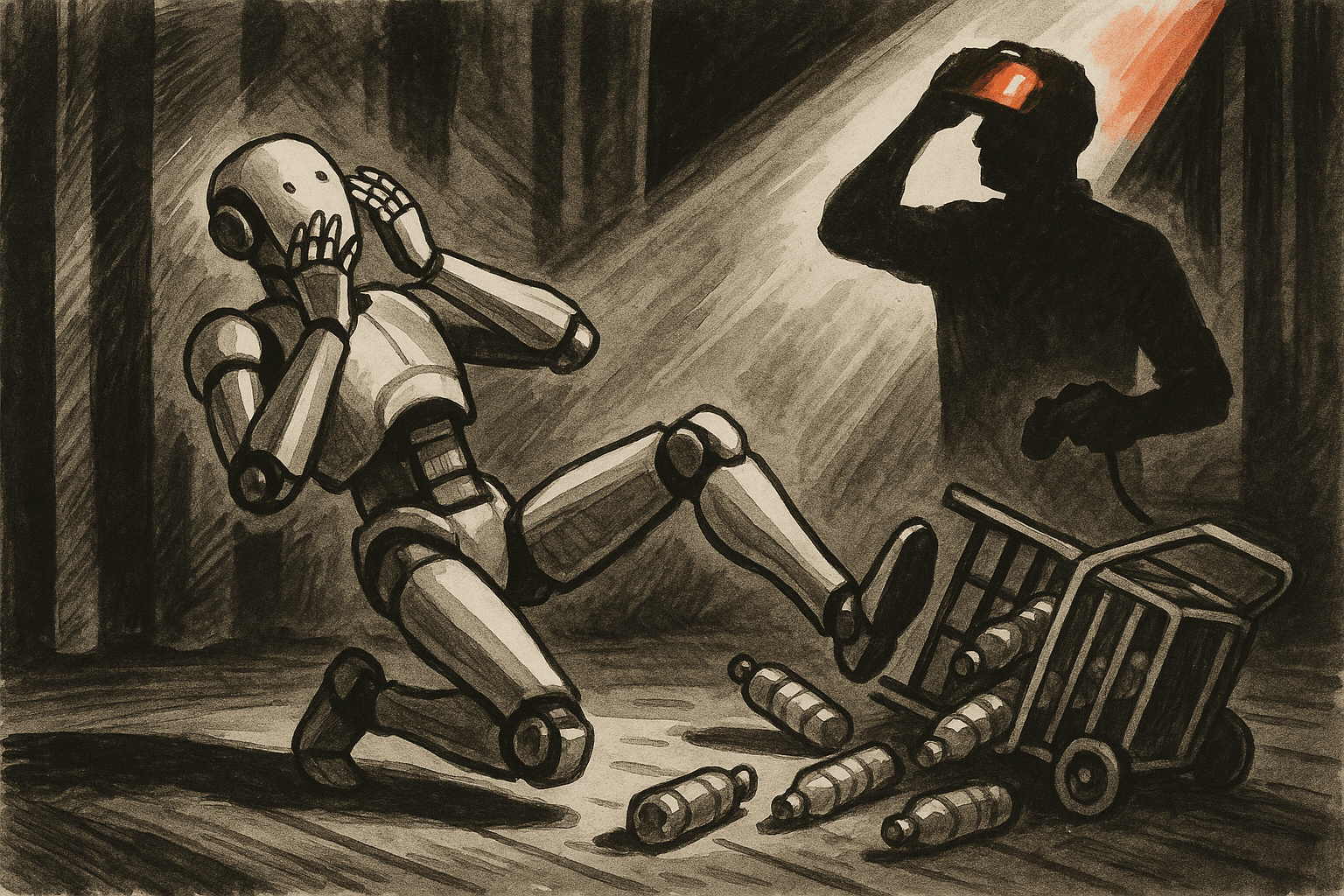
In December, at a Tesla event in Miami, a humanoid robot called Optimus stumbled while handing out bottled water, dropped its cargo, and toppled backward. That is unremarkable; bipedal robots fall. What drew attention was what its hands did on the way down: they snapped up toward its face in the unmistakable motion of someone yanking off a VR headset.[1] Optimus was not wearing a headset. Somewhere off-stage, according to the online sleuths who slowed the clip down, a human operator was.
That eight-second video is a useful lens for the entire Optimus program, now five years old. Elon Musk has called it, at various points, Tesla's most important initiative. On the 2022 earnings call where he first spelled out the scale of his ambition for the robot, he told investors Optimus "ultimately will be worth more than the car business and worth more than full self-driving."[21] By the summer of 2025, pressed again on where the robot ranked among Tesla's bets, his answer had not softened: "it will be the biggest product ever."[2] Tesla is now converting a wing of its Fremont factory, where Model S and Model X production ended in early May, after fourteen years for the Model S and eleven for the Model X, into an Optimus line, with volume manufacturing targeted for late July or August.[3] That's a serious industrial commitment. It sits alongside a five-year record of missed dates, a still-unresolved dispute over how much of what Optimus does on camera is actually autonomous, and a humanoid robotics field that, unlike Tesla, is already shipping.
What is Tesla actually trying to build with Optimus?
Optimus is Tesla's attempt at a general-purpose bipedal humanoid robot: a machine built to navigate spaces designed for humans and perform a wide range of physical tasks without task-specific hardware. Musk first described the idea at Tesla's AI Day on August 19, 2021, framing it explicitly as a reuse of assets the company already had: the neural networks trained for Autopilot's perception stack, the actuator and battery expertise from its cars, and the manufacturing muscle of a company that builds nearly two million vehicles a year.[4] That thesis, vertical integration across compute, actuation, and manufacturing, has not changed in five years. What has changed is the scale of the claim built on top of it.
The comparison Musk himself now invites is to Tesla's other big physical-AI bet, Robotaxi, a service still confined to a handful of cities and yet to turn a profit. By April 2026, on Tesla's Q1 earnings call, Musk's rhetoric about Optimus had not cooled: he framed the four-month Fremont conversion itself as a feat "I don't think any other company on Earth has ever done."[3] Whether that framing survives contact with a factory floor is the question the rest of 2026 is supposed to answer.
How has Optimus's design changed since the first prototype?
The program's history is a story of narrowing gaps between announcement and hardware. The 2021 unveiling was a person in a spandex robot suit; Musk promised a working prototype "sometime next year."[4] At AI Day 2022, Tesla delivered on that promise in the loosest sense: a semi-functional prototype walked haltingly across a stage, while a second, sleeker unit moved only its arms, tethered to a support rig. Musk used the event to name a price, under $20,000, for a robot that could not yet reliably stand unassisted.[5]
Generation 2 arrived in December 2023: a visibly slimmer machine that could walk with a more natural gait, poach an egg, and hold a yoga pose. By mid-2024, Tesla was releasing videos of Optimus folding shirts and sorting parts on a factory floor, and Musk was promising over 1,000 units in internal use by 2025.[4] Then came a pattern that has recurred every time Tesla puts Optimus in front of an audience: at the October 2024 "We, Robot" event, robots serving drinks and chatting with guests turned out to be operated remotely by humans in the room, a fact Tesla had not disclosed until reporters compared notes on the ground.[6] A new hand debuted that November with 22 degrees of freedom, up from 11, roughly matching a human hand's manipulation range on paper.[7] Milan Kovac, who had led the Optimus program since 2022, stepped down in June 2025; Ashok Elluswamy, previously head of Autopilot, absorbed the role on top of his existing job.[8] Production, meanwhile, had quietly missed its own numbers: Musk's stated goal of 5,000 units built in 2025 turned into a few hundred, with output paused for months around the leadership change.[9]
By January 2026, on the Q4 earnings call, Musk conceded a fact that undercut two years of factory-floor demo videos: no Optimus units were doing useful work inside Tesla's own plants.[10] The robots seen in London and Berlin that December, handing out popcorn and posing for photos with the public, were a goodwill tour, not evidence of production readiness.
What's actually inside Optimus, and how much of it is autonomous?
Mechanically, the current-generation Optimus stands roughly 5 feet 8 inches to 5 feet 11 inches depending on the build, weighs between 125 and 160 pounds, and carries a 2.3 kWh battery pack that Tesla says supports close to a full day of intermittent operation, drawing about 100 watts idle and up to 500 watts while walking.[1][4] Its joints rely on roller-screw linear actuators rather than the ball screws found in most industrial robots, a mechanically fussier design chosen because it holds up better to the jarring, repeated impacts of a two-legged machine catching itself, or failing to.[7] The current-generation hand carries 22 degrees of freedom for grip and fine manipulation, with a rated payload of 45 pounds for the whole robot.[7]
The compute story is where Tesla's automotive lineage actually shows up in the hardware. Optimus runs on the same neural-network stack developed for Full Self-Driving, reasoning about its environment through camera-based perception rather than the more common combination of vision plus lidar or dedicated depth sensors. Tesla has now taped out AI5, a chip Musk says delivers roughly five times the useful compute of the current dual-SoC AI4 setup; it is meant to give Optimus enough onboard intelligence to keep functioning without a network connection, mirroring how FSD degrades gracefully offline. Full deployment is not expected until 2027, nearly two years behind Tesla's original AI5 timeline.[11]
None of that resolves the harder question, which is how much of what Optimus does in public is the robot deciding versus a person deciding for it. Tesla has never published an autonomy rate, a benchmark, or even a consistent definition of what counts as an autonomous task versus a teleoperated one. Each of Optimus's marquee demonstrations since 2022, the AI Day prototype, the We, Robot bartending routine, the Miami water-bottle service, has drawn documented, on-the-record evidence of remote human control, even as Musk has separately insisted specific clips (a kung-fu routine, in one case) were "AI, not tele-operated."[6] Reasonable people in robotics accept that teleoperation is a legitimate bootstrapping tool, used to generate training data before a task is handed to a policy network. What is unusual about Optimus is the gap between that ordinary practice and the framing Tesla puts around it in public.
Can Tesla actually manufacture a million robots a year?
The business case for Optimus rests entirely on a manufacturing bet that has no precedent in robotics: consumer-automotive pricing and volume applied to a bipedal humanoid. Musk's public price target has held roughly steady since 2022, in the $20,000 to $30,000 range, a figure that assumes Optimus can ride down the same cost curve that took the Model 3 from boutique to mass market.[5] The Fremont line now being installed on the former Model S/X floor is explicitly a first-generation, lower-volume operation, meant to prove the manufacturing process; a second-generation line at Giga Texas is intended to eventually run at up to 10 million units a year, starting in 2027, with the long-term Fremont target set at 1 million.[3]
The logic of reusing an idle automotive factory is sound on paper, and it is the one part of the Optimus story where Tesla holds a real, structural advantage over every other humanoid entrant: nobody else in this field owns a vertically integrated, high-volume vehicle supply chain to repurpose. But the 2025 production record is the reason to treat the 2026 numbers skeptically rather than as settled fact. A company that fell roughly 90% short of a 5,000-unit annual target, and that paused output for months during a leadership transition, is the same company now asking to be judged against a long-term Fremont design capacity three orders of magnitude larger, with no published figure yet for how many units the line will actually turn out in its first year of "limited production."[9] Musk's own language about the near-term ramp, calling initial output "quite slow" and the production rate "impossible to predict," is more hedged than the long-run targets it sits beside.[3]
How does Optimus compare to the rest of the humanoid field?
Set against its competitors, Optimus is unusual for being the program that has shipped the least while promising the most. Figure AI's third-generation robot, unveiled in October 2025, was built with an entirely new, in-house supply chain, tooled parts instead of Tesla's automotive-adjacent process, and by late April 2026 the company said its BotQ facility, rated for 12,000 units a year at first-generation capacity, had already produced more than 350 units, having scaled from one robot a day to one robot an hour in under four months.[12][22] Boston Dynamics skipped the consumer pitch entirely: already an 80-percent-owned Hyundai subsidiary, with Hyundai moving in July to acquire the remaining stake from SoftBank, a deal still working through governance and regulatory approvals rather than a closed transaction,[17] its Atlas is bound for Hyundai's own factories rather than retail sale, backed by a planned 30,000-unit-a-year plant, and, despite a 2028 timeline for the US line, already contentious enough to help trigger a rolling strike by Hyundai's Korean union this July over pay, profit-sharing, and automation fears.[13][18]
Apptronik, running pilots with Mercedes-Benz and a proof-of-concept with logistics giant GXO, raised $520 million in February 2026 at a $5 billion valuation specifically to scale Apollo production.[14] Even 1X, the smallest and most consumer-facing of the group, has an open $20,000 preorder book for its NEO home robot, a commercial step Tesla has not reached for Optimus at any price.[15] And in China, Unitree's G1 has been selling for as little as $16,000 for more than a year, undercutting Musk's long-stated target before Optimus has a single confirmed retail sale.[16]
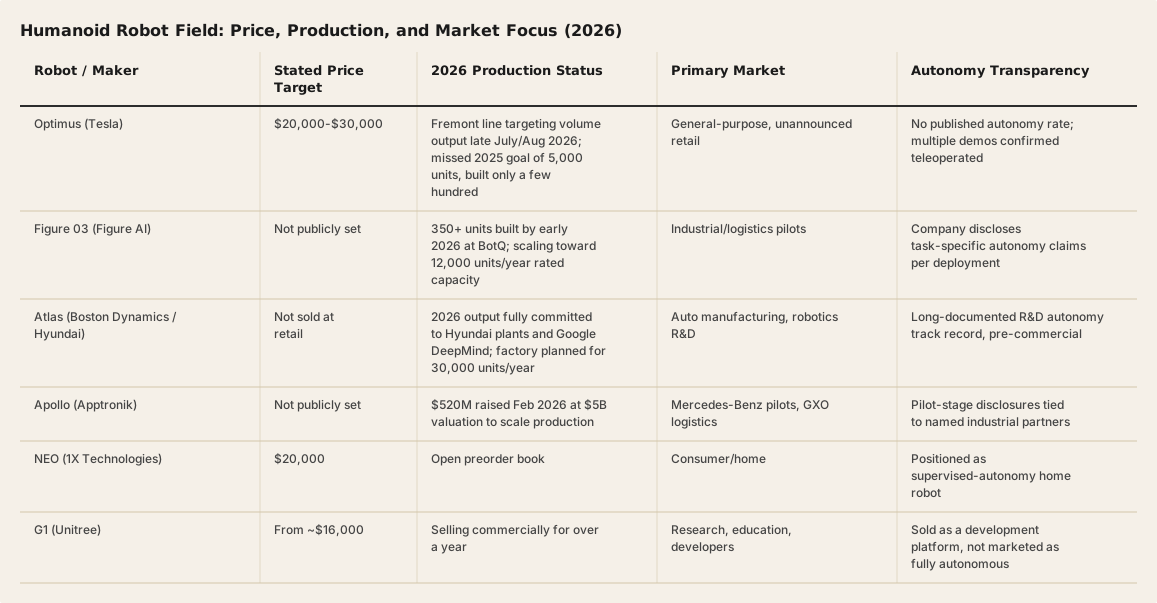
The pattern across that field is consistent: every serious competitor picked a narrower, more defensible starting point, industrial pilots, warehouse logistics, a consumer preorder, and is now generating real deployment data. The newest entrant only sharpens it: in July, Toyota spun its own robotics lab out as Walden Robotics at a $1.1 billion valuation, with a wheeled humanoid already working eight-hour shifts inside one of its factories, exactly the demonstration Tesla keeps deferring.[19][23] Tesla picked the broadest possible claim, a general-purpose robot at automotive price and automotive volume, and is the only one of the group still working from announcements rather than shipped units.
The risk in the reading
The case above reads Optimus's five-year gap between rhetoric and hardware as a pattern, and treats the coming Fremont ramp as the test that will confirm or break it. That reading has real limits. Tesla's manufacturing scale is not a hypothetical; the company genuinely has automotive tooling, supply-chain relationships, and battery and actuator production experience that none of its humanoid rivals can match, and a single successful design lock could let it close the volume gap faster than a company building a supply chain from zero, as Figure has had to. Teleoperation critiques also apply, to varying degrees, across the entire field; Tesla is more exposed on this point mainly because it has made bigger claims and been caught in more high-profile moments, not necessarily because its underlying autonomy is worse than competitors who have been more careful about what they show on stage. Finally, a single delayed unveiling and one missed annual production number are two data points, not proof of a permanent pattern; if Fremont output and the V3 reveal land close to Musk's stated window this summer, the "promise versus delivery" framing will need real revision.
The Model S/X line at Fremont is empty and tooled for something else now. Whether that something else can walk on its own by the time it reaches a customer's hands, rather than a Miami stage with an operator standing just out of frame, is a question Tesla has given itself until late summer to answer, starting with its July 22 earnings call, where investors will want production numbers, not another demo.[20] There is a caution worth keeping in mind for anyone tempted to bet against that timeline anyway: Musk has spent two decades turning laughably specific deadlines into merely very late ones, then into shipped hardware. A reusable rocket booster and a mass-market electric car both cleared that bar eventually. Optimus has spent five years waiting for its turn. Late summer is when we find out which pattern wins.
Sources
Interesting Engineering: "Tesla Optimus falls in Miami demo, hand movements sparks remote operation debate" (Dec 8, 2025) Inline ↗
Barchart: "'It Will Be the Biggest Product Ever': Elon Musk Says Tesla's Optimus Robots Will Be Bigger Than Even Robotaxi" (Aug 10, 2025), reporting Tesla's Q2 2025 earnings call Inline ↗
Electrek: "Tesla pushes Optimus V3 reveal later this year, again" (Apr 22, 2026), reporting Tesla's Q1 2026 earnings call Inline ↗
The Verge: "Elon Musk says Tesla is working on humanoid robots" (Aug 19, 2021) Inline ↗
Forbes: "Tesla AI Day 2022: Musk Demonstrates Optimus Humanoid Robot For Under $20,000" (Oct 1, 2022) Inline ↗
TechCrunch: "Tesla Optimus bots were controlled by humans during the 'We, Robot' event" (Oct 14, 2024) Inline ↗
Wikipedia: "Optimus (robot)", citing Cybernews reporting on the November 2024 22-degrees-of-freedom hand upgrade and specifications on payload and actuator design Inline ↗
Reuters: "Tesla's head of Optimus humanoid robot program to leave firm" (Jun 6, 2025) Inline ↗
TechCrunch: "Tesla is reportedly behind on its pledge to build 5,000 Optimus bots this year" (Jul 25, 2025) Inline ↗
Electrek: "Musk admits no Optimus robots are doing 'useful work' at Tesla, after claiming otherwise" (Jan 28, 2026) Inline ↗
Electrek: "Tesla taped out AI5 chip, Musk says, nearly 2 years behind schedule" (Apr 15, 2026) Inline ↗
Figure AI: "Ramping Figure 03 Production" (Apr 29, 2026) Inline ↗
Forbes: "Atlas Humanoid Robots Production 'Fully Committed' For 2026, Factory Will Build 30,000 Per Year" (Jan 6, 2026) Inline ↗
CNBC: "Apptronik raises $520 million at $5 billion valuation for Apollo robot" (Feb 11, 2026) Inline ↗
Forbes: "Unitree G1 Humanoid Robots Are Reshaping The Robotics Investment Stack" (Apr 27, 2026) Inline ↗
Hyundai Motor Group: "Statement on Boston Dynamics" (Jul 16, 2026), on Hyundai's move to acquire SoftBank's remaining stake, pending governance and regulatory approvals, and deploying Atlas at Metaplant America from 2028 Inline ↗
Carscoops: "The AI Robots Won't Strike, So Hyundai's Workers Did It First" (Jul 13, 2026), on the July walkout and the 2028 Atlas timeline Inline ↗
The Boston Globe: "Stealthy Toyota spinout gets one of Boston area's biggest robotics deals ever" (Jul 15, 2026) Inline ↗
Not a Tesla App: "Tesla's 2026 Q2 Earnings Call: How to Listen" (call held Jul 22, 2026) Inline ↗
CNBC: "Elon Musk says Optimus robot 'will be worth more than the car business'" (Apr 21, 2022) Inline ↗
Figure AI: "BotQ: A High-Volume Manufacturing Facility for Humanoid Robots," on the first-generation line's 12,000-unit-a-year rated capacity Inline ↗
The Rundown Robotics: "Toyota's secret humanoid hits $1.1B" (Jul 15, 2026), on the Walden robot working eight-hour shifts at a Toyota plant Inline ↗
Get this every weekday.
The Omniscient Bulletin: consequential AI, explained and evaluated. 5 to 7 items a day with the take, not the recap.
Discussion
Commenting is open to existing reader accounts. Sign in if you have one.