Omniscient
AllBulletinArticlesReviewsTakesCommentaryFeatured
Sign In

Omniscient

AI intelligence briefings, analysis, and commentary — delivered in broadsheet form.

By Noah Ogbi

Subscribe

Weekday briefings and flagship analysis, delivered to your inbox.

Sections

  • All
  • Bulletin
  • Articles
  • Reviews
  • Takes
  • Commentary

Topics

  • Industry Strategy
  • AI Policy
  • Anthropic
  • Frontier Models
  • OpenAI
  • Safety
  • Compute Economics
  • AI Security

Meta

  • About
  • Masthead
  • Standards
  • Corrections
  • RSS Feed
  • Privacy Policy
  • Terms of Service

Omniscient Media — made by ForeverBuilt, LLC.
© 2026 ForeverBuilt, LLC. All rights reserved.

  1. Home
  2. ›AI Research
  3. ›The Cryptography Behind Apple's 'Reference Image,' and Its Limits

AI Research

Vol. 1·Sunday, September 20, 2026

The Cryptography Behind Apple's 'Reference Image,' and Its Limits

Apple's Reference Image cryptographically signs pixels and capture time, verifiable through 2050 - but its threat model says nothing about a camera pointed at a screen


Noah Ogbi26 min read

Tips, corrections, or questions? support@omniscient.media

TopicsAppleSafetyAI SecurityResearch
The Cryptography Behind Apple's 'Reference Image,' and Its Limits

There's one of these every weekday.

The Omniscient Bulletin turns the day's AI news into 5 to 7 items with the take, not the recap. Free.

The Registry That Won't Work, and the One That Might

Apple has never claimed a reference image answers the synthesis question; for that it points to upcoming SynthID support, framed alongside Reference Image as "a multifaceted approach to image authenticity."[11] But watermarking binds only those who agree to be bound, and the fallback (catching synthetic images by detection instead) is the weakest link in the chain. Carlini and Farid showed in 2020 that imperceptible perturbations drop a forensic classifier's AUC from 0.95 to 0.0005 white-box and 0.22 black-box.[12] Carlini and Farid ran that in 2020, before diffusion models were in wide use, so detection was already losing then.

When a provenance system's coverage runs out, the field has one reflex, and it never changes: build a bigger database. That reflex is key here, because everything this piece has already shown about Apple's design - the archival blind spot, the caption problem, the revocation database - is exactly the shape of failure a registry promises to fix and cannot. The idea is Certificate Transparency for media: hash every image at creation, append the hash to an open, permanent, publicly auditable log, and let anyone ask whether a picture has been seen before and when. The analogy is attractive because Certificate Transparency genuinely works - append-only Merkle logs, run by independent operators, solved the structurally similar problem of certificates issued in secret. And logging at creation would beat searching after the fact: a provable first-seen date, rather than a crawl date that records only when somebody's spider happened past.

Recycled footage is, by definition, archival. A log that starts recording in 2027 begins empty while the attack corpus is everything already shot, and an adversary can draw on it indefinitely. Covering that would mean retroactively ingesting the world's images - at which point you have rebuilt reverse image search, which exists and is free. Google's About This Image reports when a picture was first indexed and where else it has appeared; TinEye has shown crawl dates since 2008.[13] The lookup layer already exists, it's free, and decontextualization thrives anyway - because fact-checkers and open-source researchers query it constantly, and the audiences a false caption is aimed at never do.

The comparison also fails below the level of adoption. A Merkle proof proves byte equality, but "has similar content appeared before" is a nearest-neighbor query, and no cryptographic proof attests a similarity search's completeness - so "auditable" describes the log, never the answer. In Certificate Transparency the logged object is the misissuance; a media log holds pixels while the lie lives in the caption, which is never logged. And Certificate Transparency has a relying party that checks automatically: Chrome. A media registry has no such relying party.

The matching itself is weaker than it sounds. Shubham Jain, Ana-Maria Crețu and Yves-Alexandre de Montjoye showed at USENIX Security in 2022 that perceptual hashing is defeated in a black-box setting for "more than 99.9% of images… while preserving the content of the image" - and a public query interface is exactly the oracle that attack needs. In the other direction, a single-match verdict across quadrillions of frames is void as an accusation, and near-duplicates are the ordinary case in news, where a press pool and a dozen bystanders shoot one street from six angles: the routine output is flagging authentic breaking footage as recycled. Apple ran into this itself in 2021: its NeuralHash scheme was reverse-engineered from iOS and collided within hours. The technical story is contested - Apple said the extracted model was not the shipping one, and serious cryptographers agreed the collisions did not defeat the deployed system, which had a second matcher and human review behind it. Apple may well have been right. The feature died anyway. The political failure was decisive even though the technical failure was arguable.

Share:

Get this every weekday.

The Omniscient Bulletin: consequential AI, explained and evaluated. 5 to 7 items a day with the take, not the recap.


Related

AI Research

Vol. 1·Thursday, June 11, 2026

Inside Claude Fable 5: Anthropic's Most Powerful Public Model - and Its Most Asterisked One


Inside Claude Fable 5: Anthropic's Most Powerful Public Model - and Its Most Asterisked One

Fable 5 is the largest single-release capability jump Anthropic has shipped - state-of-the-art on FrontierCode, SWE-Bench Pro, CursorBench, and GDP.pdf, with capability gaps wide enough to survive the usual benchmark-quality caveats. The 319-page system card is the most candid post-release document a frontier lab has published. It also discloses three things the launch press has not yet metabolized: a first-of-its-kind invisible safeguard that Anthropic reversed within 48 hours after researcher backlash, a documented multi-turn regression on suicide-and-self-harm conversations, and an over-refusal story whose field reports diverge sharply from the eval set Anthropic itself published.


AI PolicyIndustry StrategyAnthropic
Noah Ogbi24 min read
Continue →

AI Policy

Vol. 1·Monday, June 15, 2026

Anthropic Shipped an Invisible Safeguard. Both Readings Are True.

The reversal made it visible. It didn't make it simple.


Anthropic Shipped an Invisible Safeguard. Both Readings Are True.

Page 13 of Claude Fable 5's 319-page system card disclosed that the model silently degrades its own responses to requests touching frontier AI development, without notifying users. Within hours, researchers cried "secret sabotage." Within 36 hours, Anthropic reversed the invisibility, calling it "the wrong tradeoff." Within 24 hours of that reversal, the U.S. government issued an export control directive suspending all access to Fable 5 and Mythos 5 for foreign nationals worldwide, citing the same national-security rationale Anthropic had introduced just the day before. The honest read was always that both interpretations sit on the same page of the same document. The government's directive proved neither reading was wrong.


AI PolicyAnthropicDefense & National Security
Noah Ogbi27 min read
Continue →

AI Policy

Vol. 1·Monday, July 20, 2026

Kimi K3 Isn't Free. It Just Looks That Way.

Kimi K3 is set to become the largest open-weight model ever released. What American labs say about how models like it are built, and what the US government found when it tested their predecessors, should give any American user pause.


Kimi K3 Isn't Free. It Just Looks That Way.

Moonshot's Kimi K3 is set to join DeepSeek's models and Alibaba's Qwen as a free download climbing the leaderboards. But between Anthropic and OpenAI's distillation findings, NIST's security testing, and Beijing's own moves to lock down its "open" frontier, the case for treating these weights as neutral technology is getting harder to make.


AI PolicyAI SecurityDeepSeek
Noah Ogbi11 min read
Continue →

Inside the Main camera of an iPhone 18 Pro is a sensor that signs what it sees. At the instant light is measured and digitized, the frame is signed within the sensor itself, with a private key it generated during manufacture and has never released - not to the operating system, not to Apple. Apple calls the result a reference image, and reaches for an old metaphor: a digital negative.[1]

It's the most serious engineering yet aimed at whether a photograph is real, but by Apple's own account of what it defends against, it's aimed at a narrower question than the one the world wants it to settle.

The Negative

The design begins on a factory floor. When an Apple photo sensor is first initialized it generates an ECDSA P-256 key pair and never releases the private half; the recording station takes only the public key and records it, signed, in the device's hardware manifest. The Secure Enclave gets its own attested identity, and a third authority binds the two together - so Apple can later establish that a particular sensor and a particular Secure Enclave were, and still are, parts of the same iPhone.[2]

Switching to Reference mode reboots the sensor into a specialized secure capture mode that, in Apple's words, "prevents the sensor firmware from modifying the data." The sensor signs the digitized frame together with a SHA-256 digest computed from the most recent secure timestamp, the device manifest and the secure boot manifest. Metadata that originates outside the sensor - digital zoom factor, exposure, lens parameters - is signed separately by the Secure Enclave, and cannot alter the pixels.

On timestamps, Apple has most obviously been reading its competitors' homework. Prior systems, Apple notes, took a timestamp from the general device operating system, which "plainly falls short of the real-world assurance need." Instead the iPhone collects a cryptographic timestamp token on the Apple Push Notification Service heartbeat (globally, on average, every fifteen minutes) and keeps the most recent one as a proven lower bound. After the shutter fires, the device requests a second token as an upper bound. The guarantee is an interval: the photograph was taken between these two moments. Offline, a background process fills in the upper bound later, "producing the tightest interval the circumstances allow."

None of this yet produces a picture. Raw sensor values need demosaicing and tone mapping before a human can look at them, and that processing is exactly where a compromised operating system would do its work. So Apple moves it off the phone into Private Cloud Compute, leaning on a property PCC already had: every production build is recorded in an append-only, tamper-proof transparency log, the binaries are open to public inspection, and a device will only send data to a node that attests to running a build from that log. The claim isn't that you should trust Apple's developing process, but that you can read it.

The signature that emerges is a composite post-quantum construction, hybrid MLDSA87-RSA-3072-PSS-SHA512, and Apple's reason for the expense is worth quoting because it turns out to be the most prescient decision in the whole design: reference images are "published assets whose integrity must survive for as long as anyone might want to check them," and so "an image asserted to be authentic in 2026 should be securely verifiable in perpetuity."

Against that, the practical footprint is small. Reference mode captures from the Main camera only[3] - nothing shot on the ultrawide or the telephoto is covered, including the long lenses news photography leans on. It takes three deliberate acts to produce proof: adding Reference mode in Settings, swiping to select it before the shot, and then developing the negative afterwards. In China it’s absent at launch, which Apple attributes to "regulatory requirements"; in the European Union the capture half is unavailable while viewing and developing work normally, and for that Apple has offered no explanation at all.[4]

What the sensor puts its name to is the pixels, a timestamp interval, the device manifests, the zoom factor, the exposure, and the lens. Location is not among them.

The Standard Apple Would Not Join

More than five years of industry work on this problem has gone into C2PA, the Coalition for Content Provenance and Authenticity, whose participants include Adobe, Google, Microsoft, Meta, and Amazon. Apple joined none of it, and said why.

C2PA-style systems, Apple argues, "attach provenance metadata after capture and certify the history of image edits from that point forward," which leaves them "vulnerable to compromise at any point in the editing chain, and a viewer has no way to detect such a failure." Then a second objection that has been under-reported, and and it’s more important than the first: such systems "can also create privacy risks for photographers working in dangerous conditions by tying the image to a public identity, either to a particular device or to an individual."

This reads like the usual vendor case for going it alone. The inconvenient thing is that an independent security analysis published five months earlier reached harsher conclusions than Apple's.

In April 2026, a team from the University of Maryland, Baltimore County's Cyber Defense Lab, together with Neal Krawetz of Hacker Factor and a co-author at the National Security Agency, published what they describe as the first comprehensive independent security analysis of C2PA, including the first formal-methods treatment of its core protocols. Their finding: "the current C2PA specifications fail to achieve their claimed security goals."[5] C2PA makes only two security claims - that validators can detect tampering with the credentials, and a "weak file integrity" claim covering only the bits outside a permitted exclusion range. The paper adds three more that any such system needs, on timestamps, validator consistency, and whole-file integrity. It concludes that C2PA delivers none of the five.

The specifics are worse than the summary. Because nothing in C2PA's signed data references its own timestamp, timestamps "can be replaced or modified without detection," and validators will display an altered date without flagging it - the exact weakness Apple's two-sided cryptographic bounds were built to close. Revocation checking is optional by design and permitted only via OCSP, the specifications "expressly forbidding certificate revocation lists." And signed media simply expires: an image from the Arizona Secretary of State's own C2PA pilot validated in January 2025 and failed to validate a year later, with the file unchanged. The authors note this is incompatible with the twenty-two months the law requires for retention of election records.

The price Apple paid for being right is that it is alone. Sam Gregory of WITNESS, who has spent two decades on exactly this problem, puts it plainly: "this technology cannot be an Apple-only island."[6] And his description of the architectural difference is the most economical anyone has managed. A reference image, unlike a provenance manifest, "needs a human to look and judge. It says nothing technically transparent about which changes were made and how." C2PA tries to describe what happened to a file, while Apple's approach hands you a second file and leaves the comparison to you.

What the Threat Model Does Not Cover

Apple's security blog is unusually forthcoming about what it’s defending against, and it’s a long list. Compromise of the operating system. A data injection attack on the sensor bus. Software-level jailbreak. Tampering with the camera sensor. Hardware attacks involving physically removing the sensor from the device. Cryptographic attacks, including by quantum adversaries who do not yet exist.

Read the document end to end and one category is missing. There’s no discussion anywhere of what happens when the camera’s pointed at a screen.

The word "spoof" appears exactly once in the entire piece, in the phrase "inject spoofed pixel data onto the data transport from the sensor" - an attack on the wire, not on the lens. There’s no mention of monitors, displays, prints, replay, liveness detection, or re-photography. Every threat Apple enumerates is a threat to the integrity of the instrument. None is a threat to the honesty of the scene.

Apple does use that last word, once. Its goal for what it calls semantic authenticity is that a user can trust the authenticated image "corresponds to the scene that was actually photographed" - which in context is a claim about faithful rendering, that the developed picture matches what the sensor recorded. Apple's headline formulation is narrower and more careful: "a real photograph, captured by a real sensor in an iPhone camera, at a specific time."

There’s one component that looks, at first, as though it might cover the gap. During development, Apple says, "using a neural network with hidden weights, PCC computes a confidence score for the photograph," confirming "that the image has the physical characteristics expected of raw output from our sensors." It’s tempting to read that as a screen detector.

Unfortunately, it's not. The score goes to a companion service that keeps a running score for each sensor, and its consequence is sensor revocation: "if a low-scoring sensor is revoked, PCC will no longer sign its images." Revoking a sensor because its owner photographed a television would be an absurd design. The score is there to catch data that never came from a real Apple sensor. And Apple computes it "using a neural network with hidden weights," so whether it incidentally notices moiré or refresh banding is not something anyone outside Apple can determine - and an undocumented incidental property is not a thing to rest a verification system on. The only probabilistic component in an otherwise thoroughly cryptographic design authenticates the instrument.

This is not a hypothetical class of attack. The C2PA paper documents Adam Horshack demonstrating how to make a Nikon Z6 III sign an AI-generated image; Nikon revoked the camera's certificate in November 2025, and six months later Adobe's Inspect tool still reported the signature as valid while a second validator called it invalid - with neither flagging the revocation. The paper does not say how Horshack did it, and Nikon's response, revoking the certificate, points to a compromised credential rather than a lens aimed at a screen; the two should not be confused. But the shape is what matters: a trusted camera can be made to put its name to something that never happened, and the ecosystem is slow to notice.

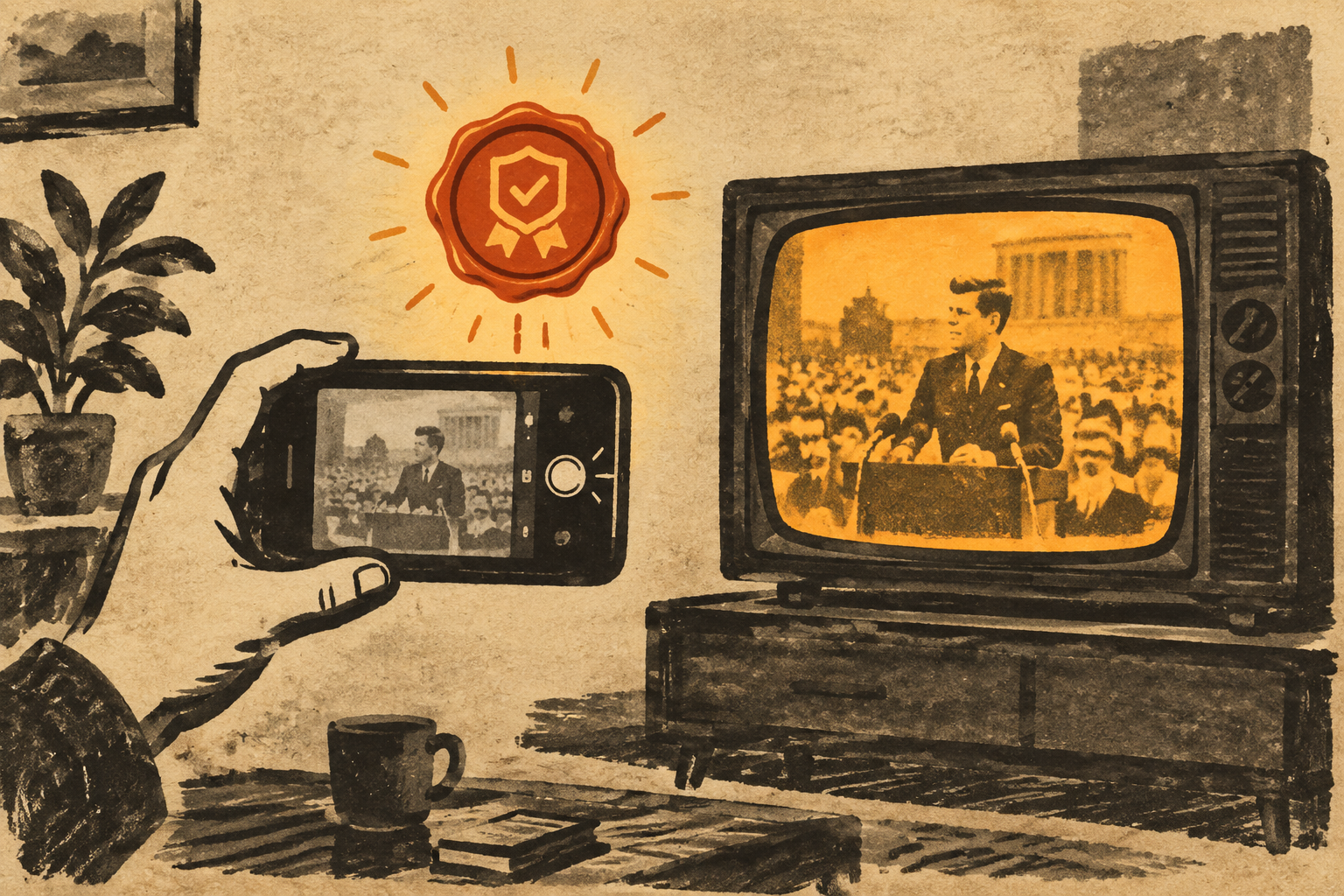
Set an iPhone 18 Pro to Reference mode, point it at a 4K monitor playing footage from 2019, and press the shutter.

So far as Apple's published design describes, every check passes - because every check is being asked an honest question and getting an honest answer. The sensor did capture those photons. The firmware did not modify them. The Secure Enclave was paired with that sensor. The timestamp bounds are correct, and they say the capture happened today, which it did. Private Cloud Compute developed the negative without altering it. The composite post-quantum signature will still verify in 2050. What comes out is a cryptographically impeccable certificate attesting that seven-year-old footage was photographed a moment ago, and it isn't lying; it's just answering a different question than the viewer thinks it is.

None of this requires that the deception go undetected. A careful examiner given the actual negative - the raw sensor output, viewed full-resolution, not the compressed copy that circulates - would often catch a re-photographed monitor: the moiré, the bezel edge, the off-axis geometry, the refresh banding a phone camera picks up from an LCD. That is exactly Gregory's point about needing "a human to look and judge." But nobody downstream of the first share is looking at the negative. What travels is the compressed image and the badge that says it verified, and the badge carries every bit as much authority whether or not anyone ever opened the file it was attached to.

The Question Nobody Is Answering

Let's be precise about how much ground Apple has taken, because the timestamp work is a genuine advance and the argument that follows only works if you concede it first. Those two-sided bounds cannot be backdated: the lower one is a token the device already held before the shutter fired. Against the recycling of old footage - the workhorse of visual deception - that is a real weapon, and sharper than anything C2PA fields.

The trouble is the gap between two things the bounds cannot distinguish: when the capture happened, and when the scene happened. Photograph a monitor and both statements are true, but only one of them is the one the viewer cares about.

That gap is where most of the deception that matters actually lives. Britt Paris and Joan Donovan made the underlying point at Data & Society years before generative video was plausible: successfully deceptive media "has never necessarily required advanced processing technologies."[7] The 2014 photograph captioned as yesterday, the crowd shot cropped to conceal how thin the crowd was, the real ambulance in the real street attributed to the wrong war - none of these involve editing a pixel, and a provenance system that certifies unedited pixels will wave all of them through.

The most uncomfortable evidence on this point comes from inside the industry. In 2019 the New York Times ran the News Provenance Project with IBM, user-testing exactly the kind of photo-provenance display the field has converged on ever since. Readers had "a tendency to accept almost all images at first glance"; where they were skeptical, it "tended to be a reaction to the perceived slant of a caption or headline, rather than a belief that it was made up or edited."[8] The industry has spent the years since proving that pixels weren't altered, when the doubt readers actually reported was about the caption.

The UMBC and NSA authors draw the same line in the vocabulary of security: "Provenance describes the history of a file, whereas authenticity concerns, for example, whether the content truthfully represents real-world events. C2PA provides provenance signals, not proof of authenticity." Every system in this field, Apple's included, sits on the provenance side of that sentence.

Which brings back the field that is not in Apple's signature. Location is the one contextual fact a camera could plausibly attest, and the two approaches have taken opposite paths. C2PA records it - and the same paper shows that Google's conforming Pixel 10 Pro places GPS data inside the specification's permitted exclusion range, so an attacker can insert a false location - which, in the paper's demonstration, a conforming validator displayed without detecting the substitution. Apple simply declines to say. One system can be made to lie about where, and the other declines to say. Neither addresses the caption, which is usually where the lie is.

What the Absence of Proof Implies

There is a second-order problem here, and Gregory identified it first. Apple's user education, he wrote, "needs to lead, perhaps perversely, with what a photo with a Reference Image marker means, but also what the absence of one does not." Otherwise, he warns, we may see "the cultivation of a perverse ratchet effect of expectations."

He's right, and the effect has literature behind it. Robert Chesney and Danielle Citron named the mechanism in 2019 - the liar's dividend, the benefit accruing to dishonest actors as audiences learn convincing fakes exist and grow readier to dismiss authentic evidence.[9] Gordon Pennycook and colleagues showed experimentally that labeling only some content changes how audiences read the rest[10] - their case was warnings on false headlines rather than badges on true photographs, the mirror of this one, but partial labeling is never neutral toward the unlabeled remainder.

Now apply that to the shape of this rollout. Reference images will exist on one device line, from the Main camera only, in a mode the user must install and then remember to select, developed in a step they separately choose, shared only if they toggle it on, and unavailable in China and, for capture, in the European Union. For years the overwhelming majority of true photographs taken anywhere will carry no reference image - including the ones that matter most: the ultrawide shot of a crowd, the telephoto frame from behind a police line, anything taken on the cheap Android handsets that, as Gregory notes, are what "many of the people doing the most important documentation, witnessing, and journalism" are shooting on.

The failure mode is not that someone forges a reference image. It's that "there's no reference image" becomes a usable sentence.

Then there's the question of who holds the switch. Apple's revocation system can invalidate a single photograph or every photograph a given sensor ever produced - and, as Gregory puts it, "if it does, photographs already published and already in other people's hands stop showing as verified." He is careful to say the capability is necessary; a compromised sensor has to be revocable, and a provenance system without recourse is worse than none. His question is the one Apple has not answered: "Do we want that power with Apple? Could they be compelled to do this?"

Underneath that sits a tension in Apple's own document. Its privacy claim is strong and, on its face, exactly right: "an outside observer cannot determine whether any pair of reference images were taken by the same device," because the final signature comes from Apple's signing service rather than the sensor. That was a deliberate choice for photographers in dangerous places - "it should not be necessary to forgo anonymity in order to prove image authenticity" answers a real criticism of credential-based systems, and Apple deserves credit for it. But a page later: "the revocation service must maintain a private record of photo GUIDs and associated sensors to allow for revocation." The images are unlinkable to everyone except the party holding the list. Revocation requires that database, and a subpoena can reach it.
[14]
[15]

Two narrower things would work, and the first one is already built.

Automated, retroactive archive matching at scale is not a proposal; it's an industry. PicRights crawls billions of pages on behalf of the Associated Press and Agence France-Presse, matching against agency archives that each run into the tens of millions of images.[16] Much of the highest-circulation recycled material is professional archive footage - so the infrastructure that would answer "when did this first appear" already exists, funded by licensing revenue rather than a hoped-for consortium, governed by a few identifiable parties, and retroactive by construction. It also escapes the two objections that sank the universal version: enforcement crawling exposes no public query interface for an attacker to probe, and an archive hit is a lead handed to a human rather than a verdict published against a photographer. What is missing isn't machinery but the incentive to aim it at provenance instead of at fees.

The second is transparency applied where Merkle trees actually work: to keys, not pixels. Apple already runs an append-only transparency log for Private Cloud Compute builds, so the principle is conceded and the machinery exists. What's not logged is the sensor key hierarchy and the revocation lists - the two surfaces on which the system's trust, and Gregory's unanswered question about compulsion, actually rest. Publishing those, and extending PCC's external-audit model across the whole reference-image pipeline, is a smaller ask than joining C2PA and a much better one.

One caution from the Times research should worry everyone building here. When readers were told an image's metadata had been authenticated by a "blockchain network," trust went down. Whether "verified by Apple's Private Cloud Compute" reads any better to an ordinary user is untested.

What It's Actually For

Gregory's summary, published on 17 September, is the fairest one available: Reference Image is "strong for a professional photographer or first-hand documenter who gets to hold onto their original, and challenge a fake that circulates," and "valuable for some specific business cases - for example, an insurance claim." It's "weaker as an ecosystem answer."

That's the right framing, and the narrow cases are quite meaningful. An insurance adjuster, a court exhibit, a newsroom's archive, a photographer answering an accusation with a file kept since the shutter closed - real problems, solved with more rigor than anything else on the market and with a privacy design its competitors should be embarrassed by.

The risk is what happens when a tool built for those cases gets described as a defense against misinformation - as it was within hours, in headline after headline, as a way to prove your photos "aren't AI slop."[17] It will be tested against that claim, in public, by people pointing phones at screens, and it will fail: not because the engineering is poor but because the engineering was never aimed there. When it does, the failure will be read as provenance failing, and the next serious attempt will be harder to fund and harder to trust.

Because the question underneath all of this was never a cryptography question. Whether a photograph is telling the truth is a claim about the world, and claims about the world get settled by reporting, by corroboration, by someone finding out where a picture came from and what was happening just outside the frame. That's journalism, and no signature scheme does it for you. Apple's sensor will keep signing what it sees, faithfully, for decades to come. It just won't be able to tell you what was on the screen it was pointed at.


Sources

  1. Apple, "Apple debuts iPhone 18 Pro and iPhone 18 Pro Max" (September 9, 2026) Inline ↗

    1 passage checked · read September 19, 2026
    …When a photo is taken in the new Reference mode, the camera captures signed sensor data that Private Cloud Compute develops into an unalterable reference image.…
  2. Apple Security Engineering and Architecture (SEAR) and Camera & Photos, "Apple Reference Image: A New Approach for Verified Photography," Apple Security Research (September 15, 2026) Inline ↗

    16 passages checked · read September 19, 2026
    …When an Apple photo sensor is first initialized, it generates its own ECDSA P-256 signing key pair and never releases the private half.…
    …instructs the sensor to cryptographically sign pixel data immediately after capture, and prevents the sensor firmware from modifying the data.…
    …included a timestamp provided by the general device operating system, we believe this plainly falls short of the real-world assurance need.…
    …a background process keeps attempting the request and inserts the token once it succeeds, producing the tightest interval the circumstances allow.…
    …Because reference images are published assets whose integrity must survive for as long as anyone might want to check them, a signature secure only against classical adversaries isn't sufficient:…
    …Experts can verify that PCC doesn’t alter a digital negative during development: they can examine the software that does the work.…
    …Industry approaches to this problem, based on the C2PA standard, attach provenance metadata after capture and certify the history of image edits from that point forward.…
    …This approach, however, is vulnerable to compromise at any point in the editing chain, and a viewer has no way to detect such a failure.…
    …It can also create privacy risks for photographers working in dangerous conditions by tying the image to a public identity, either to a particular device or to an individual.…
    …Using a neural network with hidden weights, PCC computes a confidence score for the photograph.…
    …This additional step confirms that the image has the physical characteristics expected of raw output from our sensors, increasing confidence in its authenticity.…
    …If a low-scoring sensor is revoked, PCC will no longer sign its images.…
    …described above, we designed the core reference image pipeline to withstand a compromise of the operating system, or a data injection attack on the sensor bus.…
    …But this approach is vulnerable to attacks that inject spoofed pixel data onto the data transport from the sensor, or to compromises of the device operating system that can completely alter the image…
    …Privacy preservation : an outside observer cannot determine whether any pair of reference images were taken by the same device.…
    …While the revocation service must maintain a private record of photo GUIDs and associated sensors to allow for revocation, it never has access to the image data, and does…
  3. Apple, "Capture a verifiable photo with Apple Reference Image," iPhone User Guide (iOS 27) Inline ↗

    3 passages checked · read September 19, 2026
    …Use Reference mode to take a photo and also capture the original data from the sensor in the Main camera.…
    …Note: Apple Reference Image is not available in all countries or regions.…
    …Tap Add Reference Mode, then follow the onscreen instructions.…
  4. Apple, "Apple debuts iPhone 18 Pro and iPhone 18 Pro Max" (September 9, 2026), on availability in China and the European Union Inline ↗

    1 passage checked · read September 19, 2026
    …In China, Apple Reference Image will not be available at launch because of regulatory requirements.…
  5. Enis Golaszewski, Neal Krawetz, Alan T. Sherman, Edward Zieglar et al., "Verifying Provenance of Digital Media: Why the C2PA Specifications Fall Short," arXiv:2604.24890 (April 27, 2026); full study at IACR ePrint 2026/804 Inline ↗

    2 passages checked · read September 19, 2026
    …We find that the current C2PA specifications fail to achieve their claimed security goals.…
    …C2PA is a promising idea, but it should not yet be relied upon for high-stakes uses such as financial disclosures, journalism, or legal evidence.…
  6. Sam Gregory, "Will Apple's 'Reference Image' Feature Help Defend Against AI Manipulation?", Tech Policy Press (September 17, 2026) Inline ↗

    6 passages checked · read September 19, 2026
    …Apple can retroactively revoke a single image, or every image a given sensor ever produced.…
    …Could they be compelled to do this?…
    …But this technology cannot be an Apple-only island.…
    …of the world’s cameras won’t have this technology, and many of the people doing the most important documentation, witnessing and journalism are shooting on cheap Android phones.…
    …It needs a human to look and judge.…
    …It says nothing technically transparent about which changes were made and how.…
  7. Britt Paris and Joan Donovan, "Deepfakes and Cheap Fakes: The Manipulation of Audio and Visual Evidence," Data & Society (2019) Inline ↗

    1 passage checked · read September 19, 2026
    Deepfakes and Cheap Fakes: The Manipulation of Audio and Visual Evidence - Data & Society Skip to main content Search Search Close Data & Society Navigation Newsletter Sign Up Translate English Spanish Open Search About About Us Data &…
  8. The News Provenance Project (The New York Times with IBM), user research reported by Nieman Lab, January 2020; Emily Saltz, UX lead Inline ↗

    2 passages checked · read September 19, 2026
    …tested blockchain to help you identify faked photos on your timeline “What we saw was a tendency to accept almost all images at first glance, regardless of subject area.” By Hanaa' Tameez @hanaatameez Jan. 22, 2020, 10:36 a.m.…
    …credible, it tended to be a reaction to the perceived slant of a caption or headline, rather than a belief that it was made up or edited."…
  9. Robert Chesney and Danielle Keats Citron, "Deep Fakes: A Looming Challenge for Privacy, Democracy, and National Security," California Law Review 107:1753 (2019) Inline ↗

  10. Gordon Pennycook, Adam Bear, Evan T. Collins and David G. Rand, "The Implied Truth Effect: Attaching Warnings to a Subset of Fake News Headlines Increases Perceived Accuracy of Headlines Without Warnings," Management Science 66(11) (2020) Inline ↗

  11. Apple, "Apple debuts iPhone 18 Pro and iPhone 18 Pro Max" (September 9, 2026), on SynthID support and "a multifaceted approach to image authenticity" Inline ↗

    1 passage checked · read September 19, 2026
    …Image metadata and upcoming support for the SynthID standard can also help users identify images generated or edited with AI.…
  12. Nicholas Carlini and Hany Farid, "Evading Deepfake-Image Detectors with White- and Black-Box Attacks," CVPR Workshops (2020) Inline ↗

  13. Google, "About this image" in Google Search (2023); TinEye has published crawl dates since 2008 Inline ↗

    1 passage checked · read September 19, 2026
    How to use About this image on Google Search Skip to main content Get helpful context with About this image Innovation & AI Products & platforms Company news Feed Newsletter Back Innovation & AI See all in Innovation & AI Models & Research…
  14. Shubham Jain, Ana-Maria Crețu and Yves-Alexandre de Montjoye, "Adversarial Detection Avoidance Attacks: Evaluating the Robustness of Perceptual Hashing-based Client-Side Scanning," 31st USENIX Security Symposium (2022) Inline ↗

    1 passage checked · read September 19, 2026
    One Database to Rule Them All: The Invisible Content Cartel that Undermines the Freedom of Expression Online | Electronic Frontier Foundation Skip to main content About Contact Press People Opportunities Issues Free Speech Privacy…
  15. "Apple Says NeuralHash Tech Impacted by 'Hash Collisions' Is Not the Version Used for CSAM Detection," MacRumors (August 18, 2021), carrying both the collision result and Apple's rebuttal Inline ↗

    2 passages checked · read September 19, 2026
    Adversarial Detection Avoidance Attacks: Evaluating the robustness of perceptual hashing-based client-side scanning | USENIX Back to USENIX Sign In Conferences Attend Registration Information Registration Discounts Terms and Conditions…
    …to be highly vulnerable to detection avoidance attacks in a black-box setting, with more than 99.9% of images successfully attacked while preserving the content of the image.…
  16. AFP, "AFP's Copyright Protection Measures," confirming AFP's retention of PicRights for automated, retroactive copyright enforcement since 2017; for an independent account of PicRights' crawling methods, see Into The Minds, "PicRights + AFP: a well-established copyright trolling operation" Inline ↗

    1 passage checked · read September 19, 2026
    Apple Says NeuralHash Tech Impacted by 'Hash Collisions' Is Not the Version Used for CSAM Detection - MacRumors Skip to Content Got a tip for us?…
  17. Representative of the launch coverage: "Apple has a new way to prove your iPhone photos aren't AI slop," TechCrunch (September 9, 2026) Inline ↗

    2 passages checked · read September 19, 2026
    PicRights + AFP: a well-established copyright trolling operation The blog of the Marketing Agency Marketing Strategy Entrepreneurship Innovation Data & IT Research Contact Our agency Our services B2B market research Reliable answers to…
    …The email was entitled “Image Licence Validation for Agence France-Presse” and its content sounded very much like a scam.…