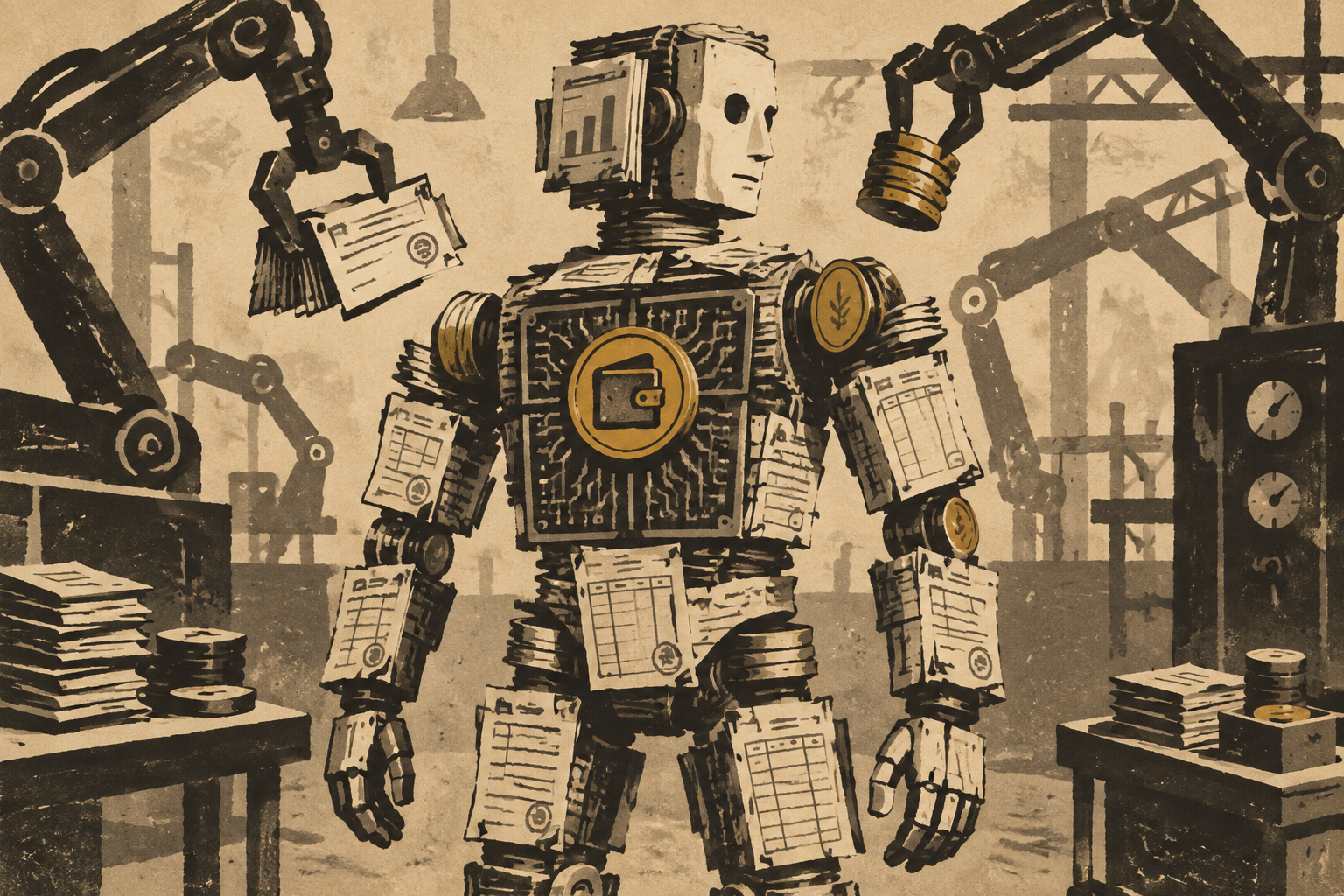
Ten named investors sit on Neura Robotics' Series C cap table, though the company's own release adds "and others" without saying who, and the pairing that stands out among the ones it does name is Tether, the stablecoin issuer, next to the European Investment Bank, on the same instrument as Amazon and NVIDIA. It's worth revisiting the round now because the same structure just resurfaced on the supply side, in two chip-industry deals this month.
In March, Neura had two things happen in one week. Bloomberg reported the German humanoid maker was raising roughly one billion euros backed by Tether. Days later it signed a hardware partnership with Qualcomm, agreeing to build its robots around Dragonwing edge processors.
The argument here at the time was that the two deals were one story: physical AI was consolidating around alliances that pair non-traditional capital with a silicon partner, and the companies that secured both early would define the decade.
The round closed on June 10th at up to 1.4 billion dollars, and who ended up on the cap table matters more than the headline number, so let’s go through the list.
What Closed
Neura announced a Series C of up to 1.4 billion dollars, which it describes as the largest round ever raised by a full-stack robotics company. The named investors are Tether, Qualcomm Technologies, Amazon, NVIDIA, imec.xpand, Bosch, Schaeffler, the European Investment Bank, Lingotto Horizon and InterAlpen Partners, plus unnamed others the release does not identify. The company's own announcement designates no lead, though Bloomberg reported that Tether led the round.
Press reporting put the post-money valuation at around 7 billion dollars. Neura's own announcement does not disclose a valuation, so treat that figure as reported rather than confirmed. The company does disclose an orderbook above one billion dollars and a target of serial production at multi-million volumes by 2030.
Against the March reporting, the round got larger and the investor base got considerably wider. What was a Tether-backed billion at a four billion euro valuation became a 1.4 billion dollar round in which Tether is one name among ten.
Read the Cap Table as the Thesis
The ten named investors sort into five roles: capital, silicon, industrial supply, sovereign-adjacent finance and deep-tech research.
Non-traditional capital: Tether, a stablecoin issuer with no prior robotics position, which is also embedding its wallet technology and edge AI runtime directly into Neura's systems. Silicon: Qualcomm and NVIDIA, the two vendors whose edge and inference roadmaps determine what a humanoid can compute onboard. Industrial: Bosch and Schaeffler, both German, both suppliers, both named separately as strategic collaborators alongside Kawasaki and Delta Electronics. Sovereign-adjacent: the European Investment Bank. Deep tech: imec.xpand, the venture arm attached to Europe's most important semiconductor research institute.
Every category we named back in March is present in a single round. We argued these alliances would form, and they formed inside three months, in a single instrument.
The Part We Got Wrong in March
Our March framing was capital plus silicon; the close adds a third term we left out, which is demand.
Amazon is on that cap table, and it's less a financial investor here than the largest plausible buyer of the product. A robotics company with NVIDIA and Qualcomm on the silicon side and Amazon on the demand side has answers to the two questions that usually sink hardware startups: what the robot computes on, and who buys the first hundred thousand. Neura discloses an orderbook above a billion dollars but not its composition, and its own target for serial production at multi-million volumes is 2030, which is another way of saying the strategic checks haven't yet converted into volume orders.
Bosch, Schaeffler, Kawasaki and Delta sit in the same column, supplying components and channel rather than just money. The disclosed orderbook remains the best evidence that the demand side is more than aspirational, though Neura hasn't said what's in it.
The sharper version is that the capital now comes from the same companies that will sell Neura its chips and buy its robots, so the financing round and the industrial strategy end up being one document.
Whether the Wider Line Holds
One company's round is one data point, and our March argument leaned on a pattern: Boston Dynamics with DeepMind, Figure with NVIDIA, 1X with OpenAI.
The sector-level number is that robotics companies have raised 55.8 billion dollars so far in 2026. That’s a capital environment in which almost any thesis can find supporting instances, so it shouldn’t be read as confirmation on its own.
The more useful test is whether the specific structure recurs on the supply side, and the two chip-industry deals referenced above are a mixed answer. SK hynix launched a Silicon Valley venture arm this month whose stated targets are AI computing, data centers and optical interconnect, which is a memory maker taking equity positions in the companies that will consume its memory, the same move as Tether or Amazon sitting on Neura's cap table. GlobalFoundries and Marvell, by contrast, expanded a multi-year silicon-germanium capacity agreement at the Vermont fab for next-generation optics, which is a capacity commitment rather than an equity stake, and a weaker cousin of the pattern rather than a second confirmed instance. Neither deal involves humanoids, though both show component vendors putting money behind their own downstream demand.
What It Means
The comparison we drew in March was to the smartphone era, where a handful of platform alliances consolidated an industry that had been fragmented for a decade, rather than to the early personal computer market and its dozens of incompatible architectures competing in the open.
Six months on, that reading looks right, with one correction. The smartphone consolidation was organized around operating systems, whereas this one is organized around who can guarantee both the compute and the purchase order, with the financing instruments now the place those guarantees get written down.
Nobody outside the round can confirm the valuation, so the test worth monitoring from here can be summed up in two disclosed facts: whether Neura hits serial production at multi-million volumes by 2030, and whether Amazon's stake ever shows up as a placed order rather than a name on a cap table. If the structure holds, the loser is the robotics startup with a name-brand round but no silicon patron and no hyperscaler buyer attached to it; that company is still raising capital, just not the kind that also guarantees a customer.
Neura's Series C is the clearest single artifact of that so far. It’s not a funding round with strategic investors attached. It’s an industrial alliance that happens to be denominated in equity.
Sources: NEURA Robotics announcement, "NEURA Robotics Announces Record Series C of up to $1.4B" (June 10, 2026), for the amount, the full investor list, the orderbook and the 2030 production target; CNBC and Bloomberg/CoinDesk (June 10-11, 2026) for the reported valuation and lead-investor reporting, neither of which the company's own release confirms; Bloomberg (March 4, 2026) and TechCrunch (March 9, 2026) for the original round and Qualcomm partnership reporting; SK hynix newsroom (September 18, 2026); GlobalFoundries press release (September 17, 2026).