AI Policy
Congress Already Turned the Dial Bill Gates Wants to Invent
Tips, corrections, or questions? support@omniscient.media
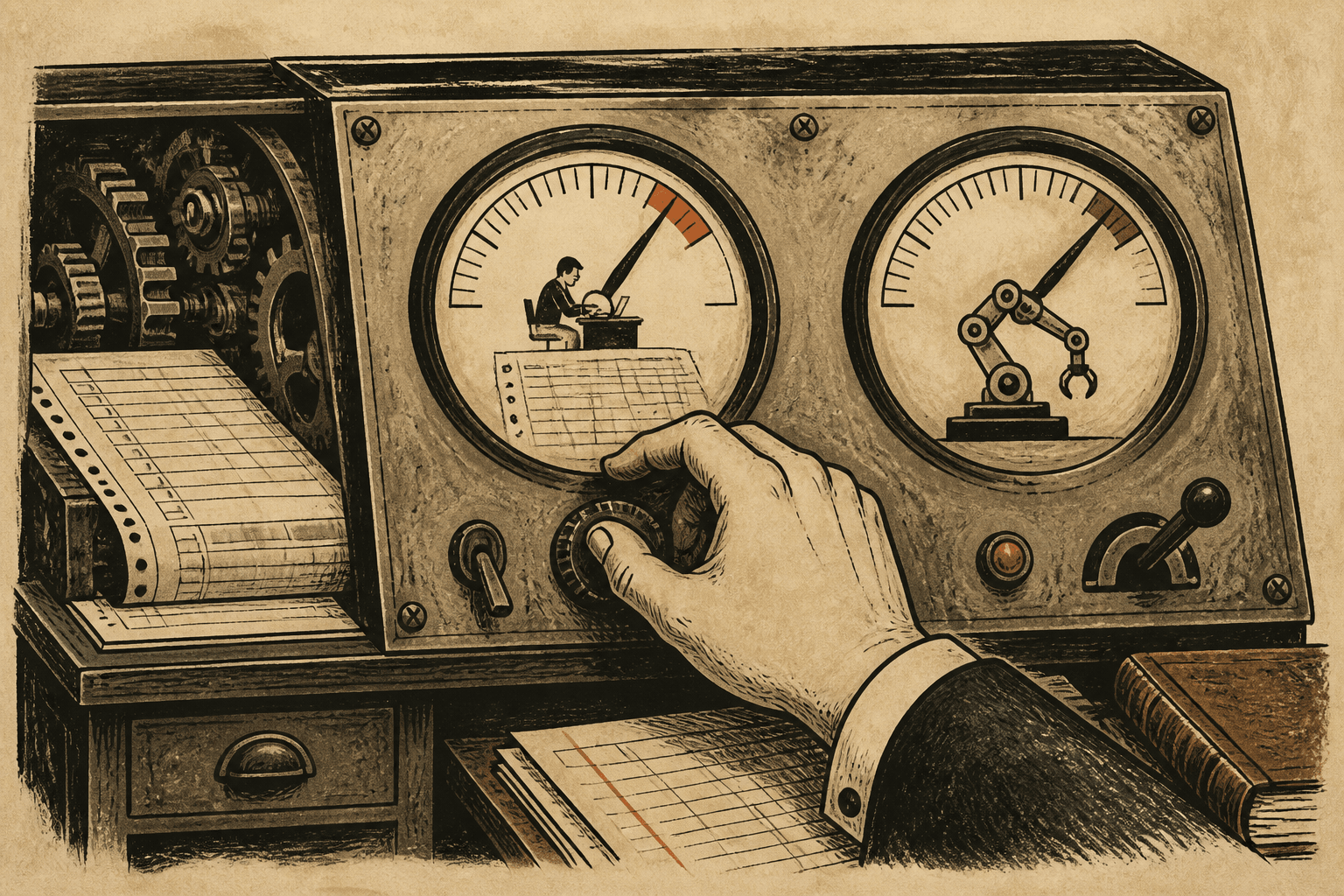
Bill Gates published an essay on August 26th arguing that AI will move through law, medicine, software and manufacturing in a decade rather than generations, and that nobody has a plan for it. Most of the essay is about capability, but buried in it is a claim about accounting: that the tax code already picks winners between people and machines. Granted, the lever already on the books works through amortization schedules, not the token-and-robot excise he's proposing.
His argument: put a person on payroll and the government collects payroll tax on their earnings the same year; buy a machine to do the job instead, and the cost is typically written off just as fast, with no comparable tax attached to the purchase. His conclusion: “The tax system nudges you toward replacing people with machines.” So he wants a tax on AI tokens and robots, an idea he first floated in 2017 aimed at robots alone and has now widened to cover tokens too.
He's right about the nudge, yet he's picked close to the weakest available evidence for it.
Gates is comparing a tax to a deduction:
Wages already get written off right away. Salary is an ordinary business expense under Section 162, deductible in full the year it is paid, and the employer’s share of payroll tax is deductible too. The real contrast isn’t a deduction against nothing; it’s a machine carrying no payroll tax against a worker carrying 7.65 percent in employer-side FICA, plus unemployment insurance and workers’ comp. That's a real wedge, worth roughly eight to ten points, and a good deal narrower than his sentence implies.
The number that would have won it for him:
Daron Acemoglu, Andrea Manera and Pascual Restrepo measured this for Brookings in 2020. Effective tax rate on labor: 25.5 to 33.5 percent. On equipment and software: roughly 20 percent in 2000, 10 percent through the 2010s, 5 percent after the 2017 act. Closing that gap toward the rates they calculate as optimal, which are narrower but not equal (18.2 percent on labor, 26.7 percent on capital, by their estimate), would raise employment about 4 percent.
That’s Gates’s claim, but larger than he made it and resting on effective marginal rates rather than a quirk of write-off timing, and he doesn’t cite it.
Section 174 already ran the experiment, on programmers:
From 2022 through 2024, US employers could not deduct software engineers’ salaries in the year they paid them. Section 174, as amended by the 2017 act, required domestic R&D wages to be amortized over five years, fifteen if the engineer sat overseas. A purchased machine, meanwhile, could still take bonus depreciation immediately: 100 percent in 2022, phasing down to 80 percent in 2023 and 60 percent in 2024.
Gates names software engineering among the first jobs AI will take. For three tax years the code treated hiring one as a capital asset with a five-year life, and the machine replacing them as a same-year write-off. How much of the 2022-24 layoff wave that explains is unsettled: founders blamed it loudly, but it landed alongside a rate-hike cycle and a post-pandemic correction, and I haven’t seen the two cleanly separated, though the asymmetry itself is not in dispute.
Congress reversed it in July 2025, restoring immediate expensing permanently through a new Section 174A for domestic R&D.
The token half of the proposal is the part I would drop:
A robot is capital equipment and tokens are an operating expense, so taxing them with one instrument means taxing two different things. An API invoice deducted immediately is treated exactly like the wages he is contrasting them with, so his write-it-off story supports the robot half and leaves the AI half unexplained.
Dave Friedman and atomic14 both got to the metering objection before this essay ran, and they're right that a token measures compute rather than work delivered. What I would add is the drift: inference keeps getting cheaper per unit of work delivered, so the base erodes fastest exactly when displacement accelerates. An eroding base is another reason to turn the dials that already exist rather than build a new one. Gates wants the tax targeted to spare the uses he calls purely beneficial, but an excise can’t tell one use from another, and slowing adoption is how the tax is supposed to work in the first place.
The nudge Gates describes is legitimate: hiring or automating is a margin, and the code sets the price on both sides. Section 174 moved that price against programmers in 2022 and moved it back in 2025. Twice in three years, and nobody called either one a robot tax. Gates has been making this same argument since 2017, through both moves, yet cited neither. The paragraph he buried in a capability essay is the one with an actual track record: the dials he wants built already exist, and they turned twice without his help. Keep an eye out for whether the effective-rate gap on equipment moves at all in the next budget cycle.
Get this every weekday.
The Omniscient Bulletin: consequential AI, explained and evaluated. 5 to 7 items a day with the take, not the recap.