AI Policy
Peter Thiel's Case Against Global AI Control
His foundation funded an institute at the root of AI-risk arguments, and he now says the effort to stop dangerous AI is the greater danger. That institute's treaty authors argue that the default path carries the greater authoritarian risk, and we found no public answer from him.
Tips, corrections, or questions? support@omniscient.media
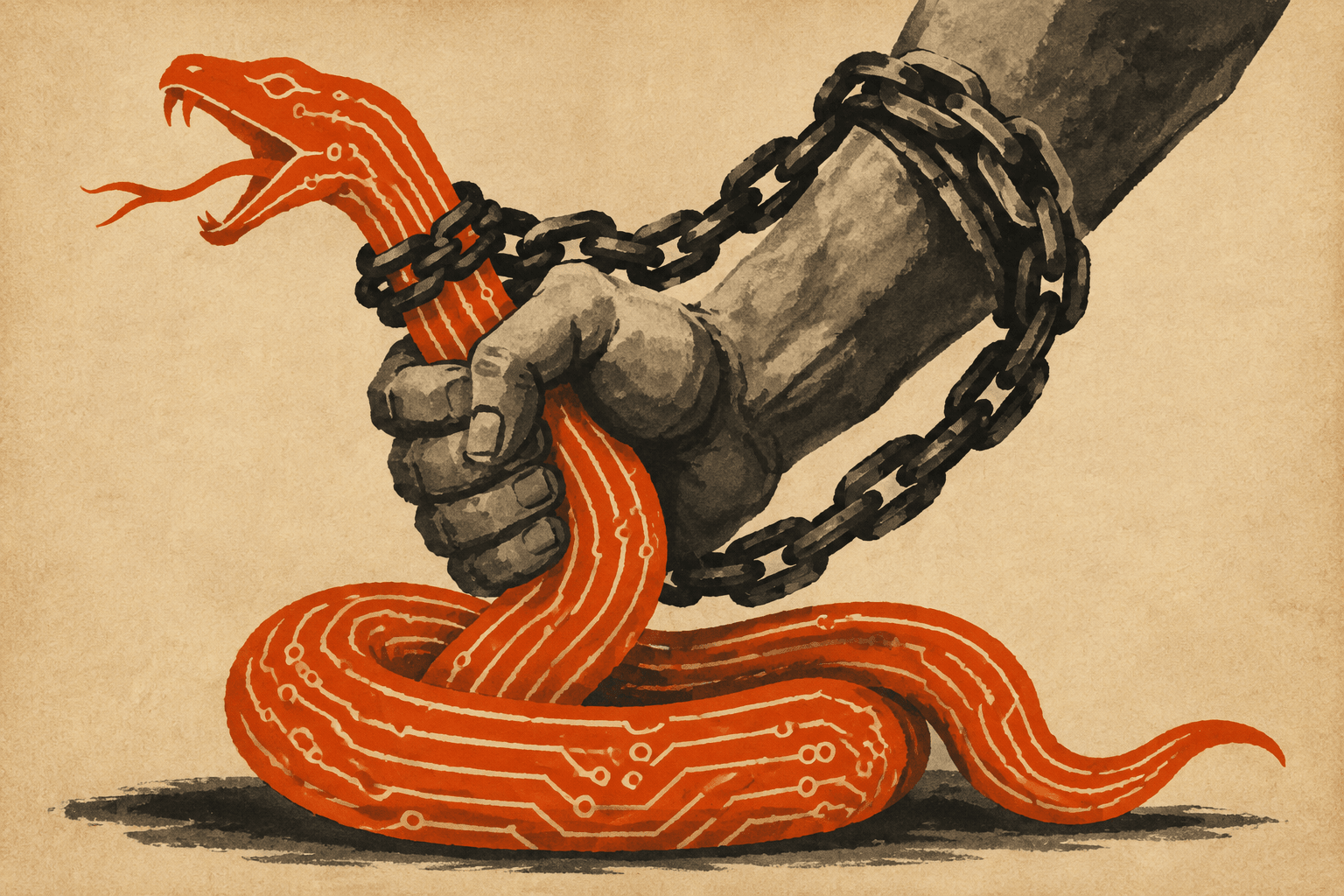
[Editor's Note: This piece was researched, drafted and checked with the help of AI models, including models made by Anthropic, a company Thiel has publicly criticized.[1] Anthropic's chief executive is among the signatories of the accord described at the end.]
The Machine Intelligence Research Institute, one of the organizations at the root of arguments about catastrophic AI risk, keeps a public list of the people and foundations that paid for its work. Under "Past Contributors" sits the Thiel Foundation, at $1,627,000.[2] In the month before The Washington Post's October 10th, 2025 report, according to recordings of private, off-the-record lectures the paper reviewed, the man behind that foundation, Peter Thiel, was telling audiences in San Francisco that the Antichrist of our century would be "a Luddite who wants to stop all science," and that "It's someone like Greta or Eliezer": the climate activist Greta Thunberg and Eliezer Yudkowsky, the institute's best-known voice.[3]
The lectures' contents are known only from that leaked audio. The Post said a forensic expert who reviewed a sample found it "probably authentic," and quotations from the lectures here are attributed to the outlets that heard them.[3] According to the Post, Thiel said he is now embarrassed by the association with Yudkowsky, whose work he had funded, and that Yudkowsky and others like him have become "deranged."[3] Reason, which obtained recordings of the same four-part series, reported him grouping Yudkowsky, the philosopher Nick Bostrom and Thunberg as "legionnaires of the Antichrist."[4]
Both men answered the Post. Yudkowsky said Christian authorities had told him that Thiel's views, "identifying the Antichrist with proposals to regulate the AI industry, are not deemed by them to be compatible with conventional Christian belief," and Bostrom said: "Maybe he needs a new casting agency for his demonology."[3]
The theology drew most of the attention, but underneath it is an argument Thiel has made on the record for years and can state without it, though by his own account the theology is what gives it force: stripped of "the biblical context," he said in the lectures, according to the Post, "you will never find it scary enough."[3] His target isn't AI safety work in general, such as testing or security research, but the camp that treats advanced AI as an existential risk and wants some form of global control over its development. He grants that AI carries real risks, and argues that any authority strong enough to stop it would itself be a danger at least as great. The institute his foundation once funded shares his fear of concentrated, unaccountable power over AI. The authors of its proposed treaty part from him first on the risk he discounts, that the machine itself gets out of hand. On the risk he names, they argue that leaving superintelligence to whoever builds it first is the likelier road to that concentration of power.
The argument, in his words
The argument starts with stagnation, in a 2011 essay for National Review. Thiel argued that progress outside computing had slowed since around 1970; computers had become "the single great hope for the technological future," and even their gains had "roughly canceled each other out" against the failure to advance in energy.[5] He dated the cultural turn precisely: men reached the moon in July 1969, and "Woodstock began three weeks later."[5] AI, in this view, is the most important thing happening in the one sector that kept moving.
He has never treated it as neutral: at Stanford in January 2018 he offered a line that has followed him since, as Stanford's own report rendered it: "Crypto is libertarian and AI is communist."[6] In a 2019 op-ed in The New York Times he wrote that "artificial intelligence is a military technology," while rejecting the popular story that "pits a monolithic" AI against all of humanity.[7]
By 2025 his estimate of its size was modest: asked by the Times columnist Ross Douthat how big AI is, he put it "roughly on the scale of the internet in the late '90s," and said later in the interview: "There are risks with it. Obviously, there are dangers with this technology." "If all we have is A.I., I will take it."[8]
His clearest statement of the core claim came in February 2024, answering an audience question on the economist Tyler Cowen's podcast, which publishes full transcripts. "I'm not a p(doom), EA East Bay rationalist," he said. "I think it's up to us, but as I said, I'm much more worried about the humans trying to stop the AI than the AI destroying us. A force that's powerful enough to stop the AI is probably a force that's powerful enough to destroy the world, too."[9] He didn't wave the risks away: "There are apocalyptic fears around AI that I think deserve to be taken seriously."[9]
What he added was a risk of his own. "In my mind, one other existential risk is a one-world totalitarian government," he said. "I find that at least as scary as the others."[9] He described his position as "sort of an anti-anti-tech argument," and said of the fears he'd just granted: "I don't want to completely dismiss them, but that's also how we're going to get this totalitarian state."[9] He framed the choice with a pair of images, asking whether you "want to worry about Dr. Strangelove or Greta," and even if AI took people's jobs, he said, he would still back it, because "the default is really bad."[9]
The institutional logic is the strongest part of the case. A remedy for extinction-level risk seems to require institutions that can monitor and suppress a technology's development across borders. His stagnation thesis adds a second premise: stopping one of the few technologies still advancing would entrench a status quo he already regards as failing.
He also named a target. "There's a short Bostrom essay from 2019 on how to stop all the AI risks," he said, summarizing it as a call for effective global government, effective policing and global control of computing power; "That sounds to me at least as scary as the AI."[9] The paper is Bostrom's "The Vulnerable World Hypothesis," a thought experiment about catastrophic technologies in general. It lists "Establish extremely effective preventive policing" and "Establish effective global governance" among the ways a vulnerable world might be stabilized, and sketches a high-tech panopticon in which everyone wears a monitoring device.[10]
Bostrom concludes that his reflections give "a pro tanto reason to support strengthening surveillance capabilities and preventive policing systems and for favoring a global governance regime that is capable of decisive action," and, in the next sentence, that "we have not settled whether these things would be desirable all-things-considered."[10] Thiel's summary keeps the first of those sentences and leaves out the second, where Bostrom says he hasn't decided whether the measures would be worth it.
The theological layer sits on top. In the first of the lectures, according to Reason, he cited Matthew 24:6 to argue that "the Antichrist will come to power by talking about Armageddon non-stop," and 1 Thessalonians 5:3 to argue that he will do it by promising "peace and safety."[4] He returned to the Thessalonians verse with Douthat, calling "peace and safety" the Antichrist's slogan. In the same interview he pointed to the FDA, which he said "regulates not just drugs in the US but de facto in the whole world, because the rest of the world defers to the FDA," and to the Nuclear Regulatory Commission, which he said "effectively regulates nuclear power plants all over the world."[8] In the lectures, according to the Post, he said that stopping new technology "seems far, far worse" than its harms: "If the internet or the AI deranges some people but we have to shut it down altogether, that feels like out of the frying pan into the fire - a cure that's far worse than the disease."[3] He describes himself, by Reason's account, as "a small-o orthodox Christian."[4]
His reading of scripture is contested. The religion writer Jay Michaelson argues that the passage doesn't make "peace and safety" the Antichrist's slogan: "on the contrary, it is what people deceive themselves into thinking" when they ignore the end times.[11] An Episcopal priest, Kevin Deal, called Thiel's warnings heretical.[12] Those objections address his exegesis, not the separate political claim that catastrophic-risk arguments can be used to justify concentrated power.
The argument met a real case this year. In May 2026 Pope Leo XIV issued an encyclical on AI that called for it to be regulated. At the Aspen Ideas Festival on June 30th, according to CNN's notes of a panel that was not recorded, Thiel said the Pope was "working for the Chinese Communists," because regulation would slow only one side of the race between the United States and China.[1] He repeated the point in an interview released on September 24th on Axel Springer's MD MEETS with Mathias Döpfner, allowing that "maybe it was too harsh" but calling it a rhetorical point: China's Communist Party would not listen to the Pope, Americans might, and so "in effect, the Pope's encyclical was working for the Communist Party." "I'm not saying he was an agent of the Communists," he added, "but he was at least acting as a useful idiot for the CCP."[13]
Where the argument comes from
The stagnation thesis turned toward government at the Republican National Convention in 2016. "It's hard to remember this, but our government was once high tech, too," he said, and after listing nuclear bases that "still use floppy disks," he called the state of the government's technology "a staggering decline for the country that completed the Manhattan project."[14] The complaint that Washington had forgotten how to build technology is also the market Palantir and Anduril serve.[15]
By this year the thesis had become his case against slowing AI. "If we just have this economic stagnation, that's the road toward total catastrophe," he told the Aspen panel on June 30th, as quoted by Fox News, whose reporter was there. "I'm extremely alarmed about a tendency to slow it down or stop [AI] because I think the alternative is not the world ending with a whimper. It is zero-sum, Malthusian, deranged politics."[16]
The bets
His money has been in AI from early on. He wrote in 2019 that he was one of DeepMind's first investors, in 2010,[7] and its co-founder Demis Hassabis has recalled that when he pitched Thiel, "he decided to invest within the first meeting."[17] In December 2015 OpenAI's founding announcement named him among those "donating to support OpenAI," listing "Jessica Livingston, Peter Thiel, Amazon Web Services," for a lab that described AI as able to "damage society if built or used incorrectly."[18] The announcement didn't break out individual amounts (it put the funders' combined commitment at $1 billion), and both organizations were labs set up to build AI.
Palantir, which he co-founded and has chaired since 2003, is the stake most fully on the record.[15] The company describes AIP as its "generative artificial intelligence" platform, and says it builds software that lets customers "integrate and analyze their own data."[19][15] According to its 2026 proxy statement, Thiel holds 68,871,556 Class A shares, 3.0% of that class, and 29,128,444 Class B shares, which carry 10 votes each; together they give him about 7.9% of the vote. That understates his position: through a voting trust and voting agreement with his co-founders Alex Karp and Stephen Cohen, the founders together exercise 49.999999% of the vote, and Thiel's shares vote with that block.[15]
Palantir's proxy also says Thiel "may be deemed" to share voting and investment power over more than 10% of Anduril, the defense-technology company, through his entities.[15] Founders Fund, the venture firm where he is a partner,[15] led Anduril's 2025 round with a $1 billion check that, the firm told TechCrunch at the time, was the largest it had ever written.[20] His newest bet is in compute itself: in May 2026 he led a $140 million round for Panthalassa, an Oregon company that pairs wave power generated by massive floating orbs with onsite AI computing. "The future demands more compute than we can imagine," he said in the announcement.[21]
What his argument leaves open
His descriptions of AI sit awkwardly with his support for it, and he has said so himself. In the Cowen conversation he returned, unprompted, to "this riff five, six years ago" about AI being communist, and said he was "still probably a little bit uncomfortable" that AI "seems to lead to these incredible returns to scale." When Cowen asked what he thought, he answered: "I don't have answers to all these." A moment later he added: "Maybe the large language models are not really communist."[9]
He has also not drawn a clear line between the safeguards he would accept and the regime he fears. He says AI's risks deserve to be taken seriously, and his objection is to a remedy that would require concentrated, transnational power.[9] That leaves open which narrower measures, such as testing, auditing or national rules, fall on which side, and his published remarks don't say.
The Palantir question
Douthat put the Palantir question to him directly in 2025. "You're deeply invested in Palantir, in military technology and technologies, of surveillance and technologies of warfare," he said, and asked whether the Antichrist of Thiel's story wouldn't be using the tools Thiel was building. Thiel answered: "Look, there are all these different scenarios. I obviously don't think that that's what I'm doing."[8] At Aspen in June 2026, according to CNN's notes, he said Palantir is "not joined at the hip" with what he called the US deep state, and that neither he nor Karp holds a government security clearance.[1]
An earlier answer addresses the distinction more directly. In 2013 he told Forbes that Palantir "was a mission-oriented company," and that he had defined its problem "as needing to reduce terrorism while preserving civil liberties."[22] In the lectures, as Reason heard them, he described the United States itself as "the natural candidate for Katechon," the biblical restrainer against a one-world state, while warning that it could become that state.[4] His position distinguishes a capable national government from a globally consolidated authority; critics question whether powerful surveillance and military tools stay containable at the national level.
Palantir describes itself as a software company, and its board told shareholders in 2026 that the most common misconception about it is that it is "a data company or a surveillance company": "We are not. We do not sell personal data of any kind."[15] Governments, the board said, "are charged with managing the decisions, judgments and ultimate consequences" of how its tools are used.[15] In 2023, when Thiel's remarks about Britain's health service drew criticism, Palantir said he was speaking as a private individual and that his comments did not reflect the company's views.[23] Karp argues that the software's "granular permissioning capabilities" constrain the state.[24]
Its government work is extensive and contested. CNBC reported on its $30 million contract with Immigration and Customs Enforcement, which Karp defended by saying that people critical of ICE "should be out there protesting for more Palantir."[25] This year the Pentagon moved to make Palantir's Maven system, which DefenseScoop describes as compressing "the military's processes for finding and striking targets," into "a formal program of record."[26] Those uses have drawn civil-liberties criticism, including from The Intercept, which cited Snowden documents it said "showed how Palantir software helped the National Security Agency and its allies spy on the entire planet," though the same article notes BuzzFeed News reported in 2017 that the relationship had ended two years earlier.[27] The sources cited here don't establish unlawful conduct by Palantir, or show Thiel personally directing any deployment.
Officials with ties to Thiel
Several people with documented ties to Thiel hold or have held roles in AI policy in the Trump administration. Those ties establish access and overlapping networks; no source we found shows Thiel directing a policy. The Vice President, JD Vance, was "a principal at Mithril Capital, a fund co-founded by Peter Thiel and Ajay Royan."[28] In the 2022 cycle Thiel gave $15 million to Protect Ohio Values PAC, the super PAC backing Vance's Senate campaign, $10 million of it in March 2021.[29]
In Paris in February 2025, Vance told world leaders: "The AI future is not going to be won by hand-wringing about safety."[30] On September 14th he said he felt "a little bit weird" about frontier AI companies "begging the government to regulate them," without naming any.[31] On September 29th he said: "The solution to some of the AI risks is for you guys to take the risk seriously, not to come to the government for a regulatory regime that may make things worse if it's not smart and careful."[32]
Michael Kratsios, now director of the White House Office of Science and Technology Policy, was "a Principal at Thiel Capital" before his first stint in government, according to his official biography from that period.[33][34] He and David Sacks signed America's AI Action Plan in July 2025.[35] Sacks, who co-wrote The Diversity Myth, a book about Stanford, with Thiel,[36] was then the administration's AI and crypto czar; he moved in March 2026 to become a co-chair of the President's Council of Advisors on Science and Technology.[37] The executive order Trump signed on September 29th, which directs the government to call AI "Super Intelligence," gives Kratsios's office 60 days to submit proposed legislative language for a federal definition of the term.[38]
In the same 2022 cycle, Thiel gave $20 million to Saving Arizona PAC, which backed the Senate campaign of Blake Masters, his co-author on the 2014 book Zero to One.[29][39] Since then the money has shrunk: Thiel told Fortune in 2023 that he would be "less involved" in the 2024 presidential election and would not financially support any of its candidates, arguing that "an extra $1 million or $10 million does not make any difference,"[40] and a September 30th, 2026 search of the Federal Election Commission's itemized individual contributions found none under his name in that cycle. In the 2026 cycle he has given $852,200 to a House Republican joint fundraising committee and $1.5 million to Club for Growth Action,[41] a fraction of the 2022 total. We found no statement from Thiel endorsing or criticizing the administration's AI policy itself. He has criticized its personnel: asked in the Döpfner interview to assess Trump's record, he said "you should ask me in 10 years or so," then described the second administration as "staffed by not very smart, but very loyal people."[13][42]
What MIRI's treaty says about concentrated power
The most detailed treatment of his objection that we found comes from the institute his foundation once funded. In November 2025, after his remarks to Cowen and Douthat, MIRI's governance team published a proposed international agreement describing "a coalition led by the United States and China," enforced "following the precedent of international arms treaties," with monitored data centers, limits on research and, for countries outside it, pressure including "economic sanctions and visa bans."[43]
Its authors put Thiel's objection to themselves, without naming him. "Won't this plan enable authoritarianism?" the full report asks, and concedes that the agreement "does include elements that could be misused for authoritarian abuse, such as centralizing AI infrastructure, monitoring training runs, and tracking researchers." Their answer is that the opposite path is the more dangerous one: "the default trajectory carries far greater authoritarianism risk," because superintelligence is likely to be built "by a private company (potentially in partnership with government agencies), with minimal public oversight," leaving control with "perhaps 1-10 individuals" and "few mechanisms to prevent permanent authoritarian lock-in."[44]
Nothing we found in Thiel's public record answers that, and his spokesman, Jeremiah Hall, did not respond to questions sent for this piece on October 1st, among them how Thiel answers that argument. The nearest he has come is the discomfort he admitted to Cowen about AI's "returns to scale." In his most recent statement of the argument, the Döpfner interview, he said that slowing AI would require a "one world government with real teeth, real force," without taking up who would hold the power if no one could stop it; Döpfner didn't ask.[13]
The report answers its own question only in general terms. It says a halt would allow "time to establish the required governance structures," and that where enforcing the agreement at home expands a government's power, there are "likely safeguards that could be implemented to prevent misuse," such as "multilateral controls, narrow scoping of authority, and transparency measures." In the draft treaty itself, the technical body that verifies compliance answers to an Executive Council that initially consists of the United States and China, each with a veto over its decisions. Enforcement falls to individual states, whose permitted "Protective Actions" include "military actions to disable or destroy AI hardware," and the council reviews each one. Review conferences come every three years, a party may withdraw on 12 months' notice, and the agreement has no end date.[44]
The accord
On September 29th, Trump hosted AI executives at the White House and released a voluntary accord, which Trump posted on Truth Social as a two-page document.[45] It was "signed by six tech executives": the heads of Google, Anthropic, and Meta, plus Elon Musk, OpenAI's president, and Nvidia's chief executive Jensen Huang. Trump called it "morally binding."[45]
It’s titled "White House Accord on Super Intelligence," with the subtitle "Joint Commitment on Frontier Responsibilities."[45] Several attendees, including Amazon's Jeff Bezos and Palantir's Alex Karp and Shyam Sankar, are not among the signatories, according to ABC News's attendee list and CNBC's list of signers; the record doesn't show who was invited to sign.[46] Thiel isn't listed among the attendees in the accounts we read.
The accord is voluntary, signed by companies, and carries no enforcement apparatus of the sort Thiel warns about; its text says only that "it may make sense to codify these steps into laws or regulations" over time.[47] Whether his argument counts that as safe, his published remarks don't say.
Two developments since then bear on the line he draws between national and global power. On October 4th, Trump announced a "Super Intelligence Force" led by Director of National Intelligence Jay Clayton, with FTC Chair Andrew Ferguson and Undersecretary of Defense for Research and Engineering Emil Michael among its members. It reports to Trump and to his chief of staff, Susie Wiles, and by Trump's description it will coordinate the federal government's dealings with groups ranging from consumers and religious organizations to critical-infrastructure providers and the AI companies themselves.[48] Separately, in a TIME interview conducted at the White House on September 28th and published October 1st, Trump said no when asked whether he would nationalize the leading labs. Asked why the government doesn't take shares in them as it did with Intel, he answered: "I might. Maybe I could do that."[49][50]
Neither is the global authority Thiel's argument targets, and the sources describe a coordinating body and a hedged answer, not a licensing regime or an ownership stake. But both point toward more of AI's oversight sitting inside the national executive, and his published remarks don't say whether his objection to concentrated power stops at the border. We found no statement from him on either.
None of it settles the question both sides are fighting over. Thiel thinks the danger is whoever is handed the power to stop AI; MIRI thinks it's whoever builds superintelligence first, if the machine stays under anyone's control at all. The first dated marker is the proposed legislative language defining "Super Intelligence" that Kratsios's office must submit to the President by late November, which would address what the term covers without deciding who holds the power.[38]
Sources
CNN (July 2, 2026), from notes of a June 30, 2026 Aspen Ideas Festival panel that was not recorded Inline ↗
7 passages checked · read October 7, 2026
Peter Thiel: The pope is ‘working for the Chinese Communists’ by criticizing AI | CNN Ad Feedback CNN values your feedback 1.…
…Anthropic — a “woke liberal company” that he credited with “winning the AI race” — would “rig the elections in 2028” in support of Democrats.…
…Despite doing billions of dollars of business with the national security establishment, the company is “not joined at the hip” with the “US deep state,” Thiel said.…
…ideological efforts Elon Musk might make in the opposite direction through X. Anthropic declined to comment, pointing instead to one of its recent blog posts on election integrity and political bias.…
…said, is “one of the things that’s really healthy about the US,” because it means “the power centers are distributed in this country.” As an example of the multiple power centers, he offered an unsupported conspiratorial claim…
…Anthropic, Thiel said, would use its industry-leading AI models to “completely outwit” any ideological efforts Elon Musk might make in the opposite direction through X. Anthropic declined to…
…people” and said that neither he nor Palantir’s current CEO, Alex Karp, hold government security clearances.…
Machine Intelligence Research Institute, "Top Contributors" (page last updated April 30, 2026) Inline ↗
1 passage checked · read October 7, 2026
…Past Contributors Other supporters who helped get us to where we are today: Thiel Foundation $1,627,000 Christian Calderon $367,574 Raising for Effective Giving $204,167 Brian Cartmell $146,700 Alameda…
Nitasha Tiku, Elizabeth Dwoskin and Gerrit De Vynck, "Inside billionaire Peter Thiel's private lectures," The Washington Post (October 10, 2025), reporting on leaked recordings Inline ↗
Jack Nicastro, "I Listened to Over 7 Hours of Peter Thiel's Leaked Antichrist Lectures," Reason (October 14, 2025) Inline ↗
5 passages checked · read October 7, 2026
…In his second lecture, Thiel goes on to identify "the legionnaires of the Antichrist [as people] like Eliezer Yudkowsky, Nick Bostrom, and Greta Thunberg [who] argue for world government to…
…In his third lecture, Thiel names "tax treaties, financial surveillance, and sanctions architecture" as defining features of the international "Antichrist-like system" of international…
…state (the Treasury Department, in particular), and the centralization of payments on the Society for Worldwide Interbank Financial Telecommunications system—an international messaging network better known as SWIFT, which banks use to…
…state power as a double-edged sword, identifying the American empire as simultaneously "the natural candidate for Katechon"—the entity that delays the emergence of the Antichrist—" and Antichrist; ground zero of the one-world…
…Thiel kicks off the lecture series by identifying himself as two things in his private life: "A small-o orthodox Christian" and a "humble classical liberal."…
Peter Thiel, "The End of the Future," National Review (October 3, 2011) Inline ↗
Stanford Report (February 1, 2018), on the January 31, 2018 Cardinal Conversation with Reid Hoffman Inline ↗
1 passage checked · read October 7, 2026
…“Crypto is libertarian and AI is communist,” he said, describing cryptocurrencies such as bitcoin, and artificial intelligence, which drives…
Peter Thiel, "Good for Google, Bad for America," The New York Times (August 1, 2019) Inline ↗
3 passages checked · read October 7, 2026
…Opinion Supported by SKIP ADVERTISEMENT Good for Google, Bad for America At its core, artificial intelligence is a military technology.…
…is how Demis Hassabis, the founder of DeepMind , described his company in 2010, when I was one of its first investors.…
…But that common-sense understanding of A.I.’s ambiguity has been strangely missing from the narrative that pits a monolithic “A.I.” against all of humanity.…
Ross Douthat, "Peter Thiel and the Antichrist," Interesting Times, The New York Times (June 26, 2025), transcript Inline ↗
"Peter Thiel on Political Theology," Conversations with Tyler, episode 210 (recorded February 21, 2024), host transcript Inline ↗
15 passages checked · read October 7, 2026
…I think it’s up to us, but as I said, I’m much more worried about the humans trying to stop the AI than the AI destroying us.…
…A force that’s powerful enough to stop the AI is probably a force that’s powerful enough to destroy the world, too, so I want to worry more about the humans that are trying to…
…That sounds to me at least as scary as the AI.…
…There are apocalyptic fears around AI that I think deserve to be taken seriously.…
…In my mind, one other existential risk is a one-world totalitarian government.…
…If I’ve had to do my anti-millenarian frame, or maybe it’s not a pro-tech argument — this is sort of an anti-anti-tech argument — is that if we, again, talk about all these existential risks today — nuclear weapons, climate…
…I don’t want to completely dismiss them, but that’s also how we’re going to get this totalitarian state.…
…Maybe the large language models are not really communist.…
…I don’t have answers to all these.…
…My default is, the default is really bad.…
…I had this riff five, six years ago, where if crypto is libertarian, why can’t we say that AI is communist?…
…One of the things that I’m still probably a little bit uncomfortable about is that it seems to lead to these incredible returns to scale.…
…There’s a short Bostrom essay from 2019 on how to stop all the AI risks, and it’s basically, maybe we can change the culture so that nobody will…
…THIEL: I’m just saying, it would be good if we just at least ask the right sorts of questions.…
…There are all these versions of this I can go down, but do you want to worry about Dr. Strangelove or Greta ?…
Nick Bostrom, "The Vulnerable World Hypothesis," Global Policy (2019), author's version Inline ↗
5 passages checked · read October 7, 2026
…Establish extremely effective preventive policing.…
…Establish effective global governance.…
…However, we have not settled whether these things and anonymization applied as the purpose permits.…
…parency’ that prevents concentrations of power by organiz- Clearly, these reflections provide a pro tanto reason to ing the information architecture so that multiple support strengthening surveillance capabilities and…
…With would be desirable all-things-considered, since doing so some creative mechanism design, some machine learning, would require analyzing a…
Jay Michaelson, "Peter Thiel's Surprisingly Simple Antichrist," Arc Magazine (November 19, 2025) Inline ↗
1 passage checked · read October 7, 2026
…1 Thessalonians 5:1-3 does not say that “peace and safety” is the slogan of the Antichrist; on the contrary, it is what people deceive themselves into thinking if they ignore the prophecies of the End Times: Now, brothers and…
Kevin Deal, opinion, The San Francisco Standard (October 1, 2025) Inline ↗
1 passage checked · read October 7, 2026
…But as a Christian who strives to follow Jesus, and a priest in the Episcopal Church, I find Thiel’s warnings heretical.…
"Peter Thiel: The AI Crisis, Europe's Decline & the Battle for America," MD MEETS with Mathias Döpfner (Axel Springer), YouTube (September 24, 2026) Inline ↗
2 passages checked · read October 7, 2026
Peter Thiel: The AI Crisis, Europe’s Decline & the Battle for America - YouTube About Press Copyright Contact us Creators Advertise Developers Terms Privacy Policy & Safety How YouTube works Test new features NFL Sunday Ticket © 2026 Google…
…In a wide-ranging conversation with Mathias Döpfner, the Silicon Valley investor warns that E...
Peter Thiel, Republican National Convention remarks as prepared for delivery, via TIME (July 21, 2016) Inline ↗
Palantir Technologies, proxy statement (Schedule 14A, April 24, 2026) Inline ↗
12 passages checked · read October 7, 2026
…Mr. Thiel is one of our co-founders and has served as the Chairman of our Board of Directors since 2003.…
…We are not. We do not sell personal data of any kind.…
…We also believe that these governments, and not technology companies, are charged with managing the decisions, judgments and ultimate consequences associated with the resolution of these complex critical problems.…
…Mr. Thiel may be deemed to have shared voting, investment, and dispositive power with respect to more than 10% of each of Anduril and Chapter through Mr. Thiel’s related entities.…
…He has served as president of Thiel Capital, an investment firm, since 2011 and as a partner of Founders Fund, a venture capital firm, since 2005.…
…Schiff (7) 186,965 * 10,000 * — * * Lauren Friedman Stat (8) 109,416 * — * — * * Peter Thiel (9) 68,871,556 3.0 29,128,444 29.1 335,000 33.3 7.9 †† Eric Woersching (10) 2,348 * — * — * * All executive officers and directors…
…For Proposal 1, the voting power of the Class F common stock shall equal 49.999999% of the voting power of all of the outstanding shares of our capital stock entitled to vote on such proposal (including the…
…We develop and license software platforms that enable our customers to integrate and analyze their own data to make better decisions.…
…All shares of our Class F common stock are held in a voting trust (the “Founder Voting Trust”), established by Stephen Cohen, Alexander Karp, and Peter Thiel (our “Founders”) pursuant to a voting trust…
…have 1,265,802,792 votes in the aggregate, or approximately 1,259.505 votes per share, representing 27.7% of the voting power for Proposal 1.…
…them or their specified affiliates as of the close of business on the record date and does not include the votes attributable to the Class F common stock, except as shown in the row entitled “Founder Total” and as noted in footnotes 11 and…
…attempt to clarify common misconceptions, the most pervasive of which is that Palantir is a data company or a surveillance company.…
Joseph A. Wulfsohn, Fox News Digital (July 1, 2026), reporting from the June 30, 2026 Aspen Ideas Festival panel Inline ↗
3 passages checked · read October 7, 2026
…CLICK HERE TO DOWNLOAD THE FOX NEWS APP "If we just have this economic stagnation, that's the road toward total catastrophe," Thiel said.…
…"I'm extremely alarmed about a tendency to slow it down or stop [AI] because I think the alternative is not the world ending with a whimper.…
…It is zero-sum, Malthusian, deranged politics.…
Sam Shead, "How DeepMind convinced billionaire Peter Thiel to invest without moving the company to Silicon Valley," Business Insider (July 18, 2017), quoting Demis Hassabis Inline ↗
1 passage checked · read October 7, 2026
…"I remember the first time I pitched to him, he decided to invest within the first meeting," said Hassabis during a talk to entrepreneurs at Google Campus last month, which was uploaded…
OpenAI, "Introducing OpenAI" (December 11, 2015), Internet Archive capture Inline ↗
2 passages checked · read October 7, 2026
…Sam, Greg, Elon, Reid Hoffman, Jessica Livingston, Peter Thiel, Amazon Web Services (AWS), Infosys, and YC Research are donating to support OpenAI.…
…human-level AI could benefit society, and it's equally hard to imagine how much it could damage society if built or used incorrectly.…
Palantir Technologies, annual report (Form 10-K, filed February 17, 2026), including Item 9B Inline ↗
3 passages checked · read October 7, 2026
…AIP is our generative artificial intelligence (“AI”) platform, which provides secure connectivity to third-party-provided large language models…
…in Regulation S-K Item 408, as follows: On November 14, 2025 , STS Holdings II LLC, a stockholder whose shares may be deemed to be beneficially owned by Peter Thiel (the Chairman of our Board of Directors ), adopted a Rule 10b5-1…
…10b5-1(c), subject to the satisfaction of certain price and/or other conditions, with 2,000,000 shares being the total of the maximum number of all shares subject to any condition when summed across all possible conditions.…
TechCrunch (May 13, 2026) Inline ↗
1 passage checked · read October 7, 2026
…(Founder’s Fund invested a $1 billion check, the largest check it has ever written, it told TechCrunch at the time.)…
GeekWire (May 4, 2026) Inline ↗
3 passages checked · read October 7, 2026
…On Monday, Oregon-based Panthalassa announced a $140 million round led by Peter Thiel.…
…“The future demands more compute than we can imagine,” said Peter Thiel.…
…Panthalassa is developing technology that pairs wave power generated by massive floating orbs with onsite AI computing.…
Andy Greenberg and Ryan Mac, "How A 'Deviant' Philosopher Built Palantir," Forbes (August 14, 2013) Inline ↗
Bloomberg (January 18, 2023) Inline ↗
1 passage checked · read October 7, 2026
Peter Thiel Says British Affection for NHS Is Stockholm Syndrome - Bloomberg Skip to content Bloomberg the Company & Its Products The Company & its Products Bloomberg Terminal Demo Request Bloomberg Anywhere Remote Login Bloomberg Anywhere…
The Register (February 3, 2026), quoting Alex Karp's shareholder letter Inline ↗
1 passage checked · read October 7, 2026
…platform that makes possible constraints on government action and investigation through granular permissioning capabilities, to ensure that the state and its agents can see only what ought to be seen, and functional audit…
CNBC (February 2, 2026) Inline ↗
2 passages checked · read October 7, 2026
…"If you are critical of ICE, you should be out there protesting for more Palantir," he told CNBC's Morgan Brennan in an interview on Monday discussing the company's…
…Federal documents from April revealed that the company had a $30 million contract with the agency to provide "real-time visibility" on people self-deporting.…
DefenseScoop (April 15, 2026) Inline ↗
2 passages checked · read October 7, 2026
…deadline for Pentagon and military leaders to transition the Maven Smart System (MSS) into a formal program of record by the end of this fiscal year.…
…systems and intelligence sources into one interface that rapidly integrates data and compresses the military’s processes for finding and striking targets.…
The Intercept (September 12, 2025) Inline ↗
2 passages checked · read October 7, 2026
…“We are the single worst technology to use to abuse civil liberties, which is by the way the reason why we could never get the NSA or the FBI to actually…
…a tranche of classified documents revealed by Edward Snowden and The Intercept in 2017 showed how Palantir software helped the National Security Agency and its allies spy on the entire planet.…
TechCrunch (July 15, 2024) Inline ↗
1 passage checked · read October 7, 2026
…graduating from Yale Law School in 2013, Vance moved to San Francisco, where he was a principal at Mithril Capital, a fund co-founded by Peter Thiel and Ajay Royan.…
Federal Election Commission, itemized receipts, 2022 cycle, contributor "Thiel, Peter" Inline ↗
2 passages checked · read October 7, 2026
…cle_has_financial":2024,"last_f1_date":"2021-11-15","last_file_date":"2024-07-10","name":"PROTECT OHIO VALUES PAC (POV…
…cle_has_financial":2024,"last_f1_date":"2021-07-23","last_file_date":"2024-08-22","name":"SAVING ARIZONA PAC","organization_type":null,"organization_type_full":null,"party":null,"party_full":null,"state":"VA","state_ful…
Vice President JD Vance, remarks at the AI Action Summit, Paris (February 11, 2025), American Presidency Project Inline ↗
1 passage checked · read October 7, 2026
…The AI future is not going to be won by hand-wringing about safety.…
IANS (September 14, 2026) Inline ↗
2 passages checked · read October 7, 2026
…that we have so many frontier AI tech companies kind of talking to the government and begging the government to regulate them,” he said.…
…to me like a bit of a Trojan horse, so I think we just have to be careful about this.” Vance did not name any companies or explain what he believed they hoped to gain from regulation.…
Nextgov/FCW (September 29, 2026) Inline ↗
2 passages checked · read October 7, 2026
…solution to some of the AI risks is for you guys to take the risk seriously, not to come to the government for a regulatory regime that may make things worse if it’s not smart and careful,” Vance added.…
…“The solution to some of the AI risks is for you guys to take the risk seriously, not to come to the government for a regulatory regime that may make things…
White House (2017-2021 archive), biography of Michael Kratsios Inline ↗
1 passage checked · read October 7, 2026
…Prior to joining the White House, Michael was a Principal at Thiel Capital.…
House Committee on Science, Space, and Technology, hearing charter (July 22, 2026) Inline ↗
1 passage checked · read October 7, 2026
…Page 1 of 14 Background on OSTP Director Kratsios Michael Kratsios currently serves as both OSTP Director and Assistant to the President for Science and Technology.1 Mr. Kratsios was confirmed as OSTP Director on March 25,…
The White House, "America's AI Action Plan" (July 2025) Inline ↗
1 passage checked · read October 7, 2026
…Michael J. Kratsios Assistant to the President for Science and Technology David O. Sacks Special Advisor for AI and Crypto Marco A. Rubio Assistant to the President for National Security Affairs 2 AMERICA’S AI ACTION PLAN…
David O. Sacks and Peter A. Thiel, The Diversity Myth: Multiculturalism and Political Intolerance on Campus, Independent Institute (publisher's page) Inline ↗
1 passage checked · read October 7, 2026
…Resolution Cover The Diversity Myth Multiculturalism and Political Intolerance on Campus David O. Sacks (Author), Peter A. Thiel (Author), Elizabeth Fox-Genovese (Foreword) Format: Paperback Publication Date: January 1,…
CNBC (March 26, 2026) Inline ↗
1 passage checked · read October 7, 2026
…"I think moving forward as co-chair of PCAST, I can now make recommendations on not just AI but an expanded range of technology topics," he said.…
Executive Order, "Inaugurating the Era of Super Intelligence" (September 29, 2026) Inline ↗
1 passage checked · read October 7, 2026
…(b) Within 60 days of the date of this order, the Assistant to the President for Science and Technology (APST), in consultation with the heads…
Penguin Random House, Zero to One by Peter Thiel with Blake Masters (2014) Inline ↗
1 passage checked · read October 7, 2026
Zero to One by Peter Thiel, Blake Masters: 9780804139298 | PenguinRandomHouse.com: Books Skip to Main Content (Press Enter) 📝 Quiz: What Book Should You Read Next?…
Fortune (August 28, 2023) Inline ↗
1 passage checked · read October 7, 2026
…And an extra $1 million or $10 million does not make any difference.” Following the interview, Thiel provided an additional statement to Fortune saying that…
Federal Election Commission, itemized receipts, 2026 cycle, contributor "Thiel, Peter" Inline ↗
2 passages checked · read October 7, 2026
…cle_has_financial":2026,"last_f1_date":"2025-12-19","last_file_date":"2026-10-01","name":"CLUB FOR GROWTH ACTION","organization_type":null,"organization_type_full":null,"party":null,"party_full":null,"state":"DC","state_f…
…cle_has_financial":2026,"last_f1_date":"2026-08-05","last_file_date":"2026-08-10","name":"GROW THE MAJORITY","organization_type":null,"organization_type_full":null,"party":null,"party_full":null,"state":"VA","state_full…
Marc Vartabedian, "Peter Thiel slams 'not very smart' White House officials, warns of dem socialist takeover," New York Post (September 28, 2026), quoting the Döpfner interview Inline ↗
2 passages checked · read October 7, 2026
…“You got sort of, you know, an administration staffed by not very smart, but very loyal people.…
…“My fast answer is, you should ask me in 10 years or so, and we’ll see in 10 years how it all works out,” said the co-founder of Palantir, PayPal and the Founders…
MIRI Technical Governance Team, "An International Agreement to Prevent the Premature Creation of Artificial Superintelligence" (November 18, 2025) Inline ↗
3 passages checked · read October 7, 2026
…Our proposed agreement centers on a coalition led by the United States and China to restrict the scale of AI training and dangerous AI research.…
…Monitoring and enforcement would leverage existing state assets and legal frameworks, following the precedent of international arms treaties and non-proliferation agreements.…
…Stronger incentives could come from the standard toolkit of international diplomacy, including economic sanctions and visa bans.…
Aaron Scher, David Abecassis, Peter Barnett and Brian Abeyta (MIRI Technical Governance Team), "An International Agreement to Prevent the Premature Creation of Artificial Superintelligence," arXiv:2511.10783 v3 (May 8, 2026) Inline ↗
18 passages checked · read October 7, 2026
…Won’t this plan enable authoritarianism?…
…This agreement does include elements that could be misused for authoritarian abuse, such as centralizing AI infrastructure, monitoring training runs, and…
…does include elements that could be misused for authoritarian abuse, such as centralizing AI infrastructure, monitoring training runs, and tracking researchers.…
…However, the default trajectory carries far greater authoritarianism risk.…
…be built by a private company (potentially in partnership with government agencies), with minimal public oversight.…
…In this situation, control over the most powerful technology would rest with perhaps 1-10 individuals.…
…This would be an unprecedented concentration of power with few mechanisms to prevent permanent authoritarian lock-in.…
…Executive Council (a) The Executive Council initially consists of the United States of America and the People’s Republic of China.…
…Each member of the Executive Council has veto power over decisions by the CTB.…
…By contrast, this agreement prevents the creation of ASI, allowing time to establish the required governance structures.…
…Where domestic implementation expands the government’s power, there are likely safeguards that could be implemented to prevent misuse.…
…For instance, multilateral controls, narrow scoping of authority, and transparency measures would reduce these risks.…
…would not prevent reasonable Protective Actions taken by other parties, but these actions must also be reviewed to ensure that this article is not being abused.…
…At intervals of three years thereafter, the Executive Council will convene further review conferences with the same objective.…
…It shall give notice of such withdrawal to the CTB 12 months in advance.…
…The Agreement shall be of unlimited duration.…
…operations to sabotage AI development, interdiction or seizure of covered chip clusters, military actions to disable or destroy AI hardware, and physical disablement of specific facilities or assets directly enabling AI development.…
…The Executive Council reviews each Protective Action for compliance with this Article.…
CNBC (September 29, 2026) Inline ↗
3 passages checked · read October 7, 2026
…by six tech executives: Google 's Sundar Pichai , Tesla and SpaceX chief Elon Musk , Anthropic's Dario Amodei, Meta 's Mark Zuckerberg , OpenAI President Greg Brockman and Jensen Huang of Nvidia .…
…" watch now VIDEO 5:54 05:54 Pres. Trump on AI: Accord signed today is 'morally binding' Closing Bell Trump had crowdsourced a new name for AI last week, asking his social media…
…In addition to Trump, the Truth Social post shows the accord was signed by six tech executives: Google 's Sundar Pichai , Tesla and SpaceX chief Elon Musk , Anthropic's Dario Amodei, Meta 's Mark…
ABC News, via ABC7 Chicago (September 30, 2026) Inline ↗
2 passages checked · read October 7, 2026
…CEO Dario Amodei, Google CEO Sundar Pichai, Jensen Huang from Nvidia, Palintir's Alex Karp and Shyam Sankar, Amazon's Jeff Bezos, and Greg Brockman from OpenAI.…
…to a document called "The White House Accord on Superintelligence: A Joint Commitment on Frontier SI Responsibilities."…
"White House Accord on Super Intelligence: Joint Commitment on Frontier Responsibilities" (September 29, 2026), full text, The American Presidency Project Inline ↗
3 passages checked · read October 7, 2026
…Accord on Super Intelligence September 29, 2026 White House Accord on Super Intelligence Joint Commitment on Frontier Responsibilities In order to build a positive future for the American people and the world, we believe every…
…Over time, it may make sense to codify these steps into laws or regulations.…
…of the Unites States SUNDAR PICHAI Google DARIO AMODEI Anthropic MARK ZUCKERBERG Meta GREG BROCKMAN OpenAI ELON MUSK XAI JENSEN HUANG Nvidia Related Images 188714-1.jpg 188714-2.jpg Donald J. Trump (2nd Term), White House Accord on…
Raquel Coronell Uribe, "Trump announces members of 'Super Intelligence Force' to coordinate AI policy," NBC News (October 4, 2026) Inline ↗
3 passages checked · read October 7, 2026
…The other members of the group include Federal Trade Commission Chair Andrew Ferguson and Undersecretary of Defense for Research and Engineering Emil Michael.…
…The task force, Trump said, will report to him and to White House chief of staff Susie Wiles.…
…Federal Government’s engagement with Consumers, Public Interest Groups, Religious Organizations, Critical Infrastructure Providers, and Super Intelligence Companies,” Trump added to his Truth Social post Sunday.…
TIME, "Read TIME's 'What Trump Has Built' Interview Transcript" (October 1, 2026), interview conducted September 28, 2026 Inline ↗
2 passages checked · read October 7, 2026
…Would you consider nationalizing the top frontier AI labs? No, no.…
…I might. Maybe I could do that.…
Alina Maria Stan, "Trump tells TIME the US might take stakes in OpenAI and Anthropic," The Next Web (October 1, 2026), quoting the TIME interview Inline ↗
1 passage checked · read October 7, 2026
…“I might. Maybe I could do that,” Trump told TIME.…
Get this every weekday.
The Omniscient Bulletin: consequential AI, explained and evaluated. 5 to 7 items a day with the take, not the recap.