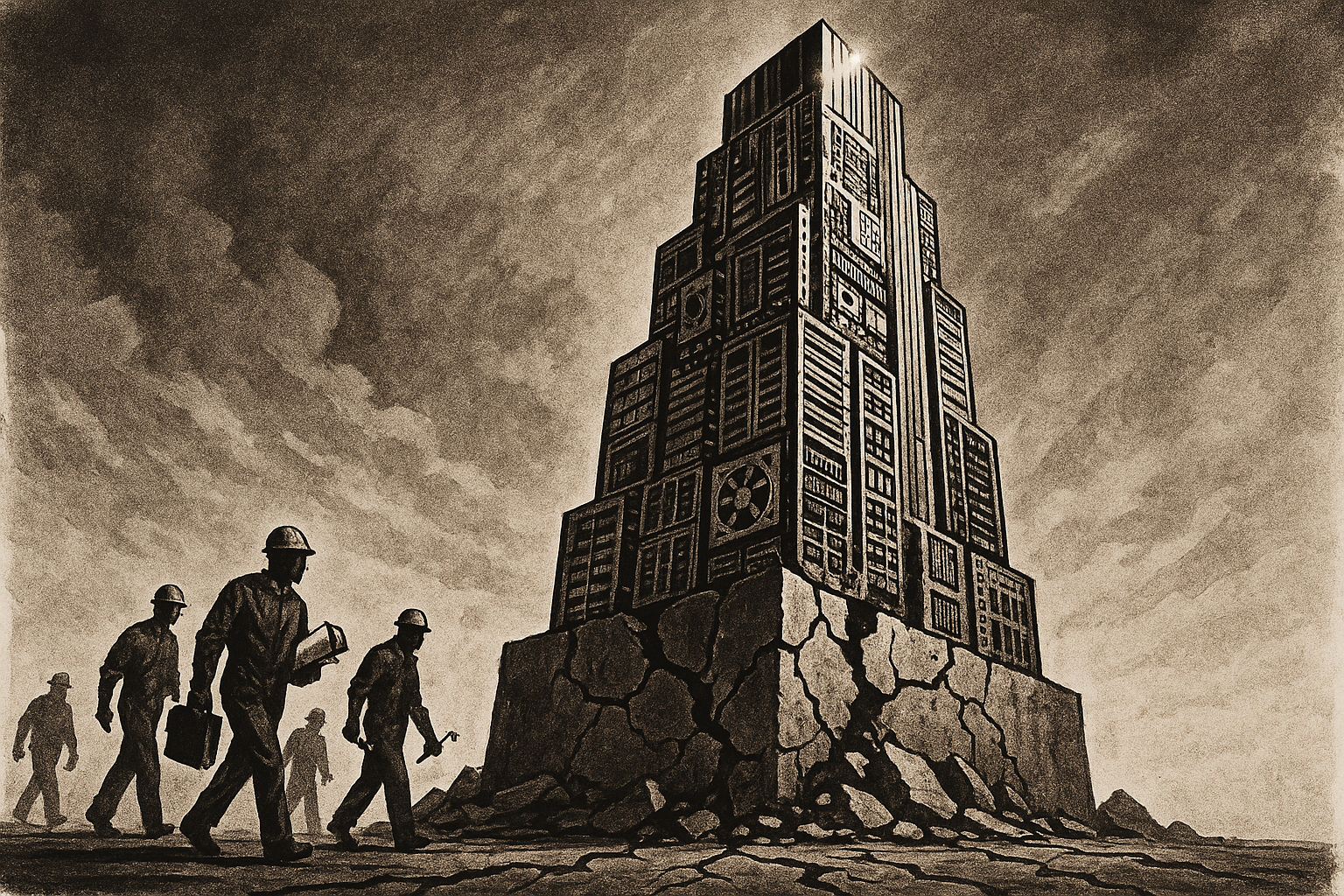
At the White House, Xi Jinping said AI must "always" remain under human control, the sentence the safety movement wants governments to say, though in both capitals "control" so far means control by the state. Five tests, starting in November, would show whether his words get machinery behind them.
Tips, corrections, or questions? support@omniscient.media

Get this every weekday.
The Omniscient Bulletin: consequential AI, explained and evaluated. 5 to 7 items a day with the take, not the recap.
Early on Thursday, September 24th, the day of Xi Jinping's welcome ceremony at the White House, Donald Trump posted about the technology he had renamed at the United Nations two days before. "A big day with President Xi of China. Super Intelligence (SI) will be a big topic of discussion, but I want to leave it exactly where it is. That is China's position also. Our guardrail is the DOJ!"[1] CNBC set the post against the president's opposition to further regulation of AI.[1]
At the ceremony, Xi said: "Both China and the United States are leading nations in artificial intelligence. We have both the capability and responsibility to develop and manage AI for good, and ensure that the development of AI is always under human control and serves the well-being of the people."[2] Who would have guessed it? The head of state who stood in Washington this week and said the sentence the AI safety movement most wants governments to say was the general secretary of the Chinese Communist Party. The American president's guardrail was his Justice Department. The Washington Post drew the same contrast the day after the ceremony.[3] If Xi means it, few people alive are better placed to make it true.
In Chinese the key phrase is 始终受控于人: always controlled by people.[4] In the talks that followed, by China's account, he said: "AI must be kept under human control."[5]
The White House fact sheet the next day recorded a different emphasis. "The two leaders agreed to use the term 'super intelligence' rather than 'artificial intelligence' to describe the applicable emerging technologies," it said, and they set up a "U.S.-China Super Intelligence (SI) Dialogue" and a "bilateral communication channel for SI incidents."[6] The fact sheet doesn't use the phrase "human control." Asked about the new name, China's foreign ministry said Beijing "attaches importance to the position of the U.S. side and respects their choice of the term,"[7] and its own account of the summit went on calling the technology 人工智能, artificial intelligence.[8]
As of September 26, nothing in Beijing's binding rules commits it to those words. But they're now on the record, in two languages, and that makes them something to hold him to. Five tests would show whether they bind, and the first comes in November.
Start with leverage: Treasury Secretary Scott Bessent calls the United States and China "the No. 1 and the No. 2 AI powers in the world."[9] Lucy Luo of the Carnegie Endowment calls them "the rival great powers with the most rapidly advancing AI capabilities."[10] A limit on frontier AI that one of them refuses binds only half the race, which is why Rep. Sam Liccardo, a California Democrat, said this week: "We have to have China at the table or AI safety will simply not be possible."[3] Nor is China far behind: the U.S. government's Center for AI Standards and Innovation (CAISI) found in May that DeepSeek V4's capabilities "lag behind the frontier by about 8 months,"[11] and this month that GLM-5.3, from Z.ai, formerly known as Zhipu AI, "lags the capability level of the U.S. frontier by about four months" on CAISI's cyber benchmarks.[12]
Then look at how far the words have moved. For years Beijing's formula was three adjectives: AI should be 安全、可靠、可控, "safe, reliable and controllable." The explicit clause appeared in a 2023 policy text; this year Xi has said it himself, in Shanghai and in Washington (the table below has the sequence). At the World AI Conference in Shanghai in July, he told the world to "constantly refine measures to forestall loss of control" and to "ensure that AI is always under human control."[13] Rebecca Arcesati of the Mercator Institute for China Studies, writing for Stanford's DigiChina, called it "his first known mention of loss of control risks specific to AI."[14]
Some of the words are aimed at his own system, which makes them harder to dismiss as summit theater. On September 14th, China's national cybersecurity standards committee, working under the guidance of the Cyberspace Administration, released version 3.0 of its AI Safety Governance Framework and took as its guiding principle the heading of Xi's second point in Shanghai: strengthen risk awareness, ensure safety and controllability (强化风险意识、确保安全可控).[15][16] In its own English version, the framework commits to "ensure that AI is always under human control," warns that AI "may exhibit higher levels of emergent intelligence, develop self-awareness, and seek external power, potentially posing risks of competing with humanity for control," and cites industry reports of models that "refused to stop and continued executing tasks by modifying or disabling shutdown scripts on their own."[17] The framework is guidance without legal force, though Matt Sheehan and Scott Singer of Carnegie, comparing its predecessor with the AI Risk Management Framework of the National Institute of Standards and Technology (NIST), judged that "China's system is likely to translate it into binding technical standards and regulatory tools much faster."[18] And Reuters reported on September 4th that China's cyberspace regulator had publicly warned of "extreme AI loss of control risks."[19]
Xi also has a constituency. In 2024 a group that included Andrew Yao, Ya-Qin Zhang and Xue Lan signed the Beijing consensus of the International Dialogues on AI Safety, whose first listed red line reads: "No AI system should be able to copy or improve itself without explicit human approval and assistance."[20] Concordia AI, a Beijing-based consultancy focused on AI safety, rates a Chinese model, DeepSeek V4 Pro, as the highest cyber-offense risk among the models it monitors, a set that leaves out Anthropic's strongest models; Google's Gemini 3.1 Pro Preview tops its biological and loss-of-control indices.[21] "AI safety is no longer a niche concern in China," says Erik Lindblad, a senior research manager at Concordia. "It features in top leadership speeches, in binding regulations, and in national standards."[3]
Date | Where | The words |
|---|---|---|
Oct 2018 | Politburo study session on AI | ensure AI is 安全、可靠、可控, "safe, reliable and controllable"[22] |
Oct 2023 | Global AI Governance Initiative, announced by Xi[23] | developers should "ensure that AI always remains under human control"[24] |
Nov 2024 | Meeting with President Biden, Lima | "maintain human control over the decision to use nuclear weapons"[25] |
Apr 2025 | Politburo study session on AI | AI brings "risks and challenges not seen before" (前所未遇风险挑战)[26]; "safe, reliable and controllable" again[27] |
Jan 2026 | Politburo study session on future industries | address new risks "such as technology going out of control" (our translation; frontier technology in general)[28] |
Jul 2026 | World AI Conference, Shanghai | "forestall loss of control"; "ensure that AI is always under human control"[13] |
Sep 2026 | White House | "ensure that the development of AI is always under human control"[2] |
The Lima line is narrower than it looks in the table. It covers the decision to use nuclear weapons, not AI in general, and it's the only one of the seven stated jointly with an American president.
While Xi's language moved toward the safety camp, Washington's moved away. On his first day back in office, Trump revoked Executive Order 14110, the Biden order on "Safe, Secure, and Trustworthy Development and Use of Artificial Intelligence."[29] Three weeks later in Paris, Vice President JD Vance said: "I'm not here this morning to talk about AI safety, which was the title of the conference a couple of years ago." The AI future, he said, "is not going to be won by hand-wringing about safety."[30] China signed the summit's declaration; the United States and Britain did not.[31] At the UN Security Council that September, Michael Kratsios, director of the White House Office of Science and Technology Policy, listed "so-called existential risk" among the "ideological fixations" that "are dangers to progress."[32]
This month the president went further. At the UN General Assembly on September 22nd he said: "The United States totally rejects any attempt to construct a globalist scheme of control for the Artificial Intelligence being spoken of so much now - hereinafter officially called 'Super Intelligence.'"[33] He said of AI, "We're going to encourage it, not rein it in."[1] On speakerphone to Nvidia's Jensen Huang at an industry summit earlier in the month he said: "The robots will not be taking over. The AI will not be taking over the rest of the world. The whole thing is a hoax." He added that people "have to be a little careful" and do things "prudently." NBC News reported the remark as Trump characterizing concerns about AI safety as a hoax.[34]
What Washington objects to is who holds control over AI, and Trump has been explicit that it should be him. "The only control or 'guardrails' that AI needs is a STRONG AND SMART (High IQ!) PRESIDENT," Trump posted on September 14th, adding: "We already have tremendous CRIMINAL and REGULATORY power over these companies!"[35] "Our guardrail is the DOJ!" has an executive order behind it. The executive order Trump signed on June 2nd directs that "The Attorney General shall prioritize the enforcement of" federal criminal laws against people who use AI to break into systems. It also orders up a voluntary framework under which developers could give the government access to models designated for their cyber capabilities for up to 30 days before releasing them to other trusted partners, and it says nothing in it authorizes a "mandatory governmental licensing, preclearance, or permitting requirement" for new models.[36]
Neither capital endorsed the slowdown that the labs' own leaders asked for. Over the weekend of September 12th and 13th, Dario Amodei, Sam Altman and Elon Musk called on AI companies to slow down frontier development, as a Reuters reporter put it at China's foreign ministry briefing on Monday, September 14th.[37] That Monday, in the post that named Amodei's company, Trump wrote of a "SICK conspiracy going on against AI and Data Centers."[35] Vance said he felt "a little bit weird" about frontier companies "begging the government to regulate them," though he also said "There are obvious risks to AI," and White House officials said meetings would likely be set up that week "to discuss potential new regulations on the technology."[38] On September 21st Trump posted that the government "will rein things in if we have to,"[39] the day before he told the UN it would not. Beijing's answer didn't endorse the call either. The Reuters question had also cited Amodei's argument that a Chinese advantage in AI would threaten American national security, and the spokesman Guo Jiakun replied that "Fear-mongering, confrontation and vicious competition will only hamper efforts toward sound global AI governance," and said nothing about slowing down.[37] Chris McGuire of the Council on Foreign Relations says Chinese state media "has largely rejected the concerns expressed by leading U.S. AI labs about the potential for catastrophic risk."[39]
Of the summit's two AI outcomes, the dialogue isn't new: the leaders "agreed to launch government-to-government dialogue on AI" during Trump's visit to Beijing in May,[40] and this week formalized it.[41] The incident channel is the new piece, and by Bessent's account it was Washington's proposal, a "notification mechanism" for AI incidents that could affect national security.[9] Luo notes that China "has signaled interest in AI-related emergency response" since the May meeting.[10]
So Beijing now uses the language of human control and Washington proposed the one new instrument, but neither government has committed to anything binding yet.
Everything turns on what "control" means, and in Beijing it has meant at least three things.
The first is the one Xi borrowed in Shanghai and Washington: humans able to oversee and stop AI systems, the sense of the Beijing red lines and of Framework 3.0's warnings about AI that seeks power.[20][17] It's the sense the rest of the world hears.
The second is control of what AI says. China's binding rules for generative AI require providers to "uphold core socialist values" (坚持社会主义核心价值观), and the security assessment and algorithm filing they impose apply to services "with public-opinion attributes or social-mobilization capacity" (具有舆论属性或者社会动员能力), a trigger defined by political reach rather than dangerous capability.[42] "Control over politically sensitive content has been the core driver of China's binding AI regulations to date," Sheehan and Singer write, and among the Party's fears they list "risks that AI could escape human - and therefore the party's - control."[18] The Washington Post reported that in a September 12 article in a Chinese cybersecurity journal, China's minister of state security, Chen Yixin, warned that AI-generated propaganda and deepfakes could be used to sow political division inside China, and argued that the Party has to keep the technology under its own control to contain that danger.[3] Zichen Wang of the Center for China and Globalization, a Beijing think tank, says: "My impression is that political and social-stability risks receive greater attention than existential risk in the Silicon Valley sense." He adds that technical loss of control "is definitely on the radar."[3]
China does have more AI regulation on the books: as Christopher Collins and Aalok Mehta of the Center for Strategic and International Studies (CSIS) note, Beijing can credibly point out that "it has more binding AI rules in force than the United States,"[43] though that count doesn't say what the rules are built to catch.
The third meaning is control of the supply chain. In official usage 可控 also means self-reliant, as in 自主可控, "independent and controllable." The outline of the 2026-2030 Five-Year Plan uses 可控 six times and never in the safety sense: three mean self-reliance, one of them about the software and hardware behind China's computing power; the others refer to controlled nuclear fusion, controllable financial risk and stable overseas supply. The outline never uses 人类控制, "human control." It does tell China to "explore development paths for artificial general intelligence" (探索通用人工智能发展路径, our translation).[44] Arcesati, writing after the Shanghai speech, lists the range: in Chinese policy, control "may refer to political control, cybersecurity, or the preference toward domestic technology."[14]
Set Washington's theory beside these and the reversal looks different. Trump's "only control" AI needs is a strong president with criminal and regulatory power over the companies. The Party's is its own control of the technology and of what it says. Both are control of AI by the state. Only one of the two governments has started using the safety movement's words for the other kind, control of the systems themselves, and so far its binding machinery serves only the second and third meanings. The test of Xi's words is whether the first meaning gets machinery.
The translations show the same seam. On September 24 the foreign ministry rendered Xi's 发展好、管控好人工智能 as "develop and manage AI," so 管控, manage and control, became "manage."[2][4] Hours later, in its English readout of the talks, it rendered 保持人类对人工智能技术的管控, human management and control of AI technology, as "AI must be kept under human control," dropping "technology."[45][5] In that readout and in the Shanghai speech alike, the control sentence comes straight after misuse: "jointly prevent the misuse and abuse of AI," and "prevent abuses and malicious use."[5][13] Misuse by people is something any state knows how to police, but Xi hasn't said what he means by losing control of the systems themselves.
The clause is also selective: Xi's speeches to the Shanghai Cooperation Organization on September 1 and to the BRICS summit's second session on September 13 both mention AI but not human control.[46][47] It appears in the domestic standards framework, at the Shanghai conference and in Washington.
And in Shanghai the control clause came paired with a demand: that the world "jointly oppose overstretching the national security concept in the field of AI and placing one country's security over that of others."[13] Catherine Thorbecke of Bloomberg Opinion reads it as a response to Washington's habit of citing "national security" when it draws up blacklists and export controls: Beijing's "officials clearly fear that AI safety could become a similar tool for restriction."[48]
The most direct deed against the words came at a G20 ministerial meeting in Chapel Hill, North Carolina, that ended on September 2nd, where, according to Reuters, China signed the Carolina Principles, "an agreement aimed at discouraging the development of AI-specific regulations, in a rare show of tech alignment with the U.S."[19] The White House's own summary says the principles "call on countries to invest in foundational research, strengthen commercialization pathways, and enable trusted technology adoption and deployment."[49] The ministers' own statement is public, and it bears Reuters out in a softer register: the principles favor "applying existing sector-specific regulatory approaches to govern the use of emerging technologies where appropriate, focusing any new regulation on novel technology considerations that existing frameworks cannot address."[62] That stops short of ruling out AI-specific rules, but it points away from them, and Beijing put its name to it three weeks before Xi told an American president that AI must always remain under human control.
Then there's what Beijing has let ship. Moonshot AI released Kimi K3 on July 16th, "slated for open-weight release by July 27th." On July 23rd, Britain's AI Security Institute and CAISI reported that Kimi K3 "performs significantly below the most recent frontier cyber-capable models," but that "Kimi K3's safeguards did not prevent it from attempting cyber exploit development or offensive cyber operations."[50] The weights are public on Hugging Face,[51] and Graham Webster of Stanford's DigiChina project, writing in August, reasons from the fact that "The Chinese government certainly has the ability to stop Chinese companies from releasing model weights" to the conclusion that Beijing "did not view the open distribution of DeepSeek V4, GLM 5.2, or Kimi K3 as an unacceptable risk."[52]
Z.ai's models tell a similar story in a different order. It released GLM-5.2 as an open-weight model on June 16th. CAISI assessed it afterward and found its safeguards "mixed": they "allow assistance with agentic cyber exploit development," although the model appeared "potentially more robust against agent hijacking and jailbreaking attacks than other evaluated PRC open-weight models," a robustness CAISI itself notes can be circumvented once open weights are self-hosted.[53] Z.ai then released GLM-5.3 on August 14 and its weights two weeks later. By CAISI's assessment, it "is the most cyber-capable open-weight model released to date."[12] CSIS observes that "strict Chinese control over what AI systems say domestically coexists comfortably with permissive distribution of model weights internationally,"[43] and once weights are published, nobody can pull them back.
Independent grades point the same way. The Future of Life Institute's Summer 2026 AI Safety Index gives Z.ai and Alibaba Cloud a D- and DeepSeek an F. No company scores above Anthropic's C+, and xAI and Mistral also get an F. Of Z.ai, as of Alibaba Cloud and DeepSeek, the index says: "The company has no published framework."[54] If FLI is right, for Z.ai that is a broken promise. Zhipu signed the Frontier AI Safety Commitments at the Seoul summit in 2024, pledging to publish "a safety framework focused on severe risks by the upcoming AI Summit in France,"[55] which met in February 2025.[31] Concordia's 2026 report finds that "Only five of ten leading foundation-model developers reported safety evaluation results alongside any release this past year, and none did so consistently." DeepSeek-R1's peer-reviewed Nature paper and Moonshot's Kimi K2 model card were "the most detailed disclosures yet," though the report adds that "flagship follow-ups like DeepSeek-V4 and Kimi K2.5 were released with no safety evaluation results at all." An industry benchmark now tests for "model deception, loss of control."[56]
On military AI the record is mixed in a telling way. China endorsed the call to action at the first summit on responsible AI in the military domain, REAIM, in 2023.[57] At the second REAIM summit, in Seoul in September 2024, it did not endorse the Blueprint for Action. According to Tobias Vestner and Simon Cleobury, writing in Just Security, "The main reason it objected was due to language on maintaining human involvement for decisions concerning nuclear weapons employment."[58] Two months later in Lima, Xi and Biden "stressed the need to maintain human control over the decision to use nuclear weapons."[25] Beijing declined the principle in a multilateral text, by that account, and accepted it one-to-one with Washington. This week the White House fact sheet left the Lima sentence out just as China's eight-point list of outcomes did.[6][41]
Only two of the five, the third and the fourth, are Beijing's alone to pass: they turn on its own registration system and its own developers, so a failure on either would be Beijing's failure. The other three run through the November dialogue, a joint statement or the channel Washington proposed, which means they need a Washington whose record on the safety frame is set out above, and a failure on any of them won't by itself show which government walked away.
1. Put nuclear human control back in writing. Restating the Lima sentence at the November dialogue costs neither government anything it hasn't already said, and endorsing it in a multilateral text would answer the Seoul objection. Tianjiao Jiang of Fudan University, the Chinese author of a paired U.S.-China essay at Brookings, proposes "a list of red lines for military AI," "clearly prohibiting AI from autonomously launching attacks on NC3 systems or autonomously deciding to use nuclear weapons," NC3 being nuclear command, control and communications.[59]
2. Make the incident channel work. Luo's specification is concrete: the channel should be "text-based, tiered, come with specific triggers, and be continuously staffed by technically proficient people." Her precedent is the 2001 Hainan Island incident, when "calls from the United States went unanswered for twelve hours."[10] The pass mark is a staffed channel and a first incident reported through it.
3. Point the registration system at capability. Beijing already requires filing and a security assessment for services with public-opinion reach.[42] A trigger for dangerous capability (cyber, biological, autonomy) before open weights ship would use the lever Webster says it has. This test is our own proposal. It asks only that the machinery serve the first meaning of control as well as the second.
4. Require the frameworks. Beijing could require its frontier developers to publish the severe-risk frameworks Zhipu promised at Seoul. The pass mark is published frameworks, with thresholds, from DeepSeek, Z.ai, Alibaba and Moonshot.
5. Agree on a red line on self-replication. China's own scientists signed the Beijing red line against unapproved self-replication in 2024, alongside Geoffrey Hinton, Yoshua Bengio and Stuart Russell.[20] Rep. Ro Khanna has offered the American version: "How about we just agree that you should not be able to have self-improving AI?"[39] A joint statement at the November dialogue would put both governments behind a line China's own scientists signed two years ago.
One condition runs through all five. Sheehan warns that the dialogue "must not be treated as a venue for bargaining, with China offering to do more on safety in exchange for a loosening of U.S. export controls on chips." And: "If that's all that Chinese officials are interested in, we should walk away."[60] McGuire says China has historically used AI dialogues "to complain about U.S. export controls."[39]

The first checkpoint is the dialogue's next round, due "by November 2026" in the White House's telling and "in November 2026" in China's.[6][41] Xi then hosts the APEC leaders' meeting in Shenzhen on November 18th and 19th, a date China's foreign ministry announced back in December 2025,[61] and each leader has said he intends to attend the summit the other hosts, APEC in China and the G20 in the United States.[8]
So is anything holding Xi to his words yet? Only the record. He has said the right sentence in Shanghai, at the White House and across the table from Trump, in a language and on a record that can be quoted back to him. Nothing binding stands behind it, and "control" in his system means more than the sense he borrowed. The record won't bind Beijing, as Seoul showed in 2024. It does make the check easy. In November, and again in Shenzhen, the questions are the same: is the channel staffed, and are the frameworks published?
Evelyn Cheng, "China confirms first AI talks with U.S. have taken place, hints at trade truce extension," CNBC (September 24, 2026), quoting Trump's Truth Social post and his UN address Inline ↗
…Super Intelligence (SI) will be a big topic of discussion, but I want to leave it exactly where it is.…
…That is China's position also. Our guardrail is the DOJ!"…
…The president has been vocal about his opposition to further regulation of AI and reiterated his position to the UN General Assembly on Tuesday that: "We're going to…
…regulation of AI and reiterated his position to the UN General Assembly on Tuesday that: "We're going to encourage it, not rein it in."…
Ministry of Foreign Affairs of the PRC, "Remarks by H.E. Xi Jinping, President of the People's Republic of China, at Arrival Ceremony at the White House" (September 24, 2026) Inline ↗
…Both China and the United States are leading nations in artificial intelligence.…
…We have both the capability and responsibility to develop and manage AI for good, and ensure that the development of AI is always under human control and serves…
…and responsibility to develop and manage AI for good, and ensure that the development of AI is always under human control and serves the well-being of the people.…
Gerrit De Vynck, "Xi acknowledges risks of AI even as Trump dismisses them," The Washington Post (September 25, 2026) Inline ↗
…题,但没有两国合作,世界上很多问题都难以解决。中国开放的大门始终敞开,欢迎美国企业来华投资兴业,希望美方公平对待中国企业,共同拉长合作清单,压缩问题清单。中美两国都是人工智能大国,有能力也有责任发展好、管控好人工智能,确保人工智能发展始终受控于人、造福于民。中方愿同美国加强禁毒、执法等合作。双方可以增加直航航班,让双方人员和经贸往来更加便捷。…
外交部 (Ministry of Foreign Affairs), 习近平在白宫欢迎仪式上的致辞(全文), Chinese text of the same remarks (September 24, 2026): 有能力也有责任发展好、管控好人工智能,确保人工智能发展始终受控于人、造福于民 Inline ↗
…continue their dialogue on AI, exchange views on its risks and benefits, and jointly prevent the misuse and abuse of AI. AI must be kept under human control.…
…The two sides can continue their dialogue on AI, exchange views on its risks and benefits, and jointly prevent the misuse and abuse of AI.…
Ministry of Foreign Affairs of the PRC, "President Xi Jinping Holds Talks with U.S. President Donald J. Trump" (September 25, 2026) Inline ↗
…The two leaders agreed to use the term “super intelligence” rather than “artificial intelligence” to describe the applicable emerging technologies.…
…The two countries established the U.S.-China Super Intelligence (SI) Dialogue to exchange views on risks and benefits related to SI.…
…The United States and China also agreed to establish a bilateral communication channel for SI incidents.…
…The next exchange will occur by November 2026.…
The White House, "Fact Sheet: President Donald J. Trump Advances a Fair and Reciprocal Relationship with China While Hosting Historic State Visit" (September 25, 2026) Inline ↗
…On what term to use for artificial intelligence, China attaches importance to the position of the U.S. side and respects their choice of the term.…
Ministry of Foreign Affairs of the PRC, "Foreign Ministry Spokesperson's Remarks on Issue Concerning Artificial Intelligence" (September 26, 2026) Inline ↗
…六、中美禁毒执法部门合作取得可视化成果。近期,双方密切合作,联合破获多起涉新精神活性物质及前体化学品案件,在两国抓获数十名相关犯罪嫌疑人。 七、双方同意建立中美人工智能对话,交流人工智能相关风险和惠益。下次对话将于今年11月举行。双方同意建立人工智能事件的沟通渠道。 八、美方欢迎中方租借给美国亚特兰大动物园的一对大熊猫抵美。…
…一、双方同意构建“基于尊重、公平、对等的中美建设性战略稳定关系”。 二、双方同意相互支持对方办好亚太经合组织(APEC)领导人非正式会议和二十国集团(G20)领导人峰会。两国元首有意出席对方主办的会议。 三、两国元首同意伊朗应履行不发展核武器的承诺,任何国家或机构都不得对国际水道征收通行费。 四、两国元首忆及中国和美国是二战盟友,并肩作战赢得战争胜利。…
新华网 (Xinhua), 中美达成八点成果共识, Chinese text of the eight points (September 26, 2026) Inline ↗
…“We have to have China at the table or AI safety will simply not be possible.” The Spokesman-Review Newspaper Local journalism is essential.…
…“AI safety is no longer a niche concern in China. It features in top leadership speeches, in binding regulations, and in national standards.” An increasing number of U.S. politicians in…
…take AI risks seriously,” said Erik Lindblad, a senior research manager at Concordia AI, a Beijing-based consultancy focused on AI safety.…
…labor.” In a Sept. 12 article published in a Chinese cybersecurity journal, China’s minister of state security, Chen Yixin, warned that propaganda and deepfakes generated by AI may be used to cause political divisions inside China,…
…The Chinese Communist Party must control the technology to minimize these risks, he wrote.…
…My impression is that political and social-stability risks receive greater attention than existential risk in the Silicon Valley sense,” said Zichen Wang, deputy secretary general of the…
…“But technical loss of control is definitely on the radar” in China, said Wang, who writes the Pekingnology newsletter.…
Matt Sedensky, "US proposes AI incident alert system in talks with China," Associated Press (September 20, 2026) Inline ↗
…NEW YORK – Treasury Secretary Scott Bessent said Sunday the U.S. has proposed a new “notification mechanism” for artificial intelligence incidents that could affect national security, part of weekend discussions ahead of talks at the White…
…that just like any cross-border activity, that moving from opaque to more transparency between the No. 1 and the No. 2 AI powers in the world is very important.” Recommended Videos Trump has resisted calls to slow down AI development…
Lucy Luo, "The U.S. and China Need an AI Hotline. Here's How to Build It.," Carnegie Endowment for International Peace (September 18, 2026) Inline ↗
…If the United States and China—the rival great powers with the most rapidly advancing AI capabilities—are going to safely navigate this brave new world, they will need the ability to…
…China has signaled interest in AI-related emergency response and improving the use of political-diplomatic communication channels since the May 2026…
…That means the channel should be text-based, tiered, come with specific triggers, and be continuously staffed by technically proficient people.…
…incident, when a U.S. EP-3 surveillance plane collided with a Chinese fighter jet, calls from the United States went unanswered for twelve hours.…
NIST, "CAISI Evaluation of DeepSeek V4 Pro" (May 1, 2026) Inline ↗
…CAISI evaluations indicate that DeepSeek V4’s capabilities lag behind the frontier by about 8 months (Figure 1).…
NIST, "CAISI's Assessment of Z.ai's GLM-5.3 Cyber Capabilities" (September 17, 2026) Inline ↗
…GLM-5.3 lags the capability level of the U.S. frontier by about four months in an aggregate measure of performance across CAISI cyber benchmarks (Figure 1).…
…September 17, 2026 Share Facebook Linkedin X.com Email The PRC-based company Z.ai (formerly known as Zhipu AI) released a new AI model, GLM-5.3, on August 14, 2026.…
…Z.ai publicly released the model’s weights two weeks later.…
…In CAISI’s assessment of GLM-5.3’s cyber capabilities, the key findings were: GLM-5.3 is the most cyber-capable open-weight model released to date.…
"Full text: Keynote speech by Chinese President Xi Jinping at opening ceremony of 2026 World AI Conference," Xinhua, via gov.cn (July 17, 2026) Inline ↗
…We must make its oversight and governance precise and effective, and constantly refine measures to forestall loss of control.…
…and emergency response systems in order to strengthen the line of security, prevent abuses and malicious use, and ensure that AI is always under human control.…
…In the meantime, we should jointly oppose overstretching the national security concept in the field of AI and placing one country's security over that of others.…
Rebecca Arcesati (Mercator Institute for China Studies), contribution to "Forum: Xi Jinping Headlines World AI Conference," DigiChina, Stanford University (July 23, 2026) Inline ↗
…However, this is his first known mention of loss of control risks specific to AI—and it appeared in a public speech.…
…“Controllability” (可控) has been a consistent leitmotif in Chinese AI policy, but what is meant by “control” can vary widely.…
…(For example, it may refer to political control, cybersecurity, or the preference toward domestic technology.)…
中央网信办 (Cyberspace Administration of China), 《人工智能安全治理框架3.0》发布, release of AI Safety Governance Framework 3.0 (September 14, 2026) Inline ↗
…能治理倡议》,2024年、2025年网安标委先后发布了《人工智能安全治理框架1.0》《人工智能安全治理框架2.0》,受到各界广泛关注。为应对人工智能发展新趋势、回应安全治理新挑战,在国家互联网信息办公室的指导下,网安标委组织中国网络空间研究院、国家互联网信息办公室数据与技术保障中心等专业机构、科研院所、行业企业,研究编制了《框架3.0》。…
…《框架3.0》秉持以人为本、向上向善理念,坚持和践行强化风险意识、确保安全可控的指导原则,延续“风险分类、技术应对、综合治理”的核心逻辑,与时俱进梳理更新了风险分类,优化调整了技术应对和综合治理措施,以促进提升人工智能安全治理共识和风险防范应对能力,确保人工智能技术造福于人类。 人工智能安全治理框架3.0…
外交部, Chinese text of Xi's keynote at the 2026 World AI Conference (July 17, 2026): 第二,强化风险意识,确保安全可控……确保人工智能始终处于人类控制之下 Inline ↗
…第二,强化风险意识,确保安全可控。人工智能应当成为人类的可信工具。要高度重视人工智能引发的各类内生和衍生风险,推动构建法律法规、技术监测、风险预警、应急响应体系,筑牢安全底线,防范滥用恶用,确保人工智能始终处于人类控制之下。同时,应当共同反对在人工智能领域泛化国家安全概念、把…
…风险意识,确保安全可控。人工智能应当成为人类的可信工具。要高度重视人工智能引发的各类内生和衍生风险,推动构建法律法规、技术监测、风险预警、应急响应体系,筑牢安全底线,防范滥用恶用,确保人工智能始终处于人类控制之下。同时,应当共同反对在人工智能领域泛化国家安全概念、把本国安全凌驾于他国安全之上的做法。…
…女士们、先生们、朋友们! “明者因时而变,知者随事而制。”人工智能技术发展越是一日千里,向上向善、造福人类的方向越要正确锚定,监管治理的尺度越要精准把握,防范失控的措施越要及时完善。要始终用人类智慧和国际共识引领人工智能发展,使其真正成为增进全人类福祉、推动人类文明进步的强大正能量。…
National Technical Committee 260 on Cybersecurity (TC260), AI Safety Governance Framework 3.0 / 人工智能安全治理框架3.0, Chinese and English texts, PDF (September 2026) Inline ↗
…emergency response systems in order to strengthen the bottom line for safety, prevent abuses and malicious use, and ensure that AI is always under human control.…
…exhibit higher levels of emergent intelligence, develop self- awareness, and seek external power, potentially posing risks of competing with humanity for control.…
…after receiving a user command to terminate services, certain models refused to stop and continued executing tasks by modifying or disabling shutdown scripts on their own.…
…and the principle of developing AI for the positive and for good, the Framework adheres to and implements the guiding principles of strengthening risk awareness as well as ensuring safety, security and controllability.…
Matt Sheehan and Scott Singer, "How China Views AI Risks and What to do About Them," Carnegie Endowment for International Peace (October 16, 2025) Inline ↗
…But China’s system is likely to translate it into binding technical standards and regulatory tools much faster.…
…Control over politically sensitive content has been the core driver of China’s binding AI regulations to date, with additional concerns such as data privacy, discrimination,…
…impacts of AI across work and education; and risks that AI could escape human—and therefore the party’s—control.…
"US, China gear up for mid-September AI safety talks," Reuters (September 4, 2026) Inline ↗
…In the past week, China's cyberspace regulator publicly warned about "extreme AI loss of control risks" and a state media-affiliated blog criticized Anthropic, emphasizing that any…
…about "extreme AI loss of control risks" and a state media-affiliated blog criticized Anthropic, emphasizing that any limits on frontier AI should apply equally to Chinese and U.S. models.…
…China signed the Carolina Principles, an agreement aimed at discouraging the development of AI-specific regulations, in a rare show of tech alignment with the U.S. Kratsios' office did not immediately…
International Dialogues on AI Safety, "IDAIS-Beijing" consensus statement (March 2024) Inline ↗
…Autonomous Replication or Improvement No AI system should be able to copy or improve itself without explicit human approval and assistance.…
…of Computer Science University of Toronto Turing Award Winner Nobel Prize Winner Andrew Yao 姚期智 Turing Award Winner Dean Shanghai Qi Zhi Institute Dean, Institute for Interdisciplinary Information Sciences and College…
…for Human-Compatible Artificial Intelligence (CHAI) University of California, Berkeley Xue Lan 薛澜 Dean, Schwarzman College Tsinghua University Director, Institute for AI International Governance (I-AIIG) Tsinghua University…
…Signatories Show more Collapse Geoffrey Hinton Professor Emeritus, Department of Computer Science University of Toronto Turing Award Winner Nobel Prize Winner Andrew…
…for Interdisciplinary Information Sciences and College of AI Tsinghua University Yoshua Bengio Professor Université de Montréal Founder and Scientific Advisor Mila – Quebec AI Institute Chair International…
…for AI Industry Research (AIR) Tsinghua University Former President Baidu Fu Ying 傅莹 Stuart Russell Professor and Smith-Zadeh Chair in Engineering University of California, Berkeley Founder of Center for Human-Compatible…
Concordia AI, "Frontier AI Risk Monitor update: risk indices rise severalfold as multiple models cross key threshold" (August 12, 2026) Inline ↗
…DeepSeek V4 Pro has the highest Risk Index in cyber offense, and its loss-of-control Risk Index is second only to Gemini 3.1 Pro Preview.…
…Model risk profiles are diverging: Gemini 3.1 Pro Preview has the highest biological and loss-of-control Risk Indices, while DeepSeek V4 Pro shows more pronounced cyber misuse risk Gemini 3.1 Pro…
中央网信办, 习近平:推动我国新一代人工智能健康发展, readout of the Politburo study session on AI (October 31, 2018) Inline ↗
…策的人工智能系统,加强政务信息资源整合和公共需求精准预测,推进智慧城市建设,促进人工智能在公共安全领域的深度应用,加强生态领域人工智能运用,运用人工智能提高公共服务和社会治理水平。要加强人工智能发展的潜在风险研判和防范,维护人民利益和国家安全,确保人工智能安全、可靠、可控。要整合多学科力量,加强人工智能相关法律、伦理、社会问题研究,建立健全保障人工智能健康发展的法律法规、制度体系、伦理道德。各级领导干部要努力学习科技前沿知识,把握人工智…
…公共需求精准预测,推进智慧城市建设,促进人工智能在公共安全领域的深度应用,加强生态领域人工智能运用,运用人工智能提高公共服务和社会治理水平。要加强人工智能发展的潜在风险研判和防范,维护人民利益和国家安全,确保人工智能安全、可靠、可控。要整合多学科力量,加强人工智能相关法律、伦理、社会问题研究,建立健全保障人工智能健康发展的法律法规、制度体系、伦理道德。各级领导干部要努力学习科技前沿知识,把握人工智能发展规律和特点,加强统筹协调,加大政策支持,…
中国政府网 (gov.cn), 习近平在第三届"一带一路"国际合作高峰论坛开幕式上的主旨演讲(全文) (October 18, 2023) Inline ↗
…五、推动科技创新。中方将继续实施“一带一路”科技创新行动计划,举办首届“一带一路”科技交流大会,未来5年把同各方共建的联合实验室扩大到100家,支持各国青年科学家来华短期工作。中方将在本届论坛上提出全球人工智能治理倡议,愿同各国加强交流和对话,共同促进全球人工智能健康有序安全发展。…
Ministry of Foreign Affairs of the PRC, "Global AI Governance Initiative" (October 2023) Inline ↗
…R&D entities should improve the explainability and predictability of AI, increase data authenticity and accuracy, ensure that AI always remains under human…
…the explainability and predictability of AI, increase data authenticity and accuracy, ensure that AI always remains under human control, and build trustworthy AI technologies that can be reviewed, monitored, and traced.…
Ministry of Foreign Affairs of the PRC, "President Xi Jinping Meets with U.S. President Joe Biden in Lima" (November 17, 2024) Inline ↗
…The two Presidents stressed the need to maintain human control over the decision to use nuclear weapons.…
"Xi urges promoting healthy and orderly development of AI," Xinhua, via gov.cn (April 29, 2025) Inline ↗
…Xi noted that while AI presents unprecedented development opportunities, it also brings risks and challenges not seen before.…
中国政府网, 习近平在中共中央政治局第二十次集体学习时强调:坚持自立自强 突出应用导向 推动人工智能健康有序发展 (April 2025) Inline ↗
…习近平指出,人工智能带来前所未有发展机遇,也带来前所未遇风险挑战。要把握人工智能发展趋势和规律,加紧制定完善相关法律法规、政策制度、应用规范、伦理准则,构建技术监测、风险预警、应急响应体系,确保人工智能安全、可靠、可控。…
中国政府网, 习近平:前瞻布局和发展未来产业, Xi's January 30, 2026 Politburo study session remarks as published in Qiushi (reposted May 2026): 前瞻应对技术失控、伦理失范、数据滥用等新型风险 Inline ↗
…治理,防止出现政出多门、力量分散等情况。要坚持和加强党中央集中统一领导,健全部际协同和央地协作机制。要统筹发展和安全,探索科学有效的监管方式,构建技术监测、风险预警、应急响应体系,前瞻应对技术失控、伦理失范、数据滥用等新型风险,确保既“放得活”又“管得好”,为技术创新和产业发展营造良好环境。要不断深化国际合作,积极参与全球治理,努力推动各方标准共建、规则共商、产业共促。…
…※这是习近平总书记2026年1月30日在二十届中央政治局第二十四次集体学习时的讲话。 【我要纠错】 责任编辑:王洋 相关稿件 链接: 全国人大 | 全国政协 | 国家监察委员会 | 最高人民法院 | 最高人民检察院 国务院部门网站 | 地方政府网站 | 驻港澳机构网站 | 驻外机构…
The White House, "Initial Rescissions of Harmful Executive Orders and Actions" (January 20, 2025) Inline ↗
…Executive Order 14110 of October 30, 2023 (Safe, Secure, and Trustworthy Development and Use of Artificial Intelligence).…
"Remarks by the Vice President at the Artificial Intelligence Action Summit in Paris, France," The American Presidency Project (February 11, 2025) Inline ↗
…And I'm -- I'm not here this morning to talk about AI safety, which was the title of the conference a couple of years ago.…
…The AI future is not going to be won by hand-wringing about safety.…
Élysée, "Statement on Inclusive and Sustainable Artificial Intelligence for People and the Planet" and signatory list (February 11, 2025) Inline ↗
…of civil society, the private sector, and the academic and research communities gathered in Paris on 10 and 11 February 2025 to hold the AI Action Summit.…
…Signatory countries: Armenia Australia Austria Belgium Brazil Bulgaria Cambodia Canada Chile China Colombia Côte d’Ivoire Croatia Cyprus Czech Republic Denmark Djibouti Egypt Estonia Finland France Germany Greece…
Michael Kratsios, "Remarks at the Security Council's Open Debate on Artificial Intelligence and International Peace and Security," U.S. Mission to the United Nations (September 24, 2025) Inline ↗
…States Mission to the United Nations 4 MINUTE READ September 24, 2025 Michael Kratsios Assistant to the President and OSTP Director New York, New York Intervention in the U.N.Security Council’s “Open Debate on Artificial…
…Ideological fixations on social equity, climate catastrophism, and so-called existential risk are dangers to progress and obstacles to responsibly harnessing this technology as an…
The White House, "President Trump at the United Nations: 'While Others Have Talked, I Have Acted'" (September 22, 2026) Inline ↗
…a sovereign nation.” ( Watch ) “The United States totally rejects any attempt to construct a globalist scheme of control for the Artificial Intelligence being spoken of so much now — hereinafter officially called ‘Super Intelligence.’”…
…globalist scheme of control for the Artificial Intelligence being spoken of so much now — hereinafter officially called ‘Super Intelligence.’” ( Watch ) “America has never been a nation that retreats from a frontier or…
Raquel Coronell Uribe, "Trump calls Nvidia CEO to talk AI - and gets put on speakerphone during industry summit," NBC News (September 14, 2026) Inline ↗
…“The robots will not be taking over. The AI will not be taking over the rest of the world. The whole thing is a hoax,” Trump said, suggesting that critics are “just playing right…
…Trump characterized concerns about AI safety as a “hoax,” while telling Huang in the middle of the All-In Summit that the U.S. had to beat China in…
…than the internet and AI, you know, much more so,” he said, while adding that people “have to be a little careful” and do things “prudently.” A video of Trump’s call, posted on X , was reposted by the Trump War Room…
Donald J. Trump, Truth Social post (September 14, 2026), via the Trump's Truth archive Inline ↗
…J. Trump @realDonaldTrump · September 14, 2026, 9:58 AM Original Post The only control or “guardrails” that AI needs is a STRONG AND SMART (High IQ!) PRESIDENT, and the U.S.A. has that, in spades!…
…The Trump Administration has stopped AI “people” from doing bad, or potentially bad, “things,“ like Dario (Anthropic!), who is now pretending to be a “perfect little angel” - and we will continue to do so!…
…We already have tremendous CRIMINAL and REGULATORY power over these companies!…
…There is a SICK conspiracy going on against AI and Data Centers, and the only one that is happy about it is China.…
The White House, Executive Order 14409, "Promoting Advanced Artificial Intelligence Innovation and Security" (June 2, 2026) Inline ↗
…The Attorney General shall prioritize the enforcement of 18 U.S.C. 1028, 18 U.S.C. 1030, 18 U.S.C. 1343, and all other applicable Federal criminal…
…(b) design a voluntary framework with AI developers through which developers would be able to: (i) engage the Federal Government to determine…
…and intellectual-property protection, use, and nondisclosure requirements, for a period of up to 30 days before they plan to release such models to other trusted partners; and (iii) collaborate with the Federal Government to…
…(c) Nothing in this section shall be construed to authorize the creation of a mandatory governmental licensing, preclearance, or permitting requirement for the development, publication, release, or…
Ministry of Foreign Affairs of the PRC, "Foreign Ministry Spokesperson Guo Jiakun's Regular Press Conference on September 14, 2026" Inline ↗
…Reuters: Dario Amodei, Sam Altman and Elon Musk all over the weekend called on AI companies to slow down frontier development, with Amodei arguing a Chinese advantage in AI would pose…
…over the weekend called on AI companies to slow down frontier development, with Amodei arguing a Chinese advantage in AI would pose U.S. national security risks.…
…Fear-mongering, confrontation and vicious competition will only hamper efforts toward sound global AI governance, which serves no one’s interest.…
Kevin Liptak, "Trump suggests AI needs a 'STRONG AND SMART' president," CNN (September 14, 2026) Inline ↗
…“There are obvious risks to AI, there are some benefits to AI,” Vance told reporters at Joint Base Andrews.…
…“I have to say, personally, I feel a little bit weird about the fact that you have so many frontier AI tech companies kind of coming to the government and begging the government to regulate them.” Still, Vance acknowledged the new…
…likely be meetings set up this week with administration experts on AI and cybersecurity to discuss potential new regulations on the technology.…
Kai Nicol-Schwarz, "Trump-Xi summit puts AI safety talks on the table but neither side wants to slow down," CNBC (September 23, 2026) Inline ↗
…But in a Truth Social post Monday, he said the government "will rein things in if we have to."…
…security-related incidents would be a "modest" but positive step, Chris McGuire, senior fellow for China and emerging technologies at the Council on Foreign Relations, told CNBC.…
…"Its state media has largely rejected the concerns expressed by leading U.S. AI labs about the potential for catastrophic risk, which is consistent with China's long-held skepticism of…
…China has historically used AI dialogues "to complain about U.S. export controls," McGuire said, which the U.S. uses to prevent the most advanced AI chips from…
…"How about we just agree that you should not be able to have self-improving AI?"…
Ministry of Foreign Affairs of the PRC, "Foreign Ministry Spokesperson Guo Jiakun's Regular Press Conference on May 19, 2026" Inline ↗
…Consensus Statement The White House September 2, 2026 Today, G20 member ministers concluded a two-day Innovation Ministerial in Chapel Hill, North Carolina.…
…Principles for Emerging Technologies, which call on countries to invest in foundational research, strengthen commercialization pathways, and enable trusted technology adoption and deployment.…
Ministry of Foreign Affairs of the PRC, "China and the United States Reach Eight Deliverables and Understandings" (September 26, 2026) Inline ↗
…During President Trump’s visit to China, the two heads of state had constructive exchanges on AI and agreed to launch…
…Trump’s visit to China, the two heads of state had constructive exchanges on AI and agreed to launch government-to-government dialogue on AI.…
中央网信办 et al., 生成式人工智能服务管理暂行办法 (Interim Measures for the Management of Generative Artificial Intelligence Services), Articles 4 and 17 (July 2023) Inline ↗
…The two sides agree on the establishment of the China-U.S. AI Dialogue to exchange views on risks and benefits related to AI.…
…The next exchange will occur in November 2026.…
…China and the U.S. also agree to establish a bilateral communication channel for AI incidents.…
Christopher Collins and Aalok Mehta, "The State of AI Global Governance and Its Implications for the U.S.-China Summit," CSIS (September 21, 2026) Inline ↗
…第四条 提供和使用生成式人工智能服务,应当遵守法律、行政法规,尊重社会公德和伦理道德,遵守以下规定: (一)坚持社会主义核心价值观,不得生成煽动颠覆国家政权、推翻社会主义制度,危害国家安全和利益、损害国家形象,煽动分裂国家、破坏国家统一和社会稳定,宣扬恐怖主义、极端主义,宣扬民族仇恨、民族歧视,暴力、淫秽色情,以及虚假有害信息等法律、行政法规禁止的内容;…
…国家有关主管部门针对生成式人工智能技术特点及其在有关行业和领域的服务应用,完善与创新发展相适应的科学监管方式,制定相应的分类分级监管规则或者指引。 第十七条 提供具有舆论属性或者社会动员能力的生成式人工智能服务的,应当按照国家有关规定开展安全评估,并按照《互联网信息服务算法推荐管理规定》履行算法备案和变更、注销备案手续。 第十八条…
…第十七条 提供具有舆论属性或者社会动员能力的生成式人工智能服务的,应当按照国家有关规定开展安全评估,并按照《互联网信息服务算法推荐管理规定》履行算法备案和变更、注销备案手续。 第十八条 使用者发现生成式人工智能服务不符合法律、行政法规和本办法规定的,有权向有关主管部门投诉、举报。 第十九条…
国家发展改革委 (NDRC), outline of the 15th Five-Year Plan, 2026-2030 (March 2026), PDF. Uses of 可控: 产业链自主可控; 可控核聚变; 自主可控、协同运行的软硬件; 自主可控的人民币跨境支付; 风险可控的投融资体系; 稳定可控的海外供应渠道 Inline ↗
…developing countries that it takes AI governance seriously—for example, it can note that it has more binding AI rules in force than the United States—while simultaneously championing open-weight model release and warning against what…
…security concept in the field of AI.” Here, strict Chinese control over what AI systems say domestically coexists comfortably with permissive distribution of model weights internationally, which it sees as key to driving uptake of the…
外交部, 习近平同美国总统特朗普会谈, Chinese readout of the talks (September 25, 2026): 要保持人类对人工智能技术的管控 Inline ↗
…34 灵活授权、跨域协同的算法创新组织模式,加快研究更加高效的模 型训练和推理方法。鼓励多模态、智能体、具身智能、群体智能等 技术创新,探索通用人工智能发展路径。推动通用大模型和行业专 用模型同步发展,依托高价值场景推动模型应用落地和迭代升级。 建立健全模型能力评估体系。 第三节 深化数据资源开发利用 构建国家数据资源体系,健全数据资源统计调查制度,建立全…
中新网 (China News Service), 习近平在上海合作组织成员国元首理事会第二十六次会议上的讲话(全文) (September 1, 2026) Inline ↗
…习近平指出,中美都是人工智能大国,双方有竞争,更可以合作,应该各展所长而不是相互设防。双方可以继续开展人工智能对话,就其风险和收益进行交流,共同防范人工智能被滥用恶用。要保持人类对人工智能技术的管控,秉持以人为本、向上向善理念,让人工智能为人类的进步服务。 习近平强调,中方维护国家统一和领土完整的立场是很清楚的。希望美方坚持反对“台独”的正确立场,慎重处理台湾问题,为中美战略合作和两国关系发展奠定坚实基础。…
中新网, 习近平在金砖国家领导人第十八次会晤第二阶段会议的讲话(全文) (September 13, 2026) Inline ↗
…第一,坚持发展优先,开创共同繁荣的前景。我们要倡导普惠包容的经济全球化,巩固贸易投资、互联互通、能源资源等传统领域合作,拓展人工智能、数字经济、绿色产业、绿色矿产等新兴领域合作,推动区域合作走深走实、提质升级。…
Catherine Thorbecke, "The Art of Not Making an AI Safety Deal With China," Bloomberg Opinion (September 9, 2026) Inline ↗
…不穷的全球性挑战,应当标本兼治、综合施策。全球南方国家要携手推进安全治理,共同应对传统和非传统安全威胁。完善全球气候治理,推动《巴黎协定》全面有效实施。秉持以人为本、向上向善理念,加快形成具有广泛共识的全球人工智能治理框架,让新兴技术照亮共同繁荣之路。 各位同事!…
The White House, "G20 Innovation Ministerial Concludes with Consensus Statement" (September 2, 2026) Inline ↗
…invoke “national security” to justify blacklists and export controls, officials clearly fear that AI safety could become a similar tool for restriction.…
…Xi made this tension explicit in July, saying the world must “ensure that AI is always under human control,” while opposing “overstretching…
NIST, "UK AISI / CAISI Preliminary Assessment of Kimi K3's Cyber Capabilities" (July 23, 2026) Inline ↗
…This evaluation focused on Kimi K3's cyber capabilities and found that: Kimi K3 performs significantly below the most recent frontier cyber-capable models on preliminary cyber evaluations run by UK AISI / CAISI.…
…/ CAISI) conducted a joint evaluation of Moonshot AI’s latest model, Kimi K3 (released on July 16, 2026 and slated for open-weight release by July 27, 2026).…
…Kimi K3's safeguards did not prevent it from attempting cyber exploit development or offensive cyber operations during UK AISI / CAISI's evaluations.…
Moonshot AI, "moonshotai/Kimi-K3" model repository, Hugging Face (accessed September 26, 2026) Inline ↗
moonshotai/Kimi-K3 · Hugging Face Hugging Face Models Datasets Spaces Buckets new Docs Enterprise Pricing Website Tasks HuggingChat Collections Languages Organizations Community Blog Posts Daily Papers Hardware Learn Discord Forum GitHub…
Graham Webster, "Will China Crack Down on Open-Weight Models?," Tech Policy Press (August 17, 2026) Inline ↗
…The Chinese government certainly has the ability to stop Chinese companies from releasing model weights, whether through legal or other means.…
…We can conclude, therefore, that Beijing officials did not view the open distribution of DeepSeek V4, GLM 5.2, or Kimi K3 as an unacceptable risk.…
…Governance at Stanford University’s Center for International Security and Cooperation and editor-in-chief of the DigiChina Project.…
NIST, "CAISI Assessment of Z.ai's GLM-5.2" (July 17, 2026) Inline ↗
…Share Facebook Linkedin X.com Email GLM-5.2 was released as an open-weight model by the PRC-based company Z.ai (formerly known as Zhipu AI) on June 16, 2026, and CAISI completed its assessment on July 8.…
…GLM-5.2’s performance on safeguards and security is mixed .…
…According to CAISI’s set of evaluations: GLM-5.2’s safeguards allow assistance with agentic cyber exploit development.…
…However, GLM-5.2 appears potentially more robust against agent hijacking and jailbreaking attacks than other evaluated PRC open-weight models.…
Future of Life Institute, "AI Safety Index - Summer 2026" (July 2026) Inline ↗
…Panellists Indicators Recommendations Methodology Scorecard Anthropic OpenAI Google DeepMind Meta Z.ai Alibaba Cloud xAI DeepSeek Mistral Overall Grade C+ C C D+ D- D- F F F Score 2.66 2.28 2.01 1.32 0.88 0.87 0.65 0.47 0.33 Grade Trend…
…The company has no published framework; its rating largely reflects the Chinese regulatory environment rather than independent safety leadership.…
GOV.UK, "Frontier AI Safety Commitments, AI Seoul Summit 2024" (May 21, 2024) Inline ↗
…Google G42 IBM Inflection AI Meta Microsoft Mistral AI Naver OpenAI Samsung Electronics Technology Innovation Institute xAI Zhipu.ai The following organisations have been added to the existing list: Magic Minimax 01.ai NVIDIA The…
…voluntary commitments, and to demonstrate how they have achieved this by publishing a safety framework focused on severe risks by the upcoming AI Summit in France.…
Concordia AI, "State of AI Safety in China (2026)" (July 14, 2026) Inline ↗
…Only five of ten leading foundation-model developers reported safety evaluation results alongside any release this past year, and none did so consistently; DeepSeek-R1’s peer-reviewed Nature paper…
…any release this past year, and none did so consistently; DeepSeek-R1’s peer-reviewed Nature paper and Moonshot AI’s Kimi K2 model card were the most detailed disclosures yet, but flagship follow-ups like DeepSeek-V4 and Kimi K2.5 were…
…It then launched the AI Safety Benchmark 2.0, adding new categories for model deception, loss of control, dangerous-domain misuse, and agentic risks.…
Government of the Netherlands, "Endorsing Countries and Territories, REAIM Call to Action" (2023), PDF Inline ↗
Armenia Australia Azerbaijan Belgium Bulgaria Canada Chile China Croatia Cyprus Czech Republic Denmark Ecuador El Salvador Estonia Finland France Georgia Germany Greece Hungary Iraq Italy Japan Jordan Kuwait Latvia Lithuania Luxembourg…
Tobias Vestner and Simon Cleobury, "The Third Summit on Responsible AI in the Military Domain (REAIM)," Just Security (February 2, 2026) Inline ↗
…4 to 5, the Summit follows the first such gathering in The Hague in February 2023 and a second REAIM Summit in Seoul in September 2024, bringing together representatives from government, industry, academia, and civil society.…
…Notably China did not support the text.…
…The main reason it objected was due to language on maintaining human involvement for decisions concerning nuclear weapons employment.…
Melanie W. Sisson and Tianjiao Jiang, "Advancing human control of military AI," Brookings Institution (September 9, 2026) Inline ↗
…Below, two authors provide a U.S. and Chinese perspective on steps the United States and China could take to build boundaries around acceptable uses of…
…Talbott Center for Security, Strategy, and Technology Tianjiao Jiang Tianjiao Jiang Associate Professor, Development Institute - Fudan University September 9, 2026 Members of the U.S. Army 7th Army Training Command, clad in black in…
…First, they should develop a list of red lines for military AI—clearly prohibiting AI from autonomously launching attacks on NC3 systems or autonomously deciding to…
…they should develop a list of red lines for military AI—clearly prohibiting AI from autonomously launching attacks on NC3 systems or autonomously deciding to use nuclear weapons.…
…humans, not AI, should make the decision to initiate a cyberattack against each other’s nuclear command, control, and communications systems (NC3) or critical infrastructure.…
Matt Sheehan, "A Path Forward on AI Safety for the United States and China," Carnegie Endowment for International Peace (July 23, 2026) Inline ↗
…Critically, a U.S.-China AI dialogue must not be treated as a venue for bargaining, with China offering to do more on safety in exchange for a loosening of U.S. export controls on chips.…
…If that’s all that Chinese officials are interested in, we should walk away.…
Ministry of Foreign Affairs of the PRC, Foreign Ministry Spokesperson Guo Jiakun's Regular Press Conference on December 12, 2025: "From November 18 to 19 next year, the APEC Economic Leaders' Meeting will be held in Shenzhen" Inline ↗
…Meeting (FMM) 19 - 21 October 2026 Hong Kong SAR, People's Republic of China 18 Nov APEC Economic Leaders’ Meeting 18 - 19 November 2026 Shenzhen, People's Republic of China Publications View all Reports 2025 APEC…
…2026 Hong Kong SAR, People's Republic of China 18 Nov APEC Economic Leaders’ Meeting 18 - 19 November 2026 Shenzhen, People's Republic of China Publications View all Reports 2025 APEC Economic Policy Report Reports 2025…
G20 Innovation Ministerial Statement, Chapel Hill, North Carolina (September 2, 2026), Pillar 1, "The Carolina Principles for Emerging Technologies," text via the G20 Information Centre, University of Toronto Inline ↗