On June 19, 2026, U.S. Commerce Secretary Howard Lutnick told executives at ASML, the Dutch firm that builds the most advanced chipmaking equipment on earth, that American officials suspect one of its extreme ultraviolet lithography machines reached China in breach of export controls that have stood since the first Trump administration. Officials said they had evidence that ASML shipped EUV components and transport equipment into the country, then declined to produce it. ASML's chief executive, Christophe Fouquet, rejected the claim flatly: no such machine exists in China, none ever has, and the company can account for every system it has ever shipped.[1]
ASML's rebuttal was unusually specific. The company says it tracks all 314 EUV machines currently in operation through remote telemetry, that none sits in China, and that a document circulated in Washington accounts for every unit ever produced. The systems, it notes, are so large and so dependent on constant factory support that a secret transfer is close to physically impossible.[2] Whether or not a machine actually slipped through, that is the detail worth sitting with. The entire AI buildout rests on a tool that exactly one company on the planet knows how to make, and this dispute is a reminder of how narrow that point of control really is.
The allegation, and what is missing from it
The concern, as relayed to ASML and first reported by Bloomberg, is not only that a finished machine may have moved, but that EUV-related components and the specialized equipment used to transport such systems found their way to China. U.S. officials told ASML they believe they have evidence; they have so far kept it private, citing sensitivity.[1] That structure, a serious accusation paired with undisclosed proof, is hard to evaluate from the outside, and ASML has treated it as close to an insult to its compliance regime.
The stakes for ASML are not abstract. China represented 19% of ASML's system sales in Q1 2026, down sharply from 36% previously as export controls tightened, and an enforcement finding would put that remaining revenue, and the company's standing with a major market, at risk.[2] Washington, meanwhile, has begun funding a domestic alternative, finalizing $150 million in CHIPS Act incentives for xLight, an American startup building a free-electron laser light source for EUV tools.[9] That investment is a tells-you-something admission: the United States would prefer not to depend on a single foreign supplier for the most important machine in computing, and it is willing to pay to reduce that exposure rather than simply enforce around it.
The machine itself
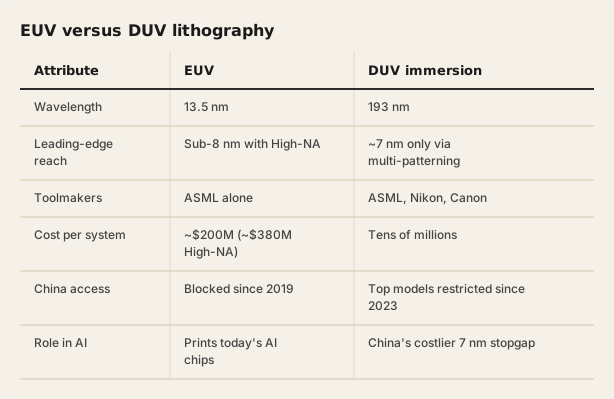
To understand why one tool can carry this much geopolitical weight, it helps to know what it does. Modern chips are printed by projecting light through a stencil onto a silicon wafer, and the shorter the wavelength of that light, the smaller the features you can draw. For decades the industry used light at 193 nanometers. EUV collapses that to 13.5 nanometers, and producing it is closer to controlled science fiction than to ordinary manufacturing.[4]
Inside an ASML light source, droplets of molten tin about 25 microns across are fired across a chamber and struck twice by a high-powered laser: a first pulse flattens each droplet, a second vaporizes it into a plasma that glows at 13.5 nanometers. The tin reaches roughly 220,000 degrees Celsius, some 40 times hotter than the surface of the sun, and the cycle repeats 50,000 times every second.[4] A standard EUV system costs around $200 million; the newest high numerical aperture models run about $380 million each, and Samsung recently paid $773 million for two.[5] The hardware is correspondingly immense. A high-NA machine weighs roughly 150 metric tons, ships in some 250 crates, and takes a team of about 250 engineers around six months to assemble on site.[6]
No other company makes one. ASML's monopoly is not a regulatory accident but the product of a supply chain it spent thirty years assembling, including the German optics maker Zeiss and U.S.-based Cymer, whose laser light-source technology ASML acquired in 2013.[8] Fouquet put it plainly in an interview this spring: when it comes to EUV, no one is coming for us.[3] That confidence is exactly what makes the machine such a clean instrument of policy. Control the supplier, and you control who can make leading-edge chips at all.
Why one machine decides a chip war
Leading-edge logic is the foundation of the AI boom. The GPUs and custom accelerators training and serving today's models are built almost entirely at the most advanced process nodes, and those nodes are not commercially viable without EUV. That is why the tool, rather than any single chip, has become the fulcrum of U.S.-China technology policy.
The controls arrived in layers. Since 2019, the Dutch government has effectively blocked the export of EUV systems to China under U.S. pressure, declining to renew the relevant export license; ASML has never shipped one there. In 2023 the restrictions widened to cover the most advanced deep ultraviolet immersion tools as well, the very machines China would otherwise lean on to approximate cutting-edge production.[7] Cut off from EUV, China's leading foundry, SMIC, has pushed older DUV equipment to its limits, using multi-patterning, exposing a wafer several times over, to reach a 7-nanometer-class process. The Huawei chip that surprised Washington in 2023 was the clearest proof of concept. It works. But it carries a yield penalty that prices China out of competitive accelerator production at scale, which is precisely the gap the controls were designed to preserve.[8]
Why EUV is the chokepoint: only ASML builds it, and the deep ultraviolet workaround China is left with is slower, costlier, and capped around a 7 nm-class process.
The chokepoint cuts both ways
Here is the uncomfortable lesson of the ASML episode. A chokepoint that powerful is also a single point of failure, and its strength depends entirely on enforcement that is far messier than the physics. A machine the size of a bus is nearly impossible to smuggle, but components, spare parts, and the knowledge of how to move and service them are not. The allegation that EUV-related components and transport equipment reached China, true or not, points straight at the seam in the system: you can ban the machine and still lose ground at the margins.[1]
The same concentration that gives Washington its leverage also leaves the West dependent on one Dutch company's records and one telemetry system to know where the most strategic hardware on earth physically sits. That is why the United States is quietly seeding a domestic EUV effort. China, for its part, keeps directing resources toward SMEE, its domestic lithography champion, and toward indigenous light-source research. SMEE has yet to ship a tool capable of mass production at leading-edge nodes; independent assessments put its best technology a generation or more behind ASML's current baseline, let alone its high-NA frontier.[8] ASML's lead is not a gap that closes in a product cycle.
For now the most important fact about the AI supply chain is not the GPU shortage or the power crunch. It is that the whole edifice narrows, a few steps upstream, to a single machine from a single maker in a single country. The China allegation will be argued over its specifics, and the evidence may or may not ever surface. The structural point will outlast it. Watch for whether the enforcement inquiry produces public findings, and whether xLight's free-electron laser prototype advances to a testable milestone at Albany - two developments that would tell you how seriously Washington is moving from leverage to self-sufficiency.